
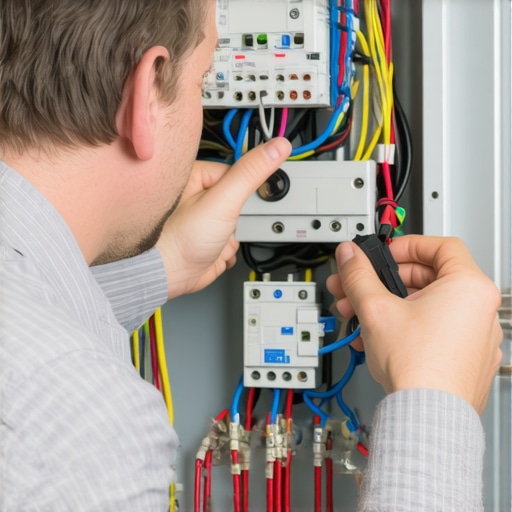
The Metallurgical Ghost in Your Walls
I have spent 35 years pulling burned-out devices from walls and telling families they were five minutes away from a total loss. If your home was built between 1965 and 1973, you aren’t just living in a house; you are living inside a giant, slow-motion physics experiment. My journeyman, a grizzly old-timer who could smell a short from the driveway, used to smack my hand with his dikes if I ever used a standard wire nut on an aluminum branch circuit. ‘You nick that copper, you create a hot spot,’ he’d scream. ‘But you trust aluminum without a torque wrench, and you’re just a glorified arsonist.’ He was right. Aluminum isn’t a bad metal, but it is a misunderstood one. In 2026, the age of these installations has reached a critical failure point. We are no longer talking about theoretical risks; we are talking about active degradation that a standard tick tracer might not even catch.
“Aluminum wire connections can overheat and cause a fire without tripping the circuit breaker.” – CPSC Safety Alert 516
The Science of Why Your House Wants to Burn
To understand the red flags, you have to understand Cold Creep and the Coefficient of Thermal Expansion. When current flows through a wire, it generates heat. Aluminum expands at a significantly higher rate than the steel or brass screws found in a standard 1970s-era outlet. Every time you turn on a space heater or a high-end vacuum, that wire expands, pushing against the screw. When you turn it off, it contracts. Over thousands of cycles, the aluminum literally ‘creeps’ out from under the terminal. This creates a gap. In the electrical world, a gap is a playground for an arc. Once an arc starts, it creates Aluminum Oxide. Unlike copper oxide, which is relatively conductive, aluminum oxide is a stubborn insulator. This creates more resistance, which creates more heat, which creates more oxide. It is a thermodynamic death spiral that ends with a 4,000-degree fireball inside your wall box.
Red Flag #1: The Ghost in the Lighting Circuits
The first sign isn’t smoke; it’s the ‘flicker.’ I’m not talking about the slight dim when a refrigerator kicks on—that’s a separate issue often solved by a service entrance upgrade. I’m talking about a rhythmic, strobing effect in your track lighting services or home theater wiring. This is the sound of an arc searching for a path. When you see a light flicker independently of other loads, it means the aluminum connection at that specific device or the upstream junction box has reached the ‘loose’ phase of cold creep. By the time it’s audible—a faint sizzling sound like frying bacon—the plastic insulation on your Romex has already begun to carbonize. A carbonized path is conductive, meaning the fire is no longer waiting for the wires to touch; it’s moving through the walls themselves.
Red Flag #2: The Scent of Fish and Ozone
If you walk into a room and smell something fishy, and you didn’t cook seafood, call me immediately. That’s the smell of phenolic resin and urea-formaldehyde in old electrical devices beginning to off-gas. It is the literal scent of a restaurant kitchen electrical system or a residential bedroom outlet reaching 300 degrees Fahrenheit. Forensic inspection often reveals that the homeowner ignored this smell, thinking it was a dead mouse. By the time I get there with my Wiggy to test voltage drops, I find the back of the outlet has melted into a black, glassy puddle. This is especially dangerous in a data closet organization scenario, where sensitive servers and networking gear generate constant heat, accelerating the oxidation of those old aluminum home runs.
“Terminal circuits shall be torqued to the manufacturer’s specified values. Failure to use a calibrated torque tool can lead to catastrophic connection failure.” – NEC Article 110.14(D)
Red Flag #3: Discolored Faceplates and ‘Dead’ Dead-Ends
If you see a brown or yellowish tint around the slots of an outlet, that is a forensic smoking gun. That is heat transfer. Many people try to hide this by doing a rough-in style replacement of the outlet themselves, but they use standard 15-cent copper-only devices. This is a widow maker move. Connecting aluminum directly to a copper-rated device triggers Galvanic Corrosion. Two dissimilar metals, a little humidity, and a flow of electrons create a battery-like reaction that eats the metal away. If you have outlets that simply ‘stopped working,’ don’t assume the wire broke. Assume the connection has oxidized so heavily that it has become an insulator. This is common in underground wiring services where moisture ingress accelerates the rot.
The Forensic Fix: Beyond the Handyman Special
You cannot ‘fix’ aluminum wiring by tightening the screws. You will only crush the brittle, 50-year-old metal and make it fail faster. The only code-compliant solutions involve Copalum crimps or AlumiConn connectors. These devices use internal ridges to bite through the oxide layer and vacuum-seal the connection with monkey shit (dielectric grease) to prevent oxygen from ever touching the metal again. While we are in there, we often find the meter socket replacement is long overdue because the same aluminum decay is happening at the main lugs. This is also the time to consider a surge protector installation. Aluminum systems are notoriously noisy; a power quality analysis usually shows massive harmonic distortion that fries modern LED drivers and smart home hubs. If you’re investing in deck lighting services or a new outdoor kitchen, your foundation—the wiring—must be stable before you add the bells and whistles.
Wow, this post really illustrates how crucial it is to understand the long-term risks of aluminum wiring, especially as it ages. I had no idea that flickering lights could be such a serious red flag — I always thought it was just a minor annoyance. Your explanation of cold creep and the thermodynamic feedback loop leading to potential fires really sheds new light on the importance of regular inspections, especially for older homes. Personally, I’ve been considering upgrading some of my home’s wiring, but I wasn’t sure where to start. Based on your expertise, would you recommend an initial comprehensive inspection, or are there specific signs that homeowners can check themselves before calling in a professional? Also, I’m curious about the cost difference between those remediation options like Copalum crimps versus full wiring replacement. Thanks for such a detailed and practical guide; it’s invaluable for anyone living in a house from that era.
This article highlights some very critical signs that often go unnoticed until a major problem arises. From my own experience, I’ve seen homes where seemingly minor issues like flickering lights or strange odors were the first hints of deeper wiring problems. I agree that DIY fixes, such as replacing outlets with copper-only devices, are a huge mistake, especially with aluminum wiring involved. The science behind cold creep and oxidation really underscores how important it is to use proper connectors like AlumiConn or Copalum crimps for repairs. I wonder, how often would you recommend homeowners have these inspections done, particularly if they’re in homes from that era? Also, what are some cost-effective yet reliable options for property owners trying to upgrade their wiring without a full overhaul? Ensuring safety should always be a priority, but understanding the timeline and scope of potential repairs can help homeowners budget smarter. Thanks for this insightful post—definitely a must-read for anyone living in a house built between 1965 and 1973.