
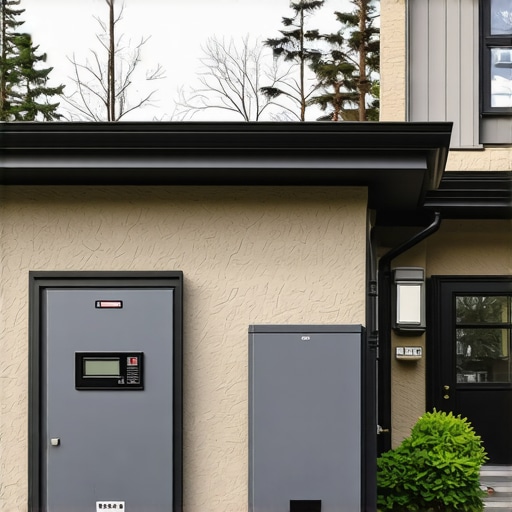
The Hum of Progress: Why Your 200-Amp Panel is Sweating
You hear it before you see it. That low-frequency, 60-cycle thrum vibrating through the drywall in the garage. It is the sound of a 200-amp main breaker screaming for mercy because you just plugged in two Level 2 EV chargers while the heat pump kicked over and the induction range was searing a steak. As we stare down the barrel of 2026, the ‘Smart Home’ isn’t just about voice-controlled blinds or a doorbell camera install that pings your phone; it is about raw, unadulterated current. My mentor, an old-school journeyman named Dutch, used to smack my hand if I stripped a wire with a pocket knife. ‘You nick the copper, you create a hot spot,’ he’d bark, brandishing his dikes like a weapon. ‘Every nick is a fuse that hasn’t blown yet.’ He was obsessed with the integrity of the conductor, and today, that obsession is the only thing keeping modern homes from turning into expensive Roman candles.
“The total connected load shall not exceed the carrying capacity of the service entrance conductors.” – National Electrical Code (NEC) Article 230
The Forensic Breakdown: Why Resistance is Your Greatest Enemy
When we talk about upgrading to a 400-amp service, we aren’t just buying ‘more electricity.’ We are managing heat. In the electrical forensics trade, we look for ‘Cold Creep’ and oxidation. Imagine your service entrance as a highway. A 100-amp service is a country road; a 200-amp service is a state highway. By 2026, with an EV charger in every stall and high-efficiency electric furnaces, you are trying to cram a NASCAR race onto a residential street. The physics are brutal: Resistance (R) generates heat (H) proportional to the square of the current (I). That means doubling your load quadruples the heat. If your lugs aren’t torqued to spec with a calibrated wrench, that heat causes the metal to expand and contract. Over time, the connection loosens—this is the ‘Cold Creep.’ Eventually, you get a microscopic gap. Electricity, being lazy and aggressive at the same time, jumps that gap. That is an arc. It smells like ozone and burnt fish, and by the time you see the smoke, your bus bar is already a puddle of molten aluminum.
Component Zooming: The 320/400 Amp Reality
Most homeowners don’t realize that a ‘400-amp service’ is often actually a 320-amp continuous / 400-amp peak setup. This involves a massive 320-amp meter base and, frequently, two 200-amp panels side-by-side. This ‘twin-engine’ approach allows you to isolate heavy ‘dirty’ loads—like your electric gate opener or underground wiring services for the pool sub-panel—away from the sensitive electronics of your smart hub. When we perform vibration analysis services on these large-scale residential installs, we are looking for harmonic distortion. If you have a massive ceiling fan array or heavy motors running, they can kick back ‘noise’ into the line. A 400-amp service provides the ‘headroom’ to ensure that when the compressor for your wine cellar kicks on, your server rack doesn’t have a heart attack. This isn’t about luxury; it’s about the thermal capacity of your infrastructure.
“Aluminum wire connections can overheat and cause a fire without tripping the circuit breaker if not properly terminated with antioxidant compound.” – CPSC Safety Alert 516
The Load Calculation: Doing the Math Before the Spark
Before you go looking for free electrical estimates, you need to understand the ‘Demand Factor.’ We don’t just add up every breaker in the box; if we did, every house would need a 1000-amp service. We use NEC 220.82. But here is where the 2026 smart home breaks the old rules. In the past, we assumed you wouldn’t run your dryer, your oven, and your welder at the same time. Smart homes, however, use automated ‘scenes.’ At 5:00 PM, your home might simultaneously start the EV charger, ramp up the HVAC, and activate fence line lighting and tree mounted lights for aesthetic. This creates a ‘simultaneous peak’ that can melt a 200-amp main lug over a single summer. If you are planning for a 2026 lifestyle, you have to account for the ‘always-on’ nature of digital infrastructure. I’ve walked into homes where the main panel was so hot I could feel the radiation through the dead front. No breaker tripped because the load was right at 195 amps—but it was 195 amps of pure, continuous heat on a bus bar rated for intermittent duty.
The Infrastructure Context: Why 400 Amps is the New 200
In mid-century homes, we are often replacing Federal Pacific or Zinsco panels—brands I call ‘Widow Makers’ because their breakers are notorious for jamming and refusing to trip during a fault. Upgrading these to a 400-amp service entrance requires more than just a new box. It involves permit pulling services because the utility company has to ‘heavy-up’ the lateral lines. If you have underground wiring services, this means trenching in 500 kcmil copper or 750 kcmil aluminum. I’ve seen guys try to avoid the permit, ‘side-loading’ a second panel onto an existing service. It’s a recipe for a structural fire. You can’t cheat the utility transformer. When we do a rough-in for a 400-amp system, we are looking at the grounding electrode system too. You aren’t just sticking one rod in the dirt; you’re likely building a ground ring to dissipate the potential surges that a 2026 smart home attracts. From the doorbell camera install to the automated gate, every piece of tech is a path for lightning. Without the massive ‘sink’ of a 400-amp-rated grounding system, your smart home is just an expensive lightning rod.
The Final Torque: Sleep Better with Headroom
Is 400 amps overkill? For a 1,200-square-foot bungalow, yes. But for a modern 3,500-square-foot home with two electric vehicles, an induction cooktop, a steam shower, and extensive tree mounted lights and fence line lighting, 200 amps is a bottleneck. You don’t want your home’s electrical heart to be running at 90% capacity every day. That leads to ‘nuisance tripping’ and accelerated degradation of the breaker’s internal springs. When I finish a trim-out on a 400-amp service, I check every lug with a tick tracer and a thermal camera. I want to see stone-cold connections under load. I use ‘monkey shit’ (duct seal) to plug the service mast so moisture doesn’t travel down the wires into the lungs of the panel. Electricity isn’t a hobby, and the ‘Smart Home’ isn’t just an app—it’s a physical machine that needs a big enough pipe to breathe. Don’t let a flipper or a ‘handyman’ tell you 200 is plenty. If you’re building for the future, you build for the peak, not the average. Get the permit, call the pros, and make sure your home run is torqued to the inch-pound spec on the label. That is how you sleep through the night without the smell of ozone waking you up.