
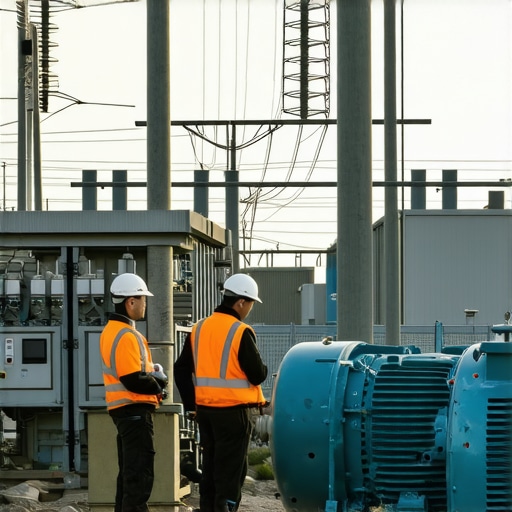
The Anatomy of a Catastrophe: Why Your Industrial Motors Are Dying
You smell it before you see it. That pungent, ozone-heavy stench of burning varnish and overheated copper. It’s the scent of a five-figure repair bill. As a master electrician who has spent three decades tracking down intermittent faults in salt-sprayed coastal enclosures and grease-slicked factory floors, I can tell you that electricity doesn’t forgive, and it certainly doesn’t forget. When we talk about 3-phase power in 2026, we aren’t just talking about wires; we are talking about a delicate harmonic balance that is increasingly threatened by modern electronic interference and environmental decay. Whether you are dealing with boat lift wiring at a marina or massive office lighting upgrades in a high-rise, the physics of failure remain the same.
My journeyman used to smack my hand if I stripped a wire with a knife. ‘You nick the copper, you create a hot spot,’ he’d scream. He was right. That tiny microscopic indentation becomes a point of high resistance, a bottleneck where electrons pile up and generate heat. In a 3-phase motor, that heat is the precursor to a winding short that will turn your expensive equipment into a boat anchor. We are going to perform a forensic autopsy on why these systems fail and the four ways to ensure they keep spinning.
“Motor-running overload protection shall be provided to protect motors, motor-control apparatus, and motor-branch-circuit conductors against excessive heating due to motor overloads and failure to start.” — NEC Section 430.32
1. Rectifying Phase Imbalance Through Rigorous Electrical Load Calculations
The most common silent killer I see in the field is phase imbalance. When you have 3-phase power, you expect the voltage to be identical across all three legs. But in the real world, as facilities add PA system installation components or access control wiring, they often tap into one leg more than the others. This creates a voltage drop on one phase. When a motor tries to run on unbalanced voltage, the current in the windings skyrockets. We aren’t talking about a small increase; a 5% voltage imbalance can cause a 50% rise in temperature in the motor windings.
Before you swap a motor, you need to perform comprehensive electrical load calculations. You can’t just eyeball a panel and assume there’s ‘enough room.’ You need to use a Wiggy or a high-end power quality analyzer to see what is happening under load. If your phases are lopsided, you’re essentially asking a three-legged stool to stand on two legs of different lengths. It’s going to wobble, and in the electrical world, wobbling means heat. Heat means the insulation on your Home Run becomes brittle and eventually fails. This is especially critical when integrating high-draw residential upgrades like whole house fan wiring or boat lift wiring onto a shared transformer.
2. Combating Coastal Corrosion in Meter Bases and Motors
If you’re operating anywhere near the coast, your enemy isn’t just heat—it’s the salt. I’ve seen meter base replacement jobs where the aluminum bus bars had turned into a white, powdery mess that looked like granulated sugar. This is the result of galvanic reaction accelerated by salt air. When salt bridges the gap between phases or between a phase and the ground, it creates a micro-arc. It’s a slow-motion explosion that eats your hardware from the inside out.
For boat lift wiring and driveway sensor lights, you cannot rely on standard enclosures. You need NEMA 4X stainless steel or non-metallic enclosures packed with Monkey Shit (duct seal) to keep the moisture out of the conduits. I always tell my apprentices: if you don’t use dielectric grease on those connections, you’re just building a future fire. The salt air acts as a conductor, and once that path is established, it’s only a matter of time before the ‘Widow Maker’—that live, ungrounded chassis—finds someone to discharge through. We also see this in up lighting services where buried splices aren’t properly potted. The moisture wicks up the Romex or THHN and rots the motor leads from the inside.
3. Mitigation of Harmonics and Office Lighting Interference
In 2026, the ‘clean’ power we once knew is a myth. Every office lighting upgrades project involving thousands of LED drivers and every PA system installation introduces non-linear loads. These devices pull current in pulses rather than a smooth sine wave, creating harmonics. These harmonics travel back through the neutral and can cause 3-phase motors to run hot, vibrate, or even rotate backwards in extreme cases of phase-shift.
When we perform a Rough-in for an industrial space, we now have to account for these ‘dirty’ loads. If you have a motor that keeps tripping its breaker but your Tick Tracer shows power is present, you’re likely dealing with harmonic distortion. The fix isn’t a bigger breaker—that’s how you burn the building down. The fix is isolation transformers or harmonic filters. Don’t let a ‘handyman’ tell you to just ‘jump the thermal.’ That’s a death sentence for the equipment and potentially the occupants. Even something as simple as smoke detector installation can be compromised if the electrical noise in the building is high enough to cause false alarms or sensor degradation.
“Aluminum wire connections can overheat and cause a fire without tripping the circuit breaker.” — CPSC Safety Alert 516
4. The Forensic Inspection of the Service Entrance
Sometimes the problem isn’t the motor at all; it’s the meter base replacement that was never done. I once investigated a site where a 3-phase motor was ‘surging.’ After peeling back the dead front, I found the main lugs were so loose they were glowing cherry red. The thermal expansion and contraction—what we call ‘Cold Creep’—had backed the set screws out over twenty years. Every time that motor kicked on, the surge of current caused the loose connection to arc, sending a spike of heat back into the system.
A proper Trim-out requires a torque wrench. If you aren’t torquing your lugs to the manufacturer’s specs, you aren’t an electrician; you’re a liability. This applies to everything from up lighting services to the most complex industrial motor controls. You have to check the integrity of the grounding electrode system. If your ground rod is nothing but a rusted nub in the dirt, your smoke detector installation and access control wiring have no path for surge dissipation. You’re just waiting for a lightning strike or a utility spike to fry the lot. Electricity is a lazy beast; it wants the easiest path to ground. If you don’t provide a safe one, it will find one through your expensive equipment or your body. Don’t cut corners on the meter base replacement or the grounding—it is the only thing standing between a functioning system and a forensic investigation. “