
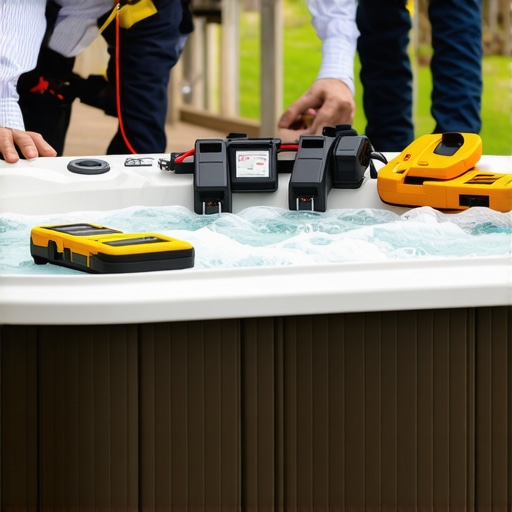
The Hum of Impending Failure: Why Your Hot Tub is More Than a Plug-and-Play Luxury
You hear it before you see it. That low-frequency 60-cycle hum vibrating through the drywall near your service panel. It’s the sound of a 100-amp bus bar screaming under the weight of a 50-amp spa heater, two pumps, and a blower motor. Most homeowners look at a hot tub and see relaxation; I look at it and see a massive inductive load that will expose every weak link in your home’s electrical infrastructure. If you’re living in a mid-century home with an old Federal Pacific or Zinsco panel, you’re not just installing a spa; you’re lighting a fuse. My old journeyman used to smack my hand with a pair of dikes if I ever got sloppy with a wire stripper. ‘You nick that copper, kid, and you’ve just built a heater inside the insulation,’ he’d bark. ‘That nick creates a hot spot, resistance goes up, and physics does the rest.’ He wasn’t being a jerk; he was teaching me that in this trade, an eighth of an inch is the difference between a satisfied customer and a 3:00 AM holiday emergency call to a house fire.
1. The Load Calculation: Beyond the Main Breaker
Before we even pull a home run of 6 AWG THHN, we have to talk about Ohm’s Law and the reality of your service entrance. A modern hot tub pulls anywhere from 40 to 60 amps. If your house has a 100-amp service, and you’ve got the AC running, a load of laundry in the dryer, and the oven preheating, you are redlining your system. This is where electrical inspections become forensic. We aren’t just looking at the breakers; we’re looking for ‘Cold Creep’ in your aluminum service entrance cables. Aluminum expands and contracts at a different rate than the zinc-plated lugs in your meter socket replacement. Over decades, this movement loosens the connection, creating an oxidation layer that acts as a resistor. More resistance equals more heat. If your lights flicker when the spa pumps kick in, you aren’t just seeing a voltage drop; you’re seeing a system at its limit.
“Aluminum wire connections can overheat and cause a fire without tripping the circuit breaker.” – CPSC Safety Alert 516
We often recommend a ‘Heavy-Up’ or service upgrade to 200 amps, utilizing rebate assistance programs to offset the cost of bringing a 1970s home into the 2026 electrical reality.
2. The GFCI Disconnect: Your Life-Saving Air Gap
Code dictates a manual disconnect within sight of the tub but no closer than five feet. This isn’t a suggestion; it’s a survival requirement. This disconnect must be Class A GFCI protected. When I walk onto a rough-in and see a ‘handyman’ has skipped the dedicated spa pack to save $150, I walk off the job. A GFCI works by monitoring the balance of current between the hot and neutral legs. If it detects as little as 5 milliamps of leakage—the kind that happens when a heater element sheath cracks and starts energizing the water—it trips in 1/40th of a second. Without it, you are the path of least resistance to ground. We also see frequent code violation corrections regarding the ’emergency shutoff’ switch for public or multi-family spas, which is now being mirrored in residential best practices for 2026 to prevent suction entrapment accidents.
3. Equipotential Bonding: The Invisible Shield
This is where the ‘weekend electrician’ gets lost. Grounding and bonding are not the same thing. Grounding electrode install is about giving lightning and surges a path to the earth. Bonding is about connecting all metal parts—the heater shell, the pump motor, even the rebar in the concrete pad—together so they stay at the same electrical potential. If you’ve ever felt a ‘tingle’ when touching the water while stepping on the grass, you have a bonding failure. This is often caused by stray voltage from a utility neutral or a neighbor’s faulty appliance. By creating an equipotential plane, we ensure that even if there is a fault, there is no voltage difference between the water and the surrounding metal or ground. We use solid 8 AWG bare copper for this, and it must be continuous. No wire nuts, no ‘close enoughs.’ I use my Wiggy or a high-impedance multimeter to verify zero potential difference before the first gallon of water hits that shell.
4. Conduit Integrity and the ‘Widow Maker’ Test
In 2026, we are seeing more fence line lighting and outdoor kitchen circuits competing for trench space. You cannot just bury Romex in the dirt and hope for the best. We use Schedule 40 or 80 PVC, buried at least 18 inches, or Rigid Metal Conduit (RMC) at 6 inches if we hit rock. But the real danger is at the ‘trim-out.’ I’ve seen meter socket replacement jobs where the installer didn’t use monkey shit (duct seal) in the conduit. Moist air from the warm ground travels up the pipe into the cold electrical panel, condenses, and drips directly onto the main lugs. This causes ‘pitting’ and eventual catastrophic arcing.
“All 15- and 20-ampere, 125-volt receptacles located within 20 feet of the inside walls of a storable pool, spa, or hot tub shall be protected by a ground-fault circuit interrupter.” – NEC Article 680
Whether it’s a generator transfer switch integration or a simple spa hookup, we treat every wire like a potential ‘Widow Maker.’ This is why our weekend electrician services focus on safety over speed. You want the tub hot; you don’t want the walls hot. We ensure every lug is torqued to the manufacturer’s inch-pound specifications—because ‘hand-tight’ is just another word for ‘fire hazard.’
Why Professional Oversight Trumps DIY Ambition
When you call for electrician services, you aren’t paying for someone to pull wire. You’re paying for the 35 years of seeing what happens when a $20 breaker fails to trip because the bus bar is corroded. You’re paying for the tick tracer that finds a hot wire buried in a wall by a flipper. Whether you need code violation corrections from a previous owner’s mistakes or a full grounding electrode install for a new installation, don’t gamble with your family’s safety. Electricity is a silent, odorless killer that is perfectly happy to use your body as a conductor if you give it the chance. Get it inspected, get it torqued, and sleep soundly.