
The Autopsy of a Failing Smart Entry: Why Your 2026 Tech is Lagging
You press the button on your smartphone, or you present your encrypted fob to the reader, and… nothing. Two seconds pass, maybe three, before the solenoid finally clicks. That delay isn’t a software glitch; it’s the physical manifestation of high resistance and lazy electrical installations. As a licensed master electrician who has spent three decades dragging a Wiggy through crawlspaces, I can tell you that ‘entry lag’ is usually the smell of a system gasping for current. When I walk onto a forensic inspection, I’m not looking at the app; I’m looking for the heat. I’m looking for the voltage drop that happens when someone tries to run a 2026 high-draw strike plate off a transformer designed for a 1980s doorbell. You want to fix the lag? You have to stop treating your data and power lines like an afterthought.
The Flipper Special: A Case Study in Hidden Hazards
I recently walked into a ‘fully renovated’ 1920s Tudor where the homeowners were complaining that their high-end doorbell camera install worked intermittently and the electronic deadbolt felt ‘sluggish.’ I pulled out my tick tracer and started tracing the low-voltage lines. I found a massive hot spot behind the foyer’s designer backsplash. I had to cut a hole in the new marble—much to the owner’s horror—only to find that the flipper had buried a live junction box where they’d spliced old, brittle 22-gauge telephone wire onto a new Romex feed using nothing but masking tape and a prayer. The copper was black with oxidation. Every time the camera’s IR lights kicked on, the resistance skyrocketed, and the voltage dropped to 14 volts. That ‘lag’ was the sound of a fire waiting to start. We ripped it out and ran a proper home run back to the data closet. That is the reality of modern entry systems in old bones; you cannot build a digital future on a rotting analog foundation.
Tactic 1: Data Closet Organization and the ‘Home Run’ Rule
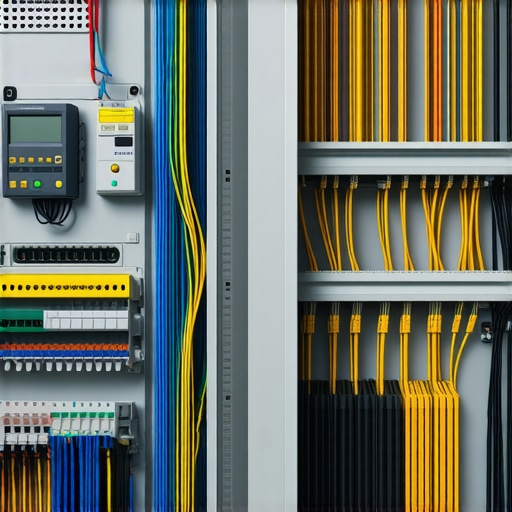
Entry lag often begins in the chaos of a bird’s-nest wiring closet. If your access control hub is buried under a pile of tangled patches and unlabelled transformers, you have an impedance nightmare. Data closet organization isn’t about aesthetics; it’s about thermal management and signal integrity. Every time a data cable is kinked or crushed under a zip-tie, you change the geometry of the twisted pairs, leading to crosstalk and packet loss. We use ‘monkey shit’ (duct seal) to block drafts from the walls, but inside the closet, we need airflow. Every access control controller should have a dedicated home run. No daisy-chaining. When you daisy-chain four readers on one 18/2 wire, the last reader in the line is fighting for the scraps of amperage left over. By the time the signal reaches the controller, it’s degraded. We install dedicated, shielded lines for every point of entry to ensure the ‘handshake’ between the reader and the server happens at the speed of light, not the speed of a dying battery.
“All wiring shall be installed in a neat and workmanlike manner.” – NEC 110.12
Tactic 2: Subpanel Installation and Circuit Isolation
If your smart lighting installation and your heavy-duty access control system are sharing a circuit with a garage refrigerator, you’re going to have lag. When the fridge compressor kicks over, it creates a voltage sag. Digital controllers hate voltage sags; they often reboot or ‘hang,’ creating that 5-second lag while the processor recovers. For a serious 2026-ready home, a subpanel installation is non-negotiable. We pull a clean feed from the main service, ensuring that your sensitive electronics are isolated from the inductive loads of vacuum cleaners and HVAC blowers. This is where we zoom into the physics of the ‘bus bar.’ In older 1940s panels, the bus bars often suffer from micro-pitting. This creates intermittent contact resistance. By installing a new subpanel with silver-plated copper bus bars, we ensure a low-impedance path to ground, which is essential for draining off the static electricity that builds up in outdoor card readers during dry winter months.
Tactic 3: Meter Socket Replacement and Service Integrity
You can’t have a fast entry system if your house is starving for power at the source. I’ve seen meter socket replacement needs that would make your skin crawl. In homes built mid-century, the lugs inside the meter can undergo ‘cold creep.’ This is a physical phenomenon where the aluminum conductors expand and contract at a different rate than the steel lugs, eventually loosening the connection. A loose lug creates an arc—a microscopic gap where electricity jumps. This creates ‘noise’ on the line. This noise travels through your whole house, interfering with the 2.4GHz and 5GHz signals your doorbell camera install relies on. If your lights flicker when the AC turns on, your meter socket is likely compromised. Replacing this with a modern, bypass-equipped socket ensures that your home backup generator install or solar panel electrical hookup has a solid, low-resistance connection to the grid. Electricity is like water; if the main valve is clogged with rust, the faucet upstairs will always have low pressure.
“Aluminum wire connections can overheat and cause a fire without tripping the circuit breaker.” – CPSC Safety Alert 516
Tactic 4: Swimming Pool Bonding and Ground Loop Mitigation
This is the one that catches everyone off guard. If you have a backyard oasis, swimming pool bonding is critical to your front door’s security. Electricity seeks all paths to ground, not just the easiest one. If your pool’s bonding grid is compromised, the earth around your home can actually carry a slight potential difference. This is called a ‘ground loop.’ If your access control system is grounded at the front door and also connected to a shielded cable that goes back to the house, that ground loop can induce a current on the data line. This ‘ghost current’ slows down data transmission and can even fry the communication chips in your smart locks. As a master electrician, I use a high-frequency tester to ensure the bonding grid is contiguous. We don’t just ‘ground’ things; we bond them. Everything—from the metal frame of your solar panels to the rebar in your pool—must be at the same electrical potential. Without this, your high-tech entry system is just a giant antenna for electrical interference.
The Forensic Conclusion: Why Warranty Backed Repairs Matter
In the end, fixing 2026 entry lag isn’t about buying a faster router. It’s about the ‘rough-in’ and the ‘trim-out.’ It’s about ensuring that every wire is stripped with a precision tool, not a pocketknife that nicks the copper and creates a hot spot. It’s about using dikes to cleanly cut your conductors and ensuring every terminal is torqued to the specific inch-pounds required by the manufacturer. If you want a system that works every time you walk up to the door, you need more than a handyman; you need a forensic approach to your home’s infrastructure. Warranty backed repairs provided by a licensed master electrician ensure that when we fix a lag issue, we aren’t just slapping a Band-Aid on it; we are correcting the underlying physics of the failure. Don’t let your home’s security be a ‘widow maker’ of bad wiring. Torque it down, bond it right, and let the tech do its job. We don’t just install devices; we engineer reliability.