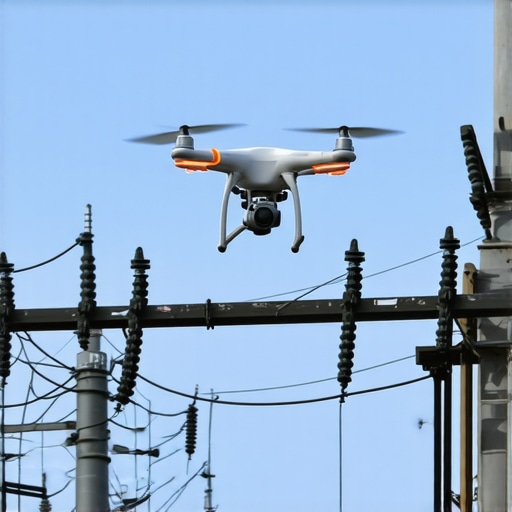
You can smell it before you see it—the sharp, metallic bite of ozone hanging in the humid air after a thunderstorm. As a licensed master electrician for over three decades, my nose is usually my first diagnostic tool, but even thirty-five years of experience can’t help me see through a 40-foot canopy or inspect a service mast from a rain-slicked roof in a gale. That’s where the high-altitude forensic inspection comes in. We’ve traded the shaky extension ladder for carbon-fiber propellers to find the hidden killers that standard inspections miss. Electricity is lazy; it always wants to find the path of least resistance to ground, and sometimes that path is a charred drip loop or a cracked insulator that hasn’t failed yet, but is currently preparing to burn your structure to the waterline.
The Lesson from the Old School
My old journeyman used to carry a heavy brass ‘Wiggy’—a solenoid voltmeter that would vibrate in your hand when it hit a live circuit. He used to smack my hand with a pair of dikes if I reached for a wire before visually tracing the entire run back to the source. ‘If you haven’t seen the insulation with your own eyes, you don’t know what’s carrying the load,’ he’d bark. He was right. Back then, we had to crawl through asbestos-laden attics and climb rusted poles to find the ‘Widow Maker’—that one nicked conductor or loose neutral that’s just waiting for a vibration to arc. Today, we apply that same cynical scrutiny using 4K thermal optics from the air. We aren’t just looking for broken wires; we are looking for the thermal signature of high-resistance connections before they become a fire statistic.
“Electrical thermal signatures occurring in overhead lines often indicate internal high-resistance connections or insulation breakdown that can lead to catastrophic failure without warning.” – NFPA 70E Standard for Electrical Safety in the Workplace
The Physics of the Aerial Failure: Why Drones?
When we perform a storm damage electrical repair, the damage isn’t always a downed line. The real danger is the ‘partial failure.’ Imagine a tree limb whips against your service entrance during a microburst. It doesn’t snap the wire, but it stretches the copper, thinning the cross-section. This creates a bottleneck. In the world of physics, this is where resistance climbs and heat begins its destructive cycle. A drone equipped with a FLIR (Forward Looking Infrared) camera identifies this heat bloom against the cool background of the sky. We can see a single lug in a subpanel or an overhead splice that is running 50 degrees hotter than its neighbors. That heat is the sound of money and safety evaporating.
Component Zooming: The Insulator Breakdown
Let’s talk about dielectric breakdown. On a standard home rewiring services call, we look at the internal Romex, but drones look at the interface between the utility and your home. Porous ceramic insulators can develop microscopic cracks over decades of thermal expansion and contraction. Moisture gets into those fissures, and suddenly you have ‘tracking.’ This is where electricity literally crawls across the surface of the insulator. From the ground, it looks fine. From a drone, it looks like a glowing beacon of imminent failure. If you don’t catch that during a routine check, that tracking eventually carbonizes the path, leading to a full-blown arc-flash that can blow your meter can right off the wall.
Storm Damage and the Invisible Threat
After a major weather event, most people look for the obvious. They see the lights are on and assume the system is intact. As a forensic inspector, I know better. Storm winds cause ‘cold creep’ in older aluminum connections. The swaying of the service mast causes the wire to move under the terminal screws. Because aluminum is softer than copper and has a different coefficient of thermal expansion, it slowly works its way out from under the lug. This creates a loose connection. A loose connection is a high-resistance connection. Using aerial drones, we can inspect the top of the service head for ‘monkey shit’ (duct seal) that has dried and cracked, allowing rainwater to travel down the inside of the service cable directly into your main panel. By the time you notice the flickering lights, the bus bars in your panel are already pitted and corroded beyond repair.
“Aluminum wire connections can overheat and cause a fire without tripping the circuit breaker, especially when subjected to mechanical stress from wind or vibration.” – CPSC Safety Alert 516
Industrial Motor Controls and the Big Picture
In industrial settings, the stakes are higher. We use drones to inspect external industrial motor controls and rooftop HVAC disconnects. A rough-in on a massive commercial site might involve miles of conduit, and finding a ground fault in a sprawling complex is like finding a needle in a hayfield of needles. Aerial thermography allows us to scan entire rooflines in minutes. We look for ‘hot spots’ on disconnect handles and junction boxes. Often, we find that a permanent holiday lighting installation or a secondary subpanel installation has been tapped off a circuit that was never designed for the load, causing the conductor to bake inside the conduit. This isn’t just about code; it’s about preventing a total facility shutdown.
The Camper Electrical Panel and Remote Hazards
We even see this in residential ‘play’ zones. A camper electrical panel installed at the edge of a property is often the most neglected part of a system. These are frequently under-sized and over-exposed. A drone can fly the length of the trench line to see if the earth is drying out or discolored above where the wire is buried—a classic sign of a ‘leaky’ underground feeder that is heating the soil because the insulation has been breached by rocks or frost heave. If you’re looking for free electrical estimates, make sure the guy giving the quote actually understands the soil chemistry and the mechanical protection required for these long runs.
Kitchens and Interior Logic
While drones handle the exterior, the forensic logic remains the same inside. When we handle kitchen range hood wiring or lighting installation services, we are looking for the same ‘thermal bottlenecks.’ People love to DIY their kitchen lighting, but they often bury junction boxes in the ceiling. While my drone stays outside, my thermal imager stays in my hand. We look for the heat of a ‘bootleg ground’—where some handyman tied the neutral to the ground wire because he was too lazy to pull a new home run back to the panel. It’s a fire waiting for a reason to happen. We don’t just ‘install’ lights; we verify the integrity of the entire circuit branch. If we find a problem, we recommend a full subpanel installation or a heavy-up to ensure your modern appliances don’t melt your vintage wiring.
Conclusion: Why Accuracy Matters
Electricity doesn’t give warnings; it gives results. Usually, those results involve a fire department. By using drone technology combined with the cynical eye of a master electrician, we remove the guesswork from the equation. We find the arcing bus bars, the corroded service masts, and the failing insulators before they transition from a ‘maintenance item’ to an ’emergency repair.’ When you’re ready to stop guessing if your home is safe and start knowing, get a forensic inspection that looks at the whole picture—from the ground to the sky. Get it torqued, get it right, and sleep through the next storm knowing your infrastructure isn’t a time bomb.
Comments are closed.