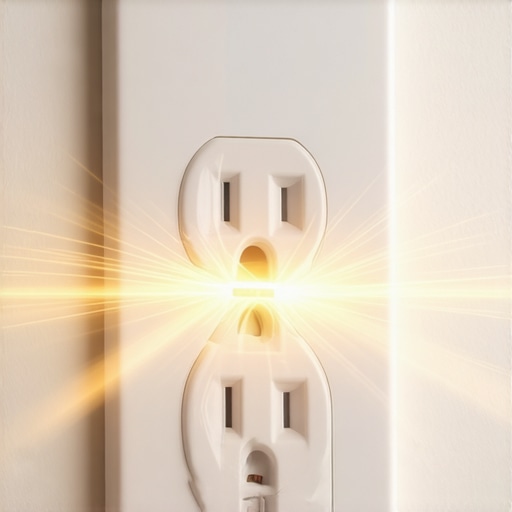
The Anatomy of a Catastrophe: Why Your Wall Is Making Noise
You’re sitting in the quiet of your living room when you hear it—a sound like a microscopic whip cracking behind the drywall. It’s followed by a scent that any veteran sparky knows instantly: the ozone-heavy, fishy stench of melting phenolic plastic and scorching PVC. Most homeowners ignore a sparking outlet if the lamp stays on, but that’s like ignoring a chest pain because you can still walk. In my 35 years of crawling through crawlspaces and dissecting burnt-out service masts, I’ve learned one thing: electricity doesn’t forgive, and it never gets better on its own.
When an outlet sparks, you aren’t just seeing light; you are witnessing a failure of physics. This is often the result of arcing, where current jumps a gap between two conductors. This gap might be caused by a screw that backed out over decades of thermal expansion or a Romex jacket that’s been gnawed by a rodent. Once that arc starts, it creates carbon tracking—a conductive path of charred insulation that makes it easier for the next arc to occur. It’s a self-sustaining cycle of destruction that ends in a 911 call.
The Old Timer’s Lesson: The Sin of the Nicked Copper
My first journeyman, a man who smelled exclusively of stale coffee and solder, used to watch me like a hawk during the rough-in phase. I remember one humid afternoon in a basement when I was stripping the jacket off a 12/2 cable with a pocket knife. He slapped my hand so hard my dikes flew across the room. ‘You nick that copper, kid, and you’ve just built a heater,’ he growled. He made me cut the wire back and start over. He was right. That tiny notch in the wire creates a high-resistance point. Under a heavy load—like a space heater or an AC unit—that resistance generates heat. Heat leads to oxidation. Oxidation leads to more resistance. Eventually, that ‘hot spot’ reaches the ignition temperature of the surrounding wood studs. Every time I perform troubleshooting on a charred outlet, I think of Gus and his ‘heater’ warning.
“Aluminum wire connections can overheat and cause a fire without tripping the circuit breaker.” – CPSC Safety Alert 516
The Mid-Century Menace: Cold Creep and Aluminum Wiring
If your home was built between the mid-60s and late 70s, you might be living with a ticking time bomb: aluminum branch circuit wiring. The physics of aluminum are vastly different from copper. Aluminum is subject to Cold Creep. Every time you plug in a toaster, the wire heats up and expands. Because aluminum expands at a different rate than the brass screws on your outlets, it slowly ‘creeps’ out from under the terminal. This leaves a loose connection. A loose connection is a high-resistance connection. This is why after hours electrical repair calls are so frequent in mid-century neighborhoods. The lights flicker, you smell smoke, and suddenly your home run back to the panel is glowing cherry red.
We don’t just ‘tighten the screws’ anymore. That’s a temporary fix that invites disaster. To fix this properly and ensure code violation corrections, we use AlumiConn connectors or CO/ALR rated devices. Using a standard 99-cent outlet on aluminum wire is a recipe for an infrared thermography scan that looks like a solar flare.
The Invisible Threat: Why You Need Infrared Thermography Scans
Sometimes the danger isn’t visible to the naked eye. This is where modern forensic tools beat the old-school Tick Tracer. During a comprehensive inspection, we use infrared thermography scans to see the heat signatures behind your walls. I’ve found industrial motor controls in commercial settings and simple battery backup wiring in residential attics that were vibrating at 200 degrees Fahrenheit despite looking perfectly normal. If your wall feels warm to the touch near an outlet, the internal arcing has already reached a critical stage. You need same day service before the oxygen-rich environment inside the wall cavity turns a spark into a flashover.
From Shed Wiring to Parking Lot Lighting: The Scope of Failure
Electrical failure isn’t limited to your toaster outlet. I’ve seen shed wiring install jobs done by ‘handymen’ where they buried indoor-rated wire directly in the dirt without conduit. Within two years, the moisture creates a ground fault that can electrify the very ground you’re walking on. I’ve seen tree mounted lights where the wire was strangled by the growth of the oak, leading to a short that turned the tree into a conductive pillar. Whether it’s parking lot lighting in a shopping center or a ceiling fan installation in a nursery, the rules of the National Electrical Code (NEC) are written in the blood of those who ignored them.
“All splices shall be made in an approved box, and no splice shall be made inside a conduit body unless the body is marked with its cubic inch capacity.” – NEC 300.15
When to Call for After Hours Electrical Repair
Electricity is a lazy beast; it always seeks the path of least resistance. If your outlets are sparking, that path is currently through the air and your insulation. You cannot wait until Monday. After hours electrical repair is necessary if: 1. The outlet is discolored (brown or black). 2. There is a persistent buzzing or popping sound. 3. The circuit breaker trips immediately after being reset. 4. You smell burning plastic but can’t find the source. This is the ‘Widow Maker’ stage of electrical failure. We don’t just swap the outlet; we trace the circuit to ensure the home run hasn’t been compromised and that the grounding system is actually doing its job. Don’t bet your house on a $5 DIY fix when your life is on the line.
Comments are closed.