The Invisible Throttle: Why Your House is Starving for Amps
My journeyman used to smack my hand if I stripped a wire with a knife. ‘You nick the copper, you create a hot spot,’ he’d scream. He was right. That tiny notch becomes a point of resistance, and resistance is just a fancy word for heat that hasn’t found a way to start a fire yet. After thirty-five years of inspecting service entrances—the literal heart of a home’s electrical system—I’ve realized most homeowners are living on a prayer. They keep adding loads, from high-end speaker system setup installations to patio cover outlets, without ever looking at the rusted, undersized metal box on the side of their house. Your service entrance is the gateway. If that gateway is narrowed by age, corrosion, or poor engineering, your entire home’s electrical health is at risk. We aren’t just talking about a tripped breaker; we are talking about a system failure that can result in a 24 hour emergency electrician visit or, worse, a structural fire.
“Aluminum wire connections can overheat and cause a fire without tripping the circuit breaker.” – CPSC Safety Alert 516
1. The Rusted Weatherhead and the Capillary Action Nightmare
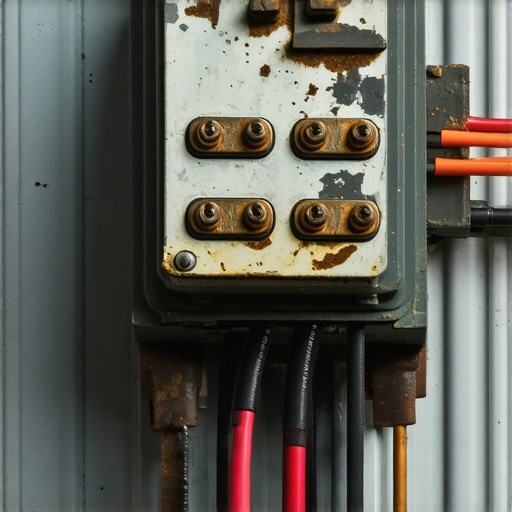
The service entrance starts at the weatherhead—the point where the utility lines meet your house. In older mid-century homes, these are often neglected. Over decades, the seals around the mast perish. When it rains, water doesn’t just hit the roof; it enters the conduit. Through a process called capillary action, moisture is sucked down the pipe directly into your meter can and eventually your main panel. I have opened panels where the main lugs were so corroded from this ‘internal rain’ that the metal had turned into a crumbly green salt. This oxidation increases resistance significantly. When you increase resistance, you decrease the available voltage. You might notice your lights dimming when the refrigerator kicks in, or perhaps your speaker system setup has a constant, low-frequency hum. That’s not a ‘quirk’ of an old house; it’s the sound of a service entrance struggling to breathe through layers of rust. If you see streaks of rust coming out of the bottom of your meter box, the clock is ticking. You are looking at a mandatory code violation corrections scenario before the bus bars pit so badly they won’t hold a breaker.
[image_placeholder_1]
2. Thermal Fatigue and the ‘Cold Creep’ of Aluminum Cables
If your home was built or renovated between 1960 and 1980, there is a high probability your service entrance cables are aluminum. Now, aluminum isn’t inherently evil, but it is temperamental. It has a high coefficient of thermal expansion. It expands and contracts significantly more than copper when current flows through it. This is known as ‘Cold Creep.’ Over forty years, those service lugs—the giant screws holding the main power lines—slowly loosen. A loose connection is an arcing connection. I’ve used drone thermography scans to inspect exterior service drops and seen the lugs glowing at 300 degrees Fahrenheit while the homeowner was inside watching TV. This thermal fatigue chokes the power. As the connection degrades, the voltage drops, and your appliances have to pull more current to do the same amount of work, which creates even more heat. It’s a death spiral for your electronics. If you’re planning a shed wiring install or a holiday light installation that demands more juice, that old aluminum connection is likely to reach its breaking point. This is why lockout tagout training is so critical for us; we never trust these old connections to stay stable while we’re working.
3. The ‘Zinsco’ or ‘FPE’ Curse: A Main Disconnect That Won’t
A service entrance is only as good as its main disconnect. In many mid-century homes, these are Federal Pacific Electric (FPE) or Zinsco panels. These brands are the pariahs of the forensic inspection world. The bus bars in Zinsco panels are made of a specific alloy that is prone to catastrophic pitting. As the breaker-to-bus-bar connection degrades, it creates an arc that literally welds the breaker to the bar. You think your power is fine, but the ‘choking’ happens because the contact point is so small and charred that electricity is fighting its way through a wall of carbon. I’ve pulled my Wiggy (solenoid voltmeter) out to test these and seen voltage fluctuations of 20 volts just by wiggling the main breaker. This is a massive fire risk. These panels often fail to trip even under a dead short. If you are still running cloth insulated wiring replacement projects but haven’t touched the FPE service entrance, you’re putting a new engine in a car with wooden brakes. No insurance company worth their salt will cover a home with these ‘time bombs’ once they are identified during drone thermography scans or a standard inspection.
“Overcurrent protection shall be provided by a circuit breaker or fuse… and shall be sized to protect the conductors from overheating.” – NEC Article 240
4. The 60-Amp Ceiling in a 200-Amp World
Many old service entrances were designed for a different era. A 60-amp or 100-amp service was plenty when the most power-hungry thing in the house was a toaster. Today, we have EV chargers, heat pumps, and a holiday light installation that could be seen from space. When you try to pull 120 amps through a 100-amp service entrance, the physics are unforgiving. The conductors heat up, the insulation becomes brittle—resembling the very cloth insulated wiring replacement we often find in the walls—and the voltage sags. This ‘choking’ isn’t always a total blackout; it’s a ‘brownout’ that kills your sensitive electronics. You might think you need a generator transfer switch because your power is ‘unreliable,’ but the reality is your service entrance simply can’t handle the load calculation of modern life. When we do a ‘Heavy Up’—upgrading you to 200 amps—we aren’t just giving you more power; we are giving you a wider ‘pipe’ so the electricity doesn’t have to work so hard (and get so hot) to reach your home run circuits. Before you add those patio cover outlets, have an inspector look at the service mast. If it’s a thin-wall conduit and not a rigid pipe, you’re likely still living in the 60-amp era. A 24 hour emergency electrician can patch a failure, but only a full service upgrade solves the bottleneck. Don’t wait until you smell the ozone; if your meter can is hot to the touch or your tick tracer is screaming when it’s 6 inches away from the enclosure, the time for code violation corrections was yesterday. Use your dikes to cut the old ties to the past and get a service entrance that doesn’t put your family at risk.