The Invisible Killer in Your Walls: A Forensic Post-Mortem
You can’t smell a loose neutral until the insulation starts to off-gas. You can’t hear a compromised bus bar until the arcing sounds like a nest of angry hornets. And you certainly can’t see the molecular degradation of a conductor under load with the naked eye. In my thirty-five years of performing electrical wiring services, I’ve learned that the most dangerous hazards are the ones that look perfectly fine under a standard flashlight. This is the reality of forensic electrical inspection: by the time a failure becomes visible, you’re usually looking at a pile of ash or a melted mess of copper. This is where professional thermal imaging changes the equation, moving us from guesswork to hard physics.
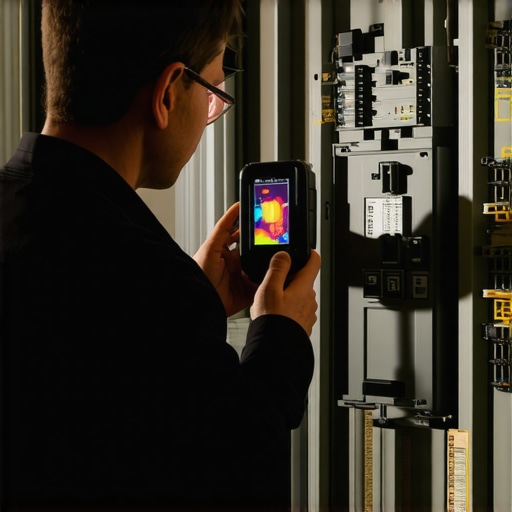
I remember a ‘renovated’ retail space I walked into about five years ago. The owner had just invested a fortune in retail store wiring and high-end aesthetic fixtures. She complained about a ‘tick’ in the wall near the register. The flipper who did the work had buried three live junction boxes behind a decorative reclaimed wood backsplash—a classic ‘Handyman Special’ violation of the NEC. My tick tracer was screaming, but it couldn’t tell me the severity. When I pulled out the thermal imager, the screen showed a white-hot bloom through the wood. A loose wire nut had created a high-resistance connection, and the heat was already charred the cedar from the inside out. If we hadn’t caught that with infrared, that shop wouldn’t have made it through the weekend rush.
“Aluminum wire connections can overheat and cause a fire without tripping the circuit breaker.” – CPSC Safety Alert 516
The Physics of Failure: Why Resistance Is Your Enemy
To understand why thermal imaging is non-negotiable for commercial electrical services, you have to understand Ohm’s Law and the thermal dynamics of a home run. Every connection point—every lug, every wire nut, every breaker contact—is a potential site for resistance. In a perfect world, resistance is zero. In the real world of workshop electrical setup and heavy machinery, resistance builds through oxidation, vibration, and thermal expansion. When resistance increases, the voltage drop across that point generates heat ($P = I^2R$).
Let’s zoom into a single breaker terminal. In mid-century panels, especially those plagued by aluminum wiring, we deal with a phenomenon called Cold Creep. Aluminum expands at a different rate than the steel screws holding it in place. Over decades of heating up during the day and cooling at night, the wire literally ‘creeps’ out from under the screw. This creates a microscopic gap. This gap is an air-gap resistor. The electricity jumps the gap (arcing) or forces its way through an oxide layer, generating temperatures that can exceed 1000 degrees Fahrenheit. Your eyes see a secure screw; the thermal imager sees a miniature sun. This is why electrical load calculations are useless if the physical integrity of the connection is compromised.
Thermal Imaging vs. The Naked Eye
When I’m called for same day service appointments because a client smells ‘fish’ (the distinct scent of burning phenolic resin), the clock is ticking. A standard visual inspection involves opening the panel and looking for discoloration. But here’s the trap: high-quality THHN insulation is designed to be tough. It can be melting at the core while the outer jacket looks pristine. Thermal imaging detects the thermal signature radiating through the materials. It identifies the exact lighting installation services point that is failing before the smoke starts. In a warehouse lighting retrofit, where you have hundreds of ballast connections or LED drivers high in the rafters, climbing a lift to check every nut is a fool’s errand. A thermal sweep identifies the outliers in seconds.
“Terminal connections shall be tightened to the torque values specified by the manufacturer. Failure to do so can result in overheating and fire.” – NEC 110.14(D)
The Forensic Breakdown of Commercial Systems
In a commercial environment, the stakes are higher. Whether it’s ethernet wiring services running alongside power lines or emergency exit lighting that must function during a blackout, reliability is tied to heat management. I’ve seen warehouse lighting retrofit jobs where the installer bypassed the electrical load calculations, oversubscribing a single phase. The bus bar didn’t melt immediately. Instead, it slowly cooked over six months. We call this ‘thermal runaway.’ As the metal gets hotter, its resistance increases, which makes it even hotter, until the structural integrity of the panel fails.
During a forensic sweep, we look for ‘phase imbalance.’ If one leg of a three-phase system is running 30 degrees hotter than the others, we know we have a load distribution problem. This isn’t just about safety; it’s about equipment longevity. Heat kills electronics. If your server room’s ethernet wiring services are backed by a power supply that’s running hot, you’re looking at data corruption and hardware failure long before a fire ever starts. Using a Wiggy or a multimeter only tells you the voltage now; it doesn’t tell you the history of the thermal stress on the copper.
The Reality of Maintenance: Don’t Trust a Visual
Many ‘inspectors’ will walk through a facility, click their dikes, and sign off if the labels look clean. That’s negligence. Professional lighting installation services and commercial electrical services must include infrared thermography. We look for ‘thermal gradients.’ For example, in a workshop electrical setup, a motor starter shouldn’t have a 20-degree variance between its input lugs. If it does, that’s a sign of internal contact pitting. You can’t see pitting through a plastic housing. But the infrared doesn’t lie. It shows the heat concentrated on the damaged internal spring.
Final Verdict: Electricity is Not a Hobby
If you’re managing a facility or a home, don’t assume that a lack of smoke means a lack of danger. The ‘Time Bomb’ in your wall is silent. Whether you need a warehouse lighting retrofit or just a workshop electrical setup, demand a thermal report. I’ve spent too many years pulling charred Romex out of attics to believe in luck. We use monkey shit to seal conduits, but we use thermal imaging to seal our peace of mind. Get the load calculations done, ensure your emergency exit lighting is thermally stable, and remember: if it’s hot, it’s failing. Sleep at night knowing every lug in your panel is torqued to spec and running cool. That’s the only way to beat the physics of fire.
Comments are closed.