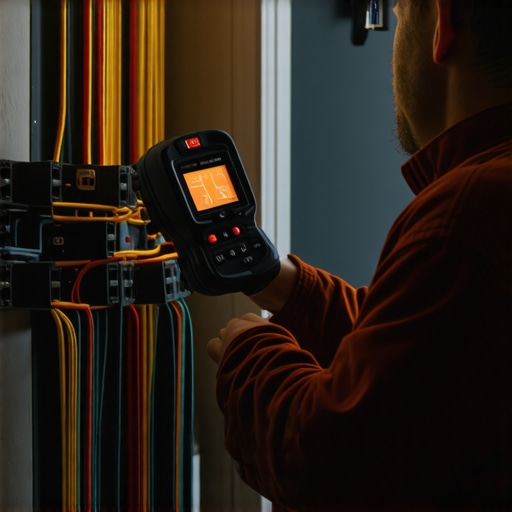
Most homeowners think an electrical fire is like a lightning strike—sudden, violent, and unpredictable. After thirty-five years of pulling Rough-in inspections and performing post-mortem forensics on charred framing, I can tell you that’s a lie. Electricity usually gives you a warning; it just speaks in a language humans can’t see without help. When I walk into a house for a 24 hour emergency electrician call, I’m not just looking for tripped breakers. I’m looking for the heat signature of a disaster in progress. That’s where infrared thermography comes in. It’s the only way to find a ‘hot spot’ before it becomes a 1,500-degree inferno.
The Journeyman’s Lesson: The Ghost in the Wire
My old journeyman, a man who smelled permanently of ozone and cheap coffee, used to make me run my hand an inch away from every enclosure we opened. ‘If you feel the ghost’s breath,’ he’d growl, ‘something’s about to pop.’ He was right. He knew that any nick in a copper conductor or a loose lug creates a bottleneck. If you nick the copper while stripping with a knife instead of the proper dikes or strippers, you reduce the cross-sectional area of the wire. Physics doesn’t care about your excuses; that smaller area has higher resistance, and resistance creates heat. Today, we don’t rely on the ‘ghost’s breath.’ We use FLIR cameras that reveal the exact thermal signature of a failing circuit. I’ve seen pendant light hanging jobs where the homeowner used oversized bulbs, turning the canopy into a slow-cooker that eventually melted the insulation into a sticky, conductive mess. You don’t see that with the naked eye until the smoke starts.
“Aluminum wire connections can overheat and cause a fire without tripping the circuit breaker.” — CPSC Safety Alert 516
The Physics of the ‘Cold Creep’ and Thermal Failure
In mid-century homes built between 1960 and 1980, the enemy isn’t just old age; it’s chemistry. We see a lot of aluminum electrical wiring services from this era. Aluminum has a much higher coefficient of thermal expansion than copper. When you run a heavy load—say, a ceiling fan installation running on high or a portable heater—the aluminum wire heats up and expands. When you turn it off, it contracts. This cycle, known as ‘Cold Creep,’ eventually loosens the terminal screws on your outlets and breakers. A loose connection is an arcing connection. An arc is essentially a tiny, continuous lightning bolt that reaches temperatures of several thousand degrees. Infrared scans catch this ‘thermal blooming’ at the source. While a Tick Tracer might tell you the wire is live, it won’t tell you the terminal is at 250 degrees Fahrenheit. Thermography does.
Arc Flash Studies and the Invisible Danger
In commercial settings or high-amperage residential ‘heavy-ups,’ we perform arc flash studies to determine the level of energy released during a fault. Heat is the primary byproduct of these inefficiencies. Whether we are dealing with battery backup wiring for a solar array or emergency exit lighting in a warehouse, the infrared camera identifies phase imbalances. If one leg of a three-phase system is running 30 degrees hotter than the others, you don’t have a load problem; you have a failing component. I’ve seen fiber optic cabling trays melted because some ‘handyman’ ran a high-voltage Home Run right over the top of the low-voltage data lines, creating an induction furnace of heat in a confined space. We even see this during holiday light installation, where people daisy-chain sixteen strands of incandescent lights into a single 14-gauge extension cord. The cord won’t trip the breaker immediately, but the infrared scan shows it glowing like a neon sign under the snow.
“Thermal abnormalities are often the first sign of equipment failure or an electrical fire hazard.” — NFPA 70E Standard for Electrical Safety
Preventative Scans: Beyond the Naked Eye
When I’m called for ethernet wiring services, I often find that the biggest threat to the data network isn’t a bad crimp; it’s the heat from nearby unshielded power lines. Using thermography, we can see the ‘heat bleed’ through the drywall. It’s about forensic accuracy. We look at the bus bars in your panel. If we see a ‘pitting’ pattern on the infrared, we know that breaker is toast, even if it looks brand new. I don’t care if the panel is a Federal Pacific or a modern Square D; if the torque isn’t hit with a calibrated wrench and verified by a thermal scan, it’s a liability. We use Monkey Shit (duct seal) to keep moisture out of the conduits, but if the heat is already building inside the wall from a ‘bootleg ground,’ no amount of sealant will save you. A professional scan catches the resistance in the wire itself, identifies the ‘hot spots’ in your battery backup wiring, and ensures your emergency exit lighting actually works when the grid goes dark. Stop guessing with your family’s safety. If you haven’t had a thermal scan of your service entrance and main panels, you’re just waiting for the ‘ghost’ to take a breath.
Comments are closed.