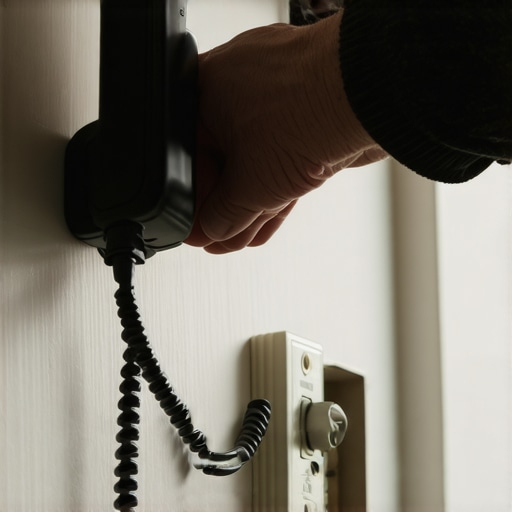
You pick up the handset, expecting a dial tone, but instead, you get the sound of a frying pan filled with bacon. That rhythmic, crackling hiss isn’t just an annoyance; it is the audible signature of a failing physical layer in your home’s communication infrastructure. As a Master Electrician who has spent decades diagnosing the aftermath of Mother Nature’s tantrums, I can tell you that static after a storm is rarely a fluke. It is a forensic clue that moisture, voltage transients, or physical degradation have compromised the circuit. If you are hearing ghosts on the wire, it means your system’s impedance has been hijacked. This guide isn’t about unplugging your base station and plugging it back in—it is about understanding why your copper is screaming.
The Old Timer’s Lesson: The Sin of the Nicked Conductor
My first journeyman was a man who viewed a pair of dikes with more suspicion than a loaded gun. I remember a humid Tuesday in July when we were chasing a noise floor issue in an old Victorian. I was stripping back the jacket on a multi-pair cable with a pocketknife, impatient to get the job done. He stopped me, his hand clamping down on my wrist like a vice. ‘You nick that copper, kid, and you’ve just built a thermal bottleneck,’ he growled. ‘In a storm, that tiny scratch becomes a point of high resistance. The moisture finds the copper, the copper oxidizes, and the static begins. If you can’t strip it clean, don’t strip it at all.’ He was right. Most of the static issues I find today trace back to poor rough-in practices where the conductor was compromised long before the rain started falling. When the storm hits, it simply exposes the sins of the installer.
The Autopsy of a Noisy Line: Why the Storm Broke Your Signal
To fix the noise, you have to understand the physics of the ‘Talk Path.’ Your home phone line operates on a DC voltage—typically 48 volts when on the hook. When a storm rolls through, three primary enemies attack this voltage: Moisture Ingress, Induced Voltage, and Ground Potential Shift. If you have an [electric gate opener] or [pathway lighting install], these systems often share the same trenching or proximity to your telco lines, creating a playground for electromagnetic interference (EMI) when things go sideways.
1. Moisture and the Green Crust of Death
The most common culprit is the Network Interface Device (NID), that gray box on the side of your house. If the ‘Monkey Shit’ (the duct seal putty) has dried out and cracked, or if the rubber grommets have perished, rain enters the enclosure. Capillary action pulls that water into the terminal blocks. When you mix 48V DC with moisture and copper, you get electrolysis. This produces copper oxide—the ‘green crust.’ This oxide layer is semi-conductive, meaning it doesn’t just stop the signal; it creates a chaotic, fluctuating resistance. That fluctuation is the crackling static you hear.
2. The Carbon Protector Failure
Inside older NIDs, there are carbon block surge arrestors. These are designed to shunt high voltage from a lightning strike to ground. If a storm was particularly violent, these arrestors might have ‘partially fired.’ This leaves a bridge of carbon dust across the gap. It’s not a direct short, but it’s enough of a leak to ground that it induces a hum or static. This is why we recommend comprehensive [electrical inspections] after any major weather event; the damage isn’t always a blown breaker; sometimes it’s a silent, smoldering leak in a protector.
“Communication wires and cables shall have a vertical clearance of not less than 8 feet from all points of roofs above which they pass.” – NEC Article 800.44(B)
Step-by-Step Forensic Diagnosis
Before you call the phone company and risk a $150 service fee for a ‘customer-side’ problem, you need to perform a demarc isolation. This is where we separate the utility’s responsibility from your own. You won’t need a Wiggy for this—that’s for your high-voltage checks—but a basic butt-set or a standard corded phone is essential.
The Demarcation Test
Open your NID. You’ll see a test jack—it looks like a standard phone plug. When you unplug that cord, you are physically disconnecting your entire house from the street. Plug your corded phone directly into that test jack. If the static is still there, the problem is ‘outside plant’—the utility’s lines are compromised. If the static disappears, the problem is inside your walls. This is where the real detective work begins. I’ve seen cases where a [home automation setup] was improperly grounded, causing a 60Hz hum to bleed into the voice pairs through a process called inductive coupling.
Checking for the ‘Widow Maker’ Short
In the trade, we sometimes refer to a high-impedance short to ground as a ‘widow maker’ for equipment. It won’t kill you, but it will kill your hardware. Use a Tick Tracer to ensure there isn’t stray AC voltage on your low-voltage lines. A common storm-related failure occurs when a [whole house fan wiring] run is abraded by a moving part, and the storm’s wind vibrates the house enough to bring that AC line into contact with your phone lines in the attic. This is a fire hazard masquerading as phone static.
Solving the Resistance: The Fix
If the static is on your side, you need to hunt for the junction. Look for any ‘Star’ or ‘Daisy Chain’ wiring configurations. In mid-century homes, these are often hidden in crawlspaces where humidity is 100% after a storm. Component Zooming on the splice points often reveals the ‘Cold Creep’ of poorly executed connections. If the wires were just twisted together and taped (the classic handyman special), the thermal expansion and contraction during the storm’s temperature drop will loosen them.
Re-terminating the Home Run
The ‘Home Run’ is the cable that goes from the NID directly to your main distribution point. If this cable is old Category 3, it lacks the twist ratio needed to reject interference. Replacing this with Shielded Cat6 can solve many static issues, especially if you live near industrial areas where [industrial motor controls] create massive amounts of electrical noise. When we do a [virtual consultation wiring] session, the first thing I look at is the cable’s jacket. If it’s brittle, the dielectric constant of the insulation has changed, and it’s no longer a cable; it’s a long, skinny antenna.
“The grounding electrode conductor shall be copper, aluminum, or copper-clad aluminum… and shall be continuous without splice or joint.” – NFPA 70-250.64(C)
The Grounding Connection: The Secret Culprit
Many homeowners don’t realize their phone system must be bonded to the main electrical grounding system. During a storm, the ground potential near your house can fluctuate. If your phone line is grounded to a separate rod that isn’t bonded to your main panel, you get a ‘Ground Loop.’ This doesn’t just cause static; it can fry your phone’s internal circuitry. Part of our [priority service membership] includes a check of these bonding jumpers. We ensure that your telco ground and your electrical ground are at the same potential. If they aren’t, the storm will find that path, and your phone line will be the fuse.
The Long-Term Solution: Professional Hardening
Static is a symptom of a system that lacks resilience. If you are tired of your communication lines failing every time a cloud passes over, it’s time to look at a [home backup generator install] for power stability and a total rewiring of your low-voltage paths. We offer a [lifetime workmanship guarantee] because we don’t just ‘twist and tape.’ We use gel-filled ‘B-Connectors’ (also known as beans) that exclude oxygen and moisture, preventing the green crust from ever forming.
Electricity isn’t a hobby, and even ‘low voltage’ systems like phone lines require a mastery of Ohm’s Law and material science to get right. Don’t let a ‘handyman’ with a roll of electrical tape touch your lines. They’ll leave you with a mess that creates static the next time the wind blows. If you want it fixed so you can sleep at night—knowing that your 911 lifeline is clear and functional—you need someone who understands the forensic reality of electrical failure. Torque it to spec, seal it from the elements, and respect the copper. That is the only way to silence the ghosts in the machine.