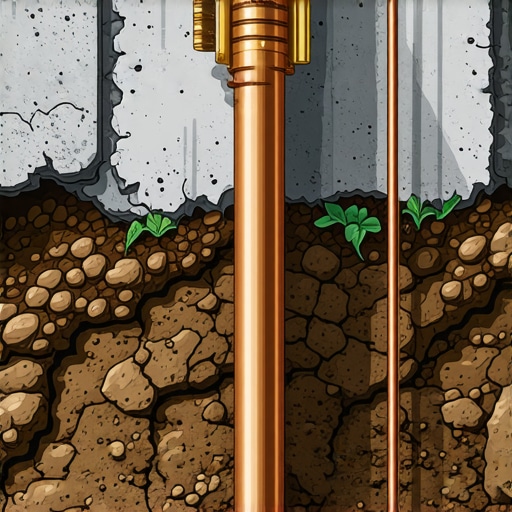
The Tingle in the Fingertips: A Forensic Autopsy of Failed Grounding
You’re standing in your kitchen, barefoot on a slightly damp tile floor, and you reach out to touch the stainless steel handle of the refrigerator. You feel it—a faint, rhythmic vibrating tingle that crawls up your arm. Most people shrug it off as a ‘quirk’ of an old house. To a master inspector, that tingle is a siren song of a system that has lost its path to the earth. It’s the smell of ozone before a lightning strike. It’s the signature of a grounding electrode system that was either installed by a hack or has succumbed to the silent rot of the soil. When we talk about How to Tell if Your Grounding Electrode Was Installed Correctly, we aren’t just talking about a copper rod in the dirt; we are talking about the only thing standing between your family and a high-voltage transient looking for a shortcut through your heart.
The Old Timer’s Lesson: The Nick that Kills
My journeyman back in the late 80s was a man who didn’t believe in safety glasses but believed religiously in the integrity of a conductor. I remember him smacking my hand with a pair of dikes because I was stripping a #6 solid copper wire with a pocket knife. ‘You nick that copper, kid, and you’ve just built a thermal bottleneck,’ he’d bark. ‘You’re creating a hot spot where the electrons get pissed off and start vibrating. In a grounding system, that nick is where the rod snaps when the frost heaves, and then you’ve got a Widow Maker—a live house with no exit strategy for a surge.’ He was right. Most grounding failures happen at the points of connection, where physics and neglect meet in the dark.
“Electrical systems shall be connected to earth in a manner that will limit the voltage imposed by lightning, line surges, or unintentional contact with higher-voltage lines.” – NEC 250.4(A)(1)
The Forensic Breakdown: Why the Rod Fails
A grounding electrode isn’t a ‘drain’ in the way a plumber thinks of a sink. It’s a reference point. When you’re doing a subpanel installation or setting up a garage wiring services package, the ground rod is there to stabilize the voltage to earth. But here is the forensic reality: most rods are ‘Suicide Stakes.’ I’ve pulled rods out of the ground that were only three feet long because the installer hit a rock and decided to cut the rest off with a hacksaw, hoping the inspector wouldn’t notice.
When we look at the physics of Cold Creep and thermal expansion, the connection between your home run and the rod is the primary failure point. If the installer used a standard zinc ‘acorn’ clamp on a copper-bonded rod buried in acidic soil, you get galvanic corrosion. The two dissimilar metals start a slow-motion war, creating an oxidation layer that acts as an insulator. Suddenly, that rod has a resistance of 400 ohms. In the event of a surge, the electricity doesn’t go into the dirt; it stays in your home theater wiring, frying your $5,000 processor because the path of least resistance was through your HDMI ports.
Visual Cues: The Anatomy of a Proper Ground
If you want to know if your system is solid, start at the meter can. You should see a thick, bare copper wire—the Grounding Electrode Conductor (GEC)—emerging from the service equipment. Is it protected? If that wire is flopping around where a weed-whacker can hit it, it’s a failure waiting to happen. In a professional recessed lighting installation or a major EV charger project, we ensure that GEC is armored or tucked tight against the structure.
Check the clamp. It should be a ‘Direct Burial’ (DB) rated brass or bronze clamp. If it looks like a cheap silver hose clamp, call an electrician. If you see ‘Monkey Shit’ (the trade term for duct seal) slapped over a corroded connection, someone is hiding something. A proper install requires the rod to be driven 8 feet into the earth. If you can see more than two inches of the rod sticking out of the grass, it wasn’t driven deep enough to reach the consistent moisture level required for low resistance.
“A rod or pipe electrode shall be installed such that at least 2.44 m (8 ft) of length is in contact with the soil.” – NEC 250.53(G)
The Modern Load: Why Old Grounds Can’t Keep Up
We live in a world of ‘dirty’ power. Modern electronics, from smart thermostat wiring to power factor correction units, are incredibly sensitive to voltage fluctuations. Older homes, especially those built between 1900 and 1950, often relied on the city water pipe as the primary ground. But then a plumber comes along and replaces a section with PEX (plastic). Suddenly, your house isn’t grounded anymore. You’re floating.
This is why we see security camera wiring melting during minor summer storms. Without a low-impedance path to earth, the static buildup on the camera housings has nowhere to go but back through the data lines. When we perform pathway lighting install, we have to consider the ‘sphere of influence’ for each grounding point. If your grounding electrode isn’t bonded correctly to the neutral bar in your main service, you create a ground loop. This is the ‘hum’ in your speakers and the ‘ghosting’ on your monitors.
The High-Stakes Inspection: EV Chargers and Subpanels
If you are hiring someone for EV charger installation, the grounding isn’t just a safety redundant; it’s a communication requirement. Most Level 2 chargers perform a ‘ground continuity test’ before they’ll even click the contactor to start charging. If your grounding electrode is high-resistance because of poor soil contact or a loose lug, the car will throw a fault code and leave you with a dead battery in the morning.
Similarly, during a subpanel installation in a detached garage, I often find people forget to keep the neutrals and grounds separate. They ‘bond’ them in the subpanel, which is a lethal mistake. It puts ‘objectionable current’ on the grounding system, meaning your garage wiring services have effectively turned every metal tool box and appliance frame into a part of the neutral circuit. I’ve used my Wiggy (solenoid tester) to prove to homeowners that their ‘grounded’ workbench was actually carrying 40 volts of stray current because of a botched bond at the electrode.
The Final Torque: Sleep Better at Night
Don’t be fooled by a ‘tick tracer’ (non-contact voltage tester) that glows green. It might tell you there is a path, but it won’t tell you if that path can handle 10,000 amps of a lightning strike. A real master electrician uses a Fall-of-Potential tester to measure the actual resistance of the soil. We look for 25 ohms or less. If we can’t get it with one rod, we drive a second one six feet away.
For our older neighbors, we often offer senior discount services because we know these 1940s bungalows are death traps of ungrounded circuits and brittle insulation. Getting your grounding electrode inspected isn’t an ‘upsell.’ It’s the foundation of the entire electrical pyramid. If the bottom of the pyramid is a ‘Suicide Stake’ buried in dry sand, the rest of the home theater wiring and smart home tech is just expensive tinder. Make sure your rods are deep, your clamps are bronze, and your connections are torqued. Because in the world of electricity, the dirt is the only thing that never lies.