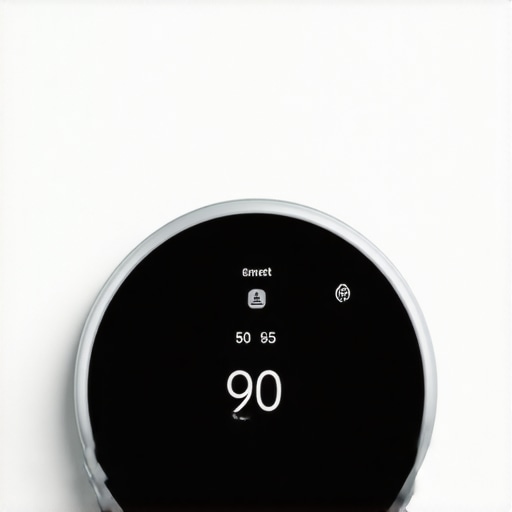
The Ghost in the Dead Display
You spent three hundred bucks on a sleek piece of glass and plastic, expecting it to revolutionize your home’s efficiency. Instead, you’re staring at a black, lifeless void on your wall while the house gets colder by the minute. You check the breakers. Nothing. You pull the faceplate off and wiggle the wires. Still nothing. Most ‘tech bloggers’ will tell you to check your Wi-Fi or reset your router, but they’ve never spent a Tuesday morning elbow-deep in a 1940s crawlspace. As a master inspector, I’ll tell you the truth: that blank screen isn’t a software glitch; it’s a physical protest from an electrical system that was never designed for the digital age.
The Journeyman’s Lesson: Nicks and Hot Spots
My journeyman used to smack my hand if I stripped a wire with a knife. ‘You nick the copper, you create a hot spot,’ he’d scream. He was right. That tiny little score mark in the metal creates a point of high resistance. In a high-voltage circuit, it might just hum. In a low-voltage control circuit—like the one powering your smart thermostat—it’s a death sentence. We’re dealing with 24 volts AC here. It’s a delicate balance. When you’re dealing with cloth insulated wiring replacement issues, you’re often looking at decades of brittle rubber and charred cotton that has high-resistance leakage everywhere. That ‘nicked’ wire from forty years ago is now a bottleneck, and your fancy thermostat simply can’t pull enough current to keep its processor awake.
“Aluminum wire connections can overheat and cause a fire without tripping the circuit breaker.” – CPSC Safety Alert 516
Blueprint: The Autopsy of a Power-Stealing Failure
When I perform electrical inspections on homes where smart tech is failing, I start with the ‘Autopsy.’ I look at the transformer in the furnace or air handler. Most older HVAC systems used a 20VA or 40VA (Volt-Amp) transformer. That was plenty to flip a mechanical relay in an old mercury-switch thermostat. But a smart thermostat is essentially a tiny computer with a backlit LCD and a Wi-Fi radio. It needs constant juice. If you don’t have a ‘C’ (Common) wire, the device tries to ‘power steal.’ It siphons a tiny bit of current off the heating or cooling circuit without quite drawing enough to trigger the system. It’s a parasitic relationship. In a home with aging infrastructure, that parasitism fails. The resistance in the old lines—especially if you still have cloth insulated wiring—causes a voltage drop. Your 24V becomes 19V. The thermostat’s internal battery drains, the screen goes dark, and the processor enters a boot-loop of despair.
The Physics of Resistance: Why Old Copper Fails New Tech
Let’s zoom in on the terminal block. In many mid-century homes, we find that the wiring isn’t just old; it’s compromised by ‘cold creep’ or oxidation. Even copper oxidizes over time, forming a layer of cupric oxide that acts as a semi-insulator. When you have a camper electrical panel or a standard home rough-in, every connection is a potential failure point. If your home backup generator install wasn’t done with a proper transfer switch, or if you’ve got power quality analysis issues, you’re seeing ‘dirty power.’ Transients and surges chew through the delicate MOVs (Metal Oxide Varistors) inside that smart thermostat. Without whole house surge protection, a single lightning strike three miles away can send a spike through those old, unshielded wires, frying the logic board of your thermostat while leaving your old-school toaster perfectly fine. This is why we recommend a full power quality analysis; we use a Wiggy or a high-end multimeter to see what’s actually happening to your sine wave.
“Overcurrent protection shall be provided in accordance with NEC 210.20.” – National Electrical Code (NEC)
The Infrastructure Crisis: From EV Chargers to Ceiling Fans
The problem is rarely isolated. If your thermostat is blanking out, it’s a symptom of a larger systemic failure. Many people try to add an EV charger or a ceiling fan installation to a circuit that is already screaming for mercy. They use a tick tracer to see if a wire is hot and assume that means it’s ‘good.’ That’s a rookie mistake. A wire can show voltage but fail under load. If you’re planning an RV hookup installation or a fire alarm system install, you have to look at the total load calculation. When the furnace kicks on, the initial ‘inrush current’ creates a massive magnetic field. If your thermostat wires are bundled too tightly with high-voltage Romex, you get inductive interference. That ‘crosstalk’ confuses the thermostat’s sensors, leading to ‘phantom’ readings or a complete system shutdown.
The Forensic Solution: Beyond the Reset Button
To fix a blank screen for good, you stop looking at the screen and start looking at the home run back to the panel. We often have to run a dedicated 18/5 or 18/8 thermostat wire to ensure a solid, dedicated Common path. We check the ‘Monkey Shit’ (duct seal) at the exterior penetrations to ensure moisture isn’t wicking down the lines and corroding the furnace control board. We check the torque on every lug. You want to sleep at night? You don’t just ‘make it work.’ You torque it to spec. Whether it’s a camper electrical panel or a 200-amp service entrance, electricity doesn’t care about your convenience; it only cares about the path of least resistance. Make sure that path isn’t through your drywall. If your house is pre-1970, stop buying gadgets and start investing in electrical inspections and whole house surge protection. It’s the difference between a smart home and a fire hazard.