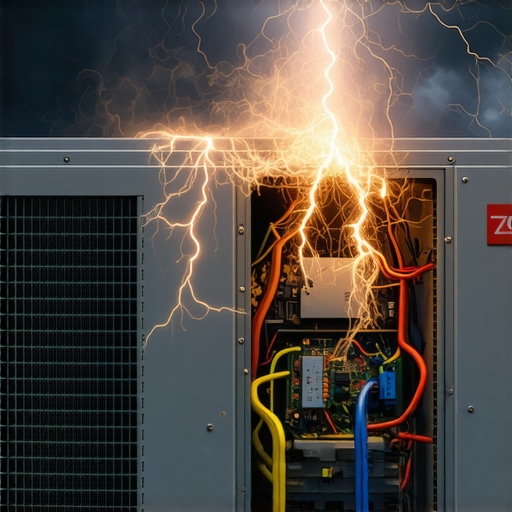
The Ghost in the Attic: Why Your HVAC is a Sitting Duck
Walk into any home built between 1900 and 1950, and you’re not just looking at historical charm; you’re looking at an electrical infrastructure that was designed when the most high-tech appliance in the house was a toaster. I’ve spent 35 years pulling Romex through tight crawlspaces and sniffing out the acrid stench of fried capacitors, and I can tell you one thing for certain: your modern, high-efficiency HVAC system is a fragile piece of glass sitting in a room full of hammers. Most homeowners think a surge is a once-in-a-decade lightning strike. They’re wrong. It’s a daily assault of micro-transients that are slowly turning your expensive control boards into charcoal.
The Flipper Special: A Forensic Case Study
I walked into a ‘fully renovated’ 1940s colonial last summer where the flipper had spent fifty grand on marble countertops but didn’t spend fifty cents on a decent ground. I was there because the brand-new $12,000 variable-speed heat pump had died three times in six months. I pulled out my tick tracer and the casing of the furnace started screaming before I even touched it. The flipper had buried three live junction boxes behind a new bathroom backsplash, and the HVAC unit was being fed by an ungrounded home run that looked like it had been chewed on by a radioactive squirrel. I found the fault using a drone thermography scan—the heat signature behind the drywall looked like a glowing vein of lava. That’s the reality of modern ‘upgrades’ in old bones. They look pretty, but the guts are a disaster waiting for a voltage spike to finish the job.
“Aluminum wire connections can overheat and cause a fire without tripping the circuit breaker.” – CPSC Safety Alert 516
The Physics of the Kill: Transients and Thermal Runaway
When we talk about the vulnerability of an HVAC system, we have to talk about the silicon. Old-school AC units used heavy-duty contactors and thick copper windings that could take a punch. Modern units rely on Integrated Circuits (ICs) and AI fault detection systems that operate on millivolts. A transient surge—a sudden spike in voltage—doesn’t have to be big to be lethal. We’re talking about nanosecond events. When a 600-volt spike hits a 12-volt control board, it causes cold creep in the solder joints and micro-pitting on the traces. This is where the physics of resistance comes into play. Every time a spike hits, it creates a tiny path of carbonized material. Carbon is conductive. Eventually, that path becomes wide enough that the normal 120-volt house current jumps the gap. That’s when you get the ‘magic smoke’ and a dead compressor.
The Unseen Enemies: Grid Switching and Neighbor Noise
Everyone worries about the sky falling, but 80% of surges are generated inside the house or just down the street. When your neighbor’s old well pump kicks on, or when the utility company performs grid switching, it sends a wave of ‘noise’ back through the transformer. If you haven’t invested in a standby generator install with an integrated surge suppressor, or at least a Type 2 protector at the panel, your HVAC unit is the largest ‘sink’ for that energy. It’s even worse if you’ve recently added a level 2 EV charger or completed an EV charger installation without recalculating your load. These high-draw devices create massive electromagnetic interference (EMI). Without proper filtering, that EMI ripples through the house, hammering the sensitive sensors in your home automation setup and your HVAC’s thermostat.
The Panel Problem: Brand Shaming for Safety
If you’re living with a Federal Pacific or Zinsco panel in an old home, you’re not just missing surge protection; you’re living with a jammed gun. These breakers are notorious for ‘freezing’ on the bus bar. I’ve seen warehouse lighting retrofit projects where we found FPE breakers that had literally welded themselves to the copper. In these scenarios, a surge comes in, the breaker fails to trip, and the energy has nowhere to go but your HVAC’s compressor. This is why AFCI breaker services are non-negotiable for older homes. An Arc-Fault Circuit Interrupter can detect the signature of a surge-induced arc before the fire starts. It’s the difference between a $200 repair and a total loss.
“The surge protective device shall be component recognized or listed to UL 1449.” – NEC Article 285
The Component Zoom: The Sacrificial MOV
Inside a proper surge protector is a component called a Metal Oxide Varistor (MOV). Think of it as a high-speed pressure relief valve for electricity. Under normal voltage, it’s a wall. When voltage exceeds a certain threshold, the MOV’s resistance drops instantly, shunting the excess energy to the ground wire. But here’s the kicker: MOVs are sacrificial. Every time they take a hit, they degrade. In an old house with a ‘bootleg ground’ (where some genius connected the neutral to the ground screw), that energy has nowhere to go. It just bounces back into the system. This is why we use lockout tagout training protocols when we inspect these systems; you never know which ‘grounded’ pipe is actually carrying a 50-amp load because of a failed surge bypass.
[image_placeholder]
The Solution: A Multi-Layered Defense
Don’t let a ‘handyman’ tell you a $20 power strip will save your HVAC. You need a tiered approach. First, a Type 1 protector at the meter can to stop the big external hits. Second, a Type 2 protector at the main load center—especially if you have up lighting services or heavy outdoor loads that can attract static. Third, a dedicated surge disconnect at the HVAC condenser itself. I always tell my clients that while they are looking at a warehouse lighting retrofit or a simple home automation setup, they should be looking at their grounding electrode system. If your ground rods are 40 years old and corroded in dry soil, they’re useless. We use AI fault detection software now to model how a surge travels through a specific home’s wiring, and 9 times out of 10, the path to ground is blocked by monkey shit (duct seal) and rust.
The Economic Trap: Insurance and Resale
Here’s the part that hurts: insurance companies are getting smart. I’ve been called as a forensic inspector by adjusters to see if an HVAC failure was caused by ‘lack of maintenance’ or a surge. If they find no surge protection and evidence of repetitive transient damage, they can deny the claim. Upgrading your protection isn’t just about the hardware; it’s about protecting your insurability. Whether you’re doing a standby generator install or just adding up lighting services, the code is moving toward mandatory surge protection for a reason. Electricity isn’t a hobby, and in an old house, it’s a living, breathing beast that wants to find the shortest path to the earth—even if that path is through your expensive furnace.
Final Torque: Sleep Better at Night
At the end of the day, you want to know that when the wind starts howling and the lights flicker, your house isn’t about to become a headline. Check your panel. If you see those old, thin breakers or a brand name that hasn’t existed since the Nixon administration, get a pro in there. Get a drone thermography scan to find the hot spots you can’t see behind the plaster. Don’t wait for the smell of ozone to tell you that you’ve got a problem. Torque your lugs, check your grounds, and for the love of all that is holy, put a surge protector on your HVAC. It’s the cheapest insurance you’ll ever buy.