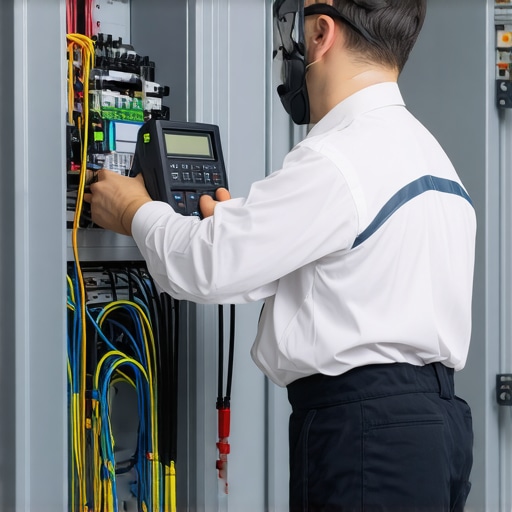
The Sensory Warning: A Smell You Never Forget
If you have spent thirty-five years in the trade, you develop a sixth sense for disaster. It usually starts with a scent—the distinct, acrid stench of burning phenolic resin and ozone. It’s the smell of money turning into ash and copper turning into vapor. When I walk into a mechanical room for commercial electrical services, I am not looking at the paint; I am looking at the dust patterns on the switchgear and listening for the ‘bacon frying’ sound of a loose connection. An arc flash study isn’t just a regulatory hoop to jump through; it is a forensic autopsy of a system that is still technically alive but might be terminal. If your facility manager is just slapping stickers on panels without understanding the coordination study behind them, you are sitting on a powder keg.
The Old Timer’s Lesson: The Sin of the Nicked Wire
My journeyman used to smack my hand with a pair of dikes if he saw me stripping a wire with a pocket knife instead of a dedicated tool. ‘You nick that copper, kid, and you’ve just built a fuse where you don’t want one,’ he’d bark. He wasn’t just being a mean old bastard; he understood the physics of the hot spot. That tiny indentation in the conductor reduces the cross-sectional area, increasing resistance at that specific point. Under a heavy load, that resistance generates heat, which causes the copper to expand and contract, eventually loosening the terminal. This is how load center upgrades become necessary—not because the hardware was bad, but because the installation was sloppy. That lesson stuck. Every connection I make today is torqued to the inch-pound, because I’ve seen what happens when ‘tight enough’ meets a high-fault current environment.
“Arc flash hazard analysis shall be updated when a major modification or renovation takes place. It shall be reviewed periodically, not to exceed five years, to account for changes in the electrical distribution system.” – NFPA 70E 130.5
Component Zooming: The Physics of the Plasma Cloud
To understand why an arc flash study is vital, you have to look at the physics of a fault. We are talking about temperatures reaching 35,000 degrees Fahrenheit—four times hotter than the surface of the sun. At those temperatures, copper doesn’t just melt; it expands 67,000 times its volume as it turns into a plasma gas. An arc flash study calculates the ‘incident energy’ available at any given point in your system. This calculation is driven by the ‘clearing time’ of your overcurrent protective devices. If a breaker is gummed up with old grease or has a failed trip unit, it might take 100 milliseconds to trip instead of 20. That tiny delay is the difference between a loud pop and a building-level explosion. When we perform AI fault detection and drone thermography scans, we are looking for the thermal signatures of high resistance before they cross the threshold into ionization. We are looking for the ‘cold creep’ in aluminum conductors and the oxidation layers on bus bars that signal a service entrance upgrade is long overdue.
The Forensic Breakdown: Why Systems Fail
When I conduct a forensic inspection, I’m often looking at the underground wiring services. In many older industrial sites, moisture ingress leads to flood water electrical safety issues that aren’t apparent until you see the results of an arc flash study showing massive leakage to ground. Water carries minerals; minerals create conductive paths across insulators. Eventually, that path becomes a highway for a phase-to-ground fault. We use fiber optic cabling for our sensing equipment because it’s immune to the electromagnetic interference that screams through a facility during a motor start-up. This allows us to get clean data on whether your equipment is healthy or just hanging on by a thread. If the study shows that your bolted fault current is higher than the interrupting rating of your breakers, you are essentially using a screen door to stop a tidal wave. That’s when we talk about a service entrance upgrade and modernizing your protection scheme with lifetime workmanship guarantee standards.
“The bolt-on connection of a circuit breaker to a bus bar is a critical point of failure. Improper torque can lead to thermal runaway and catastrophic equipment failure.” – NEC 110.14(D)
The Fix: From ‘Monkey Shit’ to Modern Precision
In the old days, we’d shove some monkey shit (duct seal) in a conduit and call it a day. Today, we have to be more surgical. If the arc flash study reveals high incident energy levels, the fix isn’t always replacing everything. Sometimes it’s about adjusting the trip curves on your existing breakers or installing maintenance switches that reduce the trip delay while workers are present. However, if we find that your gear is riddled with ‘widow makers’—improperly labeled or illegally tapped conductors—we have to go back to the rough-in phase mentally. We look at underground wiring services for signs of insulation breakdown using Megger testing. For our older clients, we often suggest senior discount services to help manage the cost of these critical safety load center upgrades. The goal is to ensure that the home run from the utility transformer to your main lug is as bulletproof as possible. You want to sleep at night knowing your lugs are torqued, your clearances are met, and your AI-driven monitors are watching for the first sign of a ‘tick tracer’ alert.
Conclusion: Electricity is Not a Hobby
An arc flash study isn’t a piece of paper; it’s a map of the invisible dangers in your walls. It reveals if your commercial electrical services provider was a pro or a pretender. When we find a system that passes with flying colors, it’s usually because someone cared about the details—the torque marks on the bolts, the clean trim-out, and the lack of ‘bird-nesting’ in the gutters. Electricity is a relentless force; it’s always looking for a path to ground, and it doesn’t care if that path is through a copper bar or your chest. Do the study, fix the faults, and hold your contractors to a lifetime workmanship guarantee. Anything less is just waiting for the lights to go out for good.