The Ghost in the Copper: Why Visual Checks Are Never Enough
My first journeyman, a chain-smoking veteran named Gus, used to slap my dikes out of my hand if he saw me rushing a rough-in. He once watched me strip the jacket off a piece of Romex with a pocket knife instead of a dedicated stripper. He grabbed my wrist, pulled me toward the panel, and pointed at a microscopic nick I’d made in the copper. ‘You see that? That’s not just a scratch, kid. That’s a stress concentrator. It’s a hot spot waiting for a load. Physics doesn’t care about your dinner plans; it only cares about resistance and heat.’ He was right. Most people think an electrical inspection is just a guy with a flashlight looking for tripped breakers. In reality, it’s a forensic deep-dive into the thermal and mechanical integrity of your home’s nervous system. When we perform annual maintenance contracts, we aren’t looking for what’s working; we are looking for what is currently in the process of failing.
The Anatomy of the Main Service Panel: The Time Bomb in the Garage
The core of any inspection begins at the main service panel. This is where we remove the ‘dead front’—that metal cover that keeps you from touching the live bus bars. We aren’t just looking for charred insulation. We are looking for ‘cold creep’ in the lugs and signs of galvanic corrosion. Over years of thermal cycling—where the wires heat up under load and cool down at night—the screws holding your home run circuits can actually back out. A loose connection is a high-resistance connection. High resistance equals heat. Heat equals fire.
“Aluminum wire connections can overheat and cause a fire without tripping the circuit breaker.” – CPSC Safety Alert 516
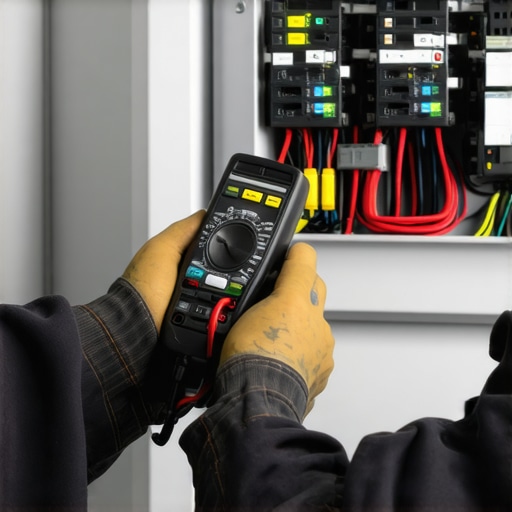
During an inspection, we often find that office lighting upgrades or DIY additions have overloaded a specific phase. We use a Wiggy or a high-end multimeter to check for voltage drops and imbalances between legs. If one leg is pulling 80 amps while the other sits at 20, you’re stressing the transformer and shortening the life of every motor in the building. For commercial clients, we incorporate vibration analysis services on heavy-duty equipment because a vibrating motor isn’t just a mechanical issue; it’s an electrical one that shakes connections loose at the disconnect.
[image_placeholder_1]
Specialized Forensic Analysis: From Docks to Decks
Electricity behaves differently when you move it outside. Dock electrical services are perhaps the most critical part of a coastal or lakeside inspection. Here, the enemy is stray current. A small leak in a submerged pump or a faulty ground on a boat lift can turn the water around a dock into a lethal ‘electric shock drowning’ zone. We test for ground fault leakage in milliamps, looking for the tiny ‘leaks’ that a standard breaker would ignore. Similarly, deck lighting services and Christmas light services are often the culprits of nuisance tripping. People tend to daisy-chain strings of lights until the total resistance drops so low the circuit is screaming. An inspector checks the weather-tight integrity of the GFCI covers, ensuring that ‘monkey shit’ (duct seal) hasn’t dried out and allowed moisture to track into the exterior junction boxes.
The Burden of Modern Life: Capacity and Safety Systems
Many homes built before the 1990s are struggling under the weight of 21st-century power demands. A home rewiring services consultation often starts during an annual inspection when we find that the fire alarm system install was tapped into a lighting circuit that is already at 90% capacity. We look for ‘bootleg grounds’—a dangerous shortcut where a ‘handyman’ connects the neutral screw to the ground screw on a three-prong outlet to fool a simple tester. My Tick Tracer might glow green, but my load tester will tell the real story of a missing equipment grounding conductor.
“Each branch circuit shall be sized to prevent overloads and shall have an ampacity not less than the maximum load to be served.” – NFPA 70E Standard for Electrical Safety
We also evaluate the specialty panels. If you have a camper electrical panel tied into your main service, we’re looking for signs of arcing at the 30-amp or 50-amp receptacle. These are notorious for melting because of the constant, high-amperage draw of RV air conditioners. The same scrutiny applies to chandelier installation. It’s not just about the weight of the fixture; it’s about the heat generated by 12 or 24 individual bulbs trapped in a ceiling canopy, which can bake the wire insulation until it’s as brittle as a potato chip.
The Final Walkthrough: The Professional Verdict
By the time we reach the trim-out phase of our report, we’ve checked the torque on every lug, the trip-curve of your AFCIs, and the grounding electrode system’s resistance to earth. An annual inspection isn’t an ‘upsell’—it’s a reset of the clock. It’s the difference between a quiet night’s sleep and the smell of ozone and melting plastic at 2:00 AM. If your inspector doesn’t come out of the attic covered in insulation and cynicism, he probably didn’t look hard enough. Electrical systems don’t heal themselves; they only degrade. Catching that degradation before it reaches the ‘flashover’ point is the only way to treat a system that is quite literally trying to return to the earth with as much energy as possible. “,”image”:{“imagePrompt”:”A close-up, high-contrast thermal imaging photograph of a residential circuit breaker panel. One 20-amp breaker is glowing bright white and orange, indicating a dangerous high-resistance connection, while the surrounding breakers are cool blue and purple. The copper bus bar is visible behind the wires.”,”imageTitle”:”Thermal Imaging Reveals Hidden Electrical Hotspot”,”imageAlt”:”Thermal scan of a breaker panel showing an overheating circuit breaker during a professional inspection.”},”categoryId”:1,”postTime”:”2023-10-27T10:00:00Z”} stripslashes