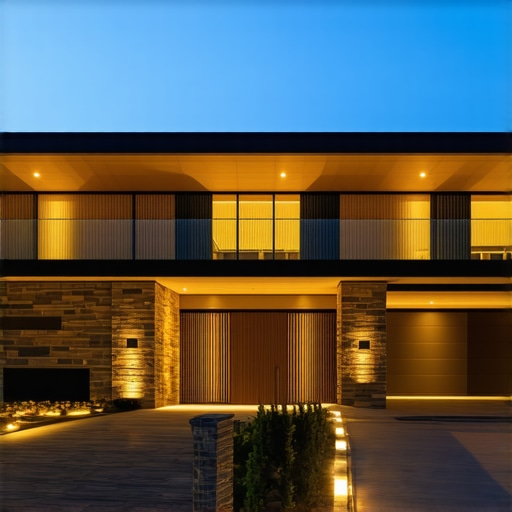
The Ghost in the Walls: Why High-End Lighting Reveals Your Home’s True Health
Most homeowners look at architectural lighting as a cosmetic upgrade, like a fresh coat of paint or a marble countertop. They are dead wrong. As someone who has spent nearly four decades chasing electrical phantoms through crawlspaces and sniffing out the acrid stench of melting PVC, I see architectural lighting as the ultimate stress test for a residential infrastructure. When you move beyond the builder-grade ‘boob lights’ and start installing sophisticated, layered systems, you are doing more than illuminating a facade; you are demanding precision from a system that might be decades past its prime.
My old mentor, a man who had more scars from ‘widow makers’ than he had fingers, once hammered a lesson into my skull during a rough-in on a sprawling mid-century estate. I was being sloppy with the wire strippers, and he snatched the dikes right out of my hand. ‘You see that nick in the copper?’ he barked, pointing at a microscopic gouge I’d left on a 12-gauge conductor. ‘That nick is a resistance heater. You’re asking this wire to carry a load for the next fifty years, and you just gave the electrons a reason to start a fire.’ He was right. In the world of high-performance electrical systems, precision is the only thing standing between a beautiful home and a pile of ash.
Blueprint of a Time Bomb: The Infrastructure Gap
The problem with the ‘lipstick on a pig’ approach to home renovation is that modern demands like architectural lighting, a level 2 EV charger, or a sauna heater installation require a rock-solid foundation. I often walk into homes built between 1960 and 1980 where the owners want to install high-end LED arrays and smart home features, yet they are still relying on a Federal Pacific or Zinsco panel. These panels are the equivalent of a ticking metronome in a room full of dynamite. The bus bars are often prone to corrosion, and the breakers are notorious for ‘jamming’—refusing to trip even when the circuit is glowing red hot.
“Aluminum wire connections can overheat and cause a fire without tripping the circuit breaker.” – CPSC Safety Alert 516
When we talk about architectural lighting increasing property value, we aren’t just talking about curb appeal. We are talking about the massive infrastructure overhaul that *should* accompany it. A professional installation involves a calculated ‘home run’ strategy, ensuring that voltage drop doesn’t dim your expensive fixtures or cook the sensitive drivers. If your home still has the original 100-amp service, you’re trying to run a marathon while breathing through a straw. Upgrading to a 200-amp or 400-amp service, complete with a smart meter installation, provides the electrical headroom necessary for modern life.
The Physics of Failure: Cold Creep and Resistance
In mid-century homes, the enemy is often hidden in the metallurgy. During the copper shortages of the 60s and 70s, aluminum wiring became the standard. The issue isn’t the conductivity; it’s the thermal expansion. Aluminum expands and contracts significantly more than copper when current flows through it. This is ‘Cold Creep.’ Over time, the wire literally crawls out from under the terminal screws of your switches and outlets. This creates a gap. A gap creates an arc. An arc creates heat—upwards of 3,000 degrees Fahrenheit. This is why we insist on AlumiConn connectors or a complete copper rewire before we even think about mounting a $2,000 architectural sconce.
If you’re planning a workshop electrical setup or adding heavy-draw appliances, the load calculation is your bible. We look at the ‘continuous load’—anything running for more than three hours. Your new architectural lighting system, if left on overnight for security and aesthetics, becomes a continuous load. This requires us to derate the breakers, meaning we only use 80% of their rated capacity. If your ‘handyman’ doesn’t know how to use a Wiggy or a tick tracer to verify circuit integrity, he’s not an electrician; he’s a liability.
The Value of Protection: Surge and Smart Tech
Property value is intrinsically linked to the longevity of the home’s systems. This is where whole house surge protection becomes non-negotiable. Modern architectural lighting relies on delicate LED drivers and digital dimming modules. A single transient voltage spike from a nearby lightning strike or a utility company switching error can fry $10,000 worth of lighting in a millisecond. By installing a Type 1 or Type 2 surge protector at the main panel, you’re essentially putting an insurance policy on every piece of silicon in your house, from your smart thermostat wiring to your network cable installation.
“The service equipment shall be provided with a surge-protective device (SPD).” – National Electrical Code (NEC) 230.67
Furthermore, professional architectural lighting often integrates with smart home ecosystems. This isn’t just about convenience; it’s about efficiency. Properly executed smart thermostat wiring and lighting controls reduce the ‘vampire load’ of your home. When a prospective buyer sees a clean, labeled panel with modern AFCI/GFCI breakers and a dedicated network rack for the home’s automation, they see a home that won’t cost them a fortune in forensic repairs three months after closing.
The Forensic Inspector’s Final Word
I’ve seen what happens when people prioritize the ‘pretty’ over the ‘protected.’ I’ve smelled the ‘fishy’ scent of a plastic outlet housing carbonizing from a loose neutral. I’ve seen retail store wiring in residential basements that looked like a bird’s nest of Romex and ‘monkey shit’ duct seal. Architectural lighting increases value because it demands excellence. It forces the homeowner to address the aging service mast, the lack of GFCI outlet installation in the garage, and the outdated grounding rods that have likely rusted into nothingness. Don’t just light your home; secure its future. When the torque is right and the load is balanced, you can finally sleep at night without one ear open for the sound of a crackling breaker.