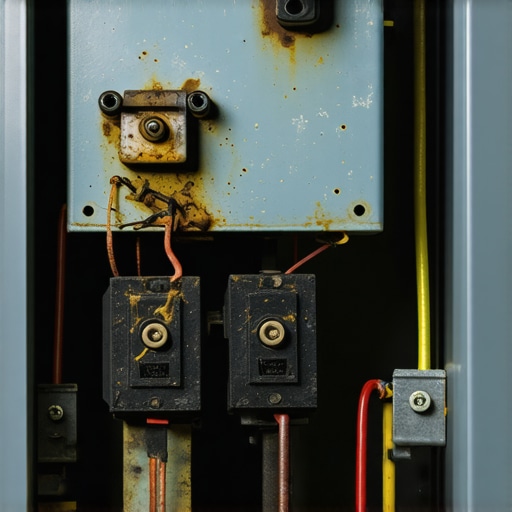
The Silence of a Failed System: A Forensic Autopsy
The sky goes black, the wind howls, and the grid finally gives up the ghost. You head to the garage, confident that your backup system is ready to hum. You throw the lever on your manual transfer switch, or wait for the clunk of the Automatic Transfer Switch (ATS), and… nothing. Or worse, the smell of acrid, burning plastic starts wafting from the enclosure. As a forensic inspector who has spent 35 years poking around the charred remains of ‘bulletproof’ systems, I can tell you that a transfer switch doesn’t just ‘stop working.’ It fails because of physics, neglect, or the hubris of a bad install. When the power goes out, the sudden demand for current—the inrush—is a violent event for the metallurgy of your electrical system.
I remember my first week as an apprentice. My journeyman, a guy who had lost two fingers to a 480V bus bar, watched me stripping back a piece of 4/0 aluminum for a meter base replacement. I was using a pocket knife, scoring the metal. He didn’t just yell; he slapped the knife out of my hand. ‘You nick that conductor, you create a stress riser and a hot spot,’ he growled. ‘In five years, that wire will snap under load, and the house will burn while you’re sleeping.’ He was right. Most generator failures I see today aren’t about the engine; they are about the invisible degradation of the connection points within the transfer switch itself.
The Physics of Contact Pitting and Carbon Tracking
When your transfer switch attempts to bridge the gap between your dead utility line and your generator’s live output, an arc is created. Even if it lasts only milliseconds, that arc generates localized temperatures exceeding 3,000 degrees Fahrenheit. This leads to what we call ‘contact pitting.’ Over time, the smooth silver or copper surface of the internal contactors becomes a lunar landscape of microscopic craters. This increases resistance. According to Ohm’s Law (V=IR), as resistance increases at a fixed voltage, heat must increase. Eventually, the contactor welds itself shut or develops enough oxidation that it acts as an insulator, preventing the home run from ever reaching your panel.
“Aluminum wire connections can overheat and cause a fire without tripping the circuit breaker.” – CPSC Safety Alert 516
In many mid-century homes where we are retrofitting modern backup power, we find the old ‘Cold Creep’ phenomenon in full effect. Aluminum conductors used for the generator feed expand and contract at different rates than the steel lugs of the transfer switch. Each thermal cycle loosens the connection just a hair. Eventually, the gap is wide enough for a ‘Tick Tracer’ to scream, but the current can’t jump the divide without creating a fire hazard. If you haven’t checked the torque on your lugs with a calibrated wrench lately, you’re living on borrowed time.
The Coastal Curse: Salt, Corrosion, and Galvanic Reaction
If you’re dealing with boat lift wiring or a home near the coast, the failure mechanism changes entirely. Salt air is an electrolyte. It enters the transfer switch enclosure and begins a process of galvanic corrosion between dissimilar metals. I’ve seen bollard light installation projects where the owner tied the generator into the same line, only to find the entire switch turned into a green, crusty mess within two seasons. The salt bridges the gap between phases, leading to ‘carbon tracking.’ This is where a conductive path of carbonized material forms across the insulating body of the switch. Once that path is established, the electricity will leak across it, heating the plastic until it ignites.
For these environments, you can’t just use standard ‘Monkey Shit’ (duct seal) and call it a day. You need NEMA 4X stainless steel enclosures and a liberal application of dielectric grease on every terminal. If you don’t, that meter base replacement you did last year won’t matter because the transfer switch will be the weak link that kills the system.
Load Calculations: The Silent Killer of Transfer Switches
The most common reason for a total system meltdown during an outage is a failure in electrical load calculations. People think a 10,000-watt generator can run a 10,000-watt house. It can’t. When your HVAC compressor kicks in, the ‘Locked Rotor Amps’ (LRA) can be five to seven times the running amperage. If your transfer switch is rated for 30 amps but you’re slamming it with a 150-amp surge from an old AC unit and a chandelier installation with sixty incandescent bulbs, the contacts inside the switch will literally spray molten metal. This is why we use remote electrical diagnostics today; I can see the heat signature of a failing switch before the homeowner even knows there is a problem.
“The service disconnecting means shall have a rating not less than the calculated load to be carried.” – NEC Section 230.79
Whether you are dealing with tiny home wiring or a massive estate, the transfer switch must be sized for the peak surge, not the average draw. If you’ve added a PA system installation or an RV hookup installation since your generator was installed, your load profile has changed. You are likely redlining your transfer switch every time it cycles.
The Forensic Solution: Why It Must Be Torqued to Spec
To ensure your system actually works when the grid fails, you need to treat the transfer switch as a precision instrument, not a ‘set and forget’ box. This means verifying the grounding electrode system. If you have a ‘floating neutral’ in your generator but a ‘bonded neutral’ in your main service, you can create circulating currents that trip GFCI breakers and prevent the switch from engaging. In flood water electrical safety scenarios, a submerged transfer switch is a total loss—do not attempt to dry it out. The silt and minerals left behind will create those carbon tracks I mentioned, and the first time you flip that switch, it will become a ‘Widow Maker.’
Check your lugs. Use your ‘Wiggy’ to verify voltage under load. If you see a voltage drop of more than 3% across the transfer switch, your contacts are shot. Replace the unit with a high-quality, silver-alloy contactor model. Stop trusting the ‘Handyman Special’ and start respecting the physics of high-amperage switching. You want to sleep at night? Make sure your home run is tight, your rough-in was clean, and your load calculations are honest. Anything less is just waiting for a spark in the dark.