The Sensory Warning: When Your Walls Start Screaming
You’re sitting in the kitchen, the house is quiet, and then you hear it—that rhythmic, low-frequency hum vibrating out of the intercom speaker. It’s not a ghost; it’s physics. As a forensic inspector who has spent 35 years tracking down phantom voltages and arcing neutrals, that sound tells me one thing: your home’s electrical integrity is compromised. Intercom noise isn’t just an annoyance; it is a diagnostic symptom of electromagnetic bleeding. Most homeowners think it’s a ‘broken’ unit, but usually, it’s a case of poorly executed rough-in wiring or the introduction of high-draw modern appliances into a system never designed to handle them. I’ve seen intercoms pick up the signature of a level 2 EV charger three rooms away because some ‘pro’ ran the signal line parallel to the 50-amp feeder without a lick of shielding.
The Old Timer’s Lesson: The Mystery of the Nicked Conductor
My journeyman, a grizzled guy named Sal who smelled like stale coffee and ozone, used to smack my hand with a wooden folding rule if I used a knife to strip low-voltage wire. ‘You nick that copper, kid, you’re creating a hot spot and a radio antenna,’ he’d growl. He was right. When you’re dealing with the delicate millivolt signals of a home intercom, even a microscopic gouge in the wire changes the resistance. That nick becomes a point of capacitive coupling. I once spent six hours on an insurance claim electrical work case where a ‘flickering’ intercom was actually the precursor to a fire. The installer had used his dikes to strip the signal wire, nicked it, and over twenty years of thermal expansion, that nick turned into a microscopic gap that was arcing every time the doorbell rang. It sounded like static to the homeowner; to me, it sounded like an impending disaster.
Forensic Breakdown: Why the System Failed
To understand the ‘why’ behind the noise, we have to look at the workshop electrical setup or the kitchen circuits nearby. Intercom noise is typically categorized as either Electromagnetic Interference (EMI) or Radio Frequency Interference (RFI). In older homes built between 1900 and 1950, we often see un-grounded systems where the lack of a dedicated equipment grounding conductor means the intercom’s metal chassis is essentially a floating antenna.
“Communication conductors shall be stayed at least 2 inches away from light, power, or Class 1 circuit conductors unless they are in a raceway or are permanently separated.” – National Electrical Code (NEC) Article 800.133
When a home run for a new appliance is tossed into the same wall cavity as the intercom wire, you get inductive coupling. The 60Hz magnetic field from the power line ‘leaks’ into the intercom wire. This is why you hear a hum that gets louder when you turn on the vacuum. If you’ve recently had a surge protector installation, you might think you’re safe, but if that protector is dumping transients to a poor ground, that noise has to go somewhere—and it usually ends up in your audio circuits.
Component Zooming: The Physics of Cold Creep and Induction
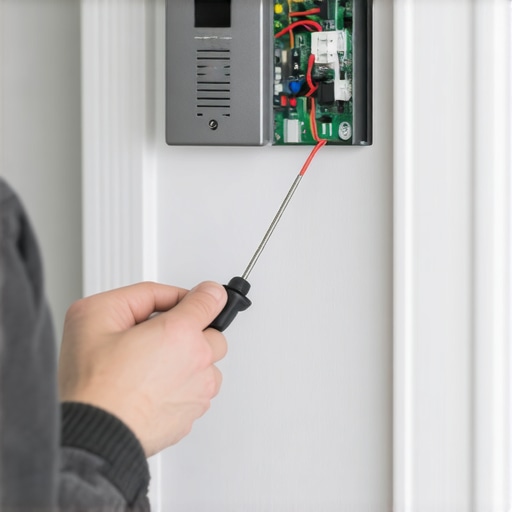
We need to talk about Cold Creep and how it affects signal integrity, especially if your intercom is tied into a mid-century system. In homes with aluminum branch wiring, the connection points at the intercom transformer expand and contract at different rates than the brass or copper terminals. This creates a high-resistance oxide layer. This resistance doesn’t just generate heat; it creates a nonlinear junction that can actually rectify RFI into audible noise. It turns your intercom into a crystal radio set that picks up every overhead service drop in the neighborhood. Then there is the skin effect. High-frequency noise travels on the outside of the conductor. If your intercom wire is cheap, unshielded Romex scraps—a common ‘handyman special’ sin—it lacks the ‘drain wire’ necessary to shunt that noise to ground.
[IMAGE_PLACEHOLDER_1]
The Fix: Code-Compliant Repair vs. The Handyman Special
Don’t reach for the electrical tape. The first thing I do is pull out my Wiggy (solenoid voltmeter) and my Tick Tracer to map the proximity of high-voltage lines. If I find that your intercom lines are zip-tied to a 240v line for your workshop electrical setup, we’re re-routing. Period. Military discount wiring projects I’ve overseen often prioritize redundant shielding for this very reason. We install ferrite beads—choke coils—at the base of the master station to filter out high-frequency garbage. If the noise is coming from the utility side, I’ll look at the overhead service drop. Sometimes a loose neutral at the weatherhead causes current to return through the grounding system of the house, saturating the intercom with ‘dirty power.’ Replacing the transformer and ensuring it’s not shared with emergency exit lighting or other inductive loads is mandatory. We also look for rebate assistance programs that might cover a full ‘heavy-up’ of your panel, especially if you’re adding modern loads like an EV station.
The Trap: Insurance and Safety
Ignoring that intercom ‘static’ is a rookie mistake. If the noise is caused by an arc flash risk within the walls—where a wire is slowly carbonizing its insulation—you’re sitting on a time bomb. I’ve performed arc flash studies in industrial settings that started because of ‘comms interference.’ In a residential setting, if your intercom is buzzing, it could be the sound of a loose lug in the panel vibrating under load. If you don’t address it and a fire starts, insurance claim electrical work becomes a nightmare of ‘denied due to lack of maintenance.’ Get same day service appointments if the noise is accompanied by a fishy smell or warm cover plates. This isn’t a hobby; it’s life safety.
Close: Sleep at Night Knowing It’s Torqued
In the end, silencing a noisy intercom is about respecting the laws of electromagnetism. It’s about ensuring every terminal is torqued to spec and every signal wire is isolated from the ‘noise’ of modern life. Whether we’re talking about a level 2 EV charger installation or just a basic workshop electrical setup, the principle is the same: clean paths, solid grounds, and no shortcuts. When I walk away from a job, I want to know that the only thing coming through that speaker is a clear voice—not the sound of your house trying to tell you it’s about to catch fire.