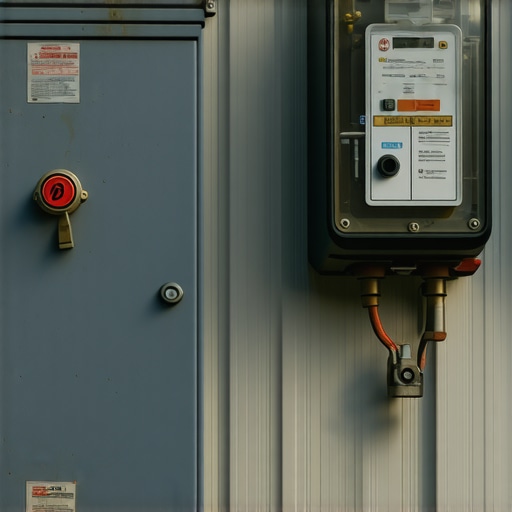
The Ghost in the Meter Socket: A History of Hazards
Your house has a secret, and if it was built before the latest National Electrical Code revisions, that secret could be a slow-burning disaster. I’ve spent thirty-five years pulling back the covers on service entrances that looked fine from the curb but were cooking themselves from the inside out. When we talk about the service entrance, we’re talking about the gateway where the utility’s raw power hits your home’s infrastructure. For decades, that power came in unfused and unchecked until it reached the main breaker inside your basement or garage. That’s a long stretch of ‘Widow Maker’ wire that can’t be shut off in an emergency. My old journeyman used to smack my hand if I even thought about stripping a wire with a pocketknife. ‘You nick the copper, you create a hot spot,’ he’d scream. He was right. That tiny nick becomes a point of resistance, resistance generates heat, and heat eventually leads to fire damage wiring restoration calls. If you don’t have an emergency disconnect switch outside, you’re betting your life on a system that has no ‘kill switch’ for the first twenty feet of its journey.
“All service conductors shall have a disconnecting means… The service disconnecting means shall be installed at a readily accessible location either outside of a building or structure or inside nearest the point of entrance of the service conductors.” – NEC Section 230.70(A)(1)
The Physics of the Unprotected Run
Think about the mechanics of a fault. When a tree limb brings down a service mast or a rogue squirrel short-circuits the weatherhead, the utility transformer keeps pumping thousands of amps into those wires. If you have an internal main breaker but no external disconnect, those conductors remain live and lethal all the way into your home. This is where electrical wiring services become forensic in nature. We see the ‘Cold Creep’ in action—where the constant expansion and contraction of copper or aluminum under load eventually loosens the lugs in the meter can. Once that lug is loose, you get arcing. Arcing creates an ionized gas path that can reach temperatures hotter than the surface of the sun. Without an external disconnect, a firefighter can’t just flip a switch to safe the building; they have to wait for the utility company to arrive and cut the ‘drip loop’ at the pole. That wait time is the difference between a small electrical fire and a total loss.
The 2020 NEC Revolution: Safety Over Convenience
The 2020 update to the National Electrical Code introduced Section 230.85, which mandates an emergency disconnect for one- and two-family dwellings. This isn’t just bureaucratic red tape; it’s a response to decades of forensic data. We’ve seen too many instances where AFCI breaker services couldn’t stop a fire because the fault happened before the breakers. By installing a heavy-duty, outdoor-rated disconnect, you provide a manual override for the entire system. This is especially critical if you are considering harmonic filter services or modern demand response systems that integrate with your smart meter. These systems are sensitive. A surge or a neutral failure at the service entrance can fry thousands of dollars in electronics before an internal breaker even thinks about tripping. I’ve used my Wiggy to test lines where the neutral was totally gone, and the only thing keeping the lights on was the grounding rod—a terrifying scenario that an emergency disconnect could have mitigated instantly.
“Failure of electrical distribution systems is a leading cause of residential fires, often originating in the service equipment or branch circuit wiring.” – CPSC Safety Publication 518
Component Zooming: The Anatomy of a Service Failure
Let’s look at the actual metal. Inside a standard meter socket, you have jaw-like terminals that grip the meter blades. Over time, salt air (if you’re near the coast) or simple humidity causes oxidation layers to form. This oxidation acts as an insulator. When the current tries to jump that insulator, it creates micro-arcs. These micro-arcs carbonize the surrounding plastic or ‘Monkey Shit’ (the duct seal we use to plug the mast). If you’ve ever smelled a faint ‘fishy’ odor near your electrical panel, that’s the smell of burning phenolic resin. By the time your tick tracer starts beeping, the damage is often structural. Integrating an external disconnect allows for remote electrical diagnostics and safer maintenance. We can isolate the entire house to perform a warehouse lighting retrofit or a complex attic fan installation without ever pulling the meter and risking an arc flash in our faces.
Aesthetics vs. Survival: Lighting and External Loads
I get homeowners all the time who care more about their deck lighting services or tree mounted lights than they do about the service entrance. They want the pretty glow, but they ignore the rotting service mast. Every time you add a load—whether it’s high-draw outdoor lighting or a new HVAC system—you increase the ‘demand’ on those service lugs. If those connections aren’t torqued to spec, they will fail. An emergency disconnect provides a safe point of termination for these additional circuits. It also means that if a storm knocks down your fancy tree lights and creates a dead short, you have a way to kill the power to the exterior of the property immediately without fumbling through a dark basement with a flashlight, hoping the main breaker isn’t jammed.
The Final Torque: Why Professional Installation is Non-Negotiable
Electricity isn’t a hobby, and it certainly isn’t a DIY project for a Saturday afternoon. When we perform electrical wiring services, we aren’t just twisting wires; we are managing heat and resistance. We use dikes to trim conductors precisely so there are no stray strands to catch an arc. We apply the right tension to the lugs because under-tightening causes heat, and over-tightening crushes the wire and creates a weak point. An emergency disconnect is your last line of defense. It’s the difference between a controlled shutdown and a catastrophic event. When you sleep at night, you want to know that if the worst happens, the ‘kill switch’ is right there on the outside of the house, ready and waiting. Don’t wait for a forensic inspector like me to tell you what went wrong after the smoke clears. Get the disconnect installed, get your system torqued, and keep the ‘widow makers’ at bay.