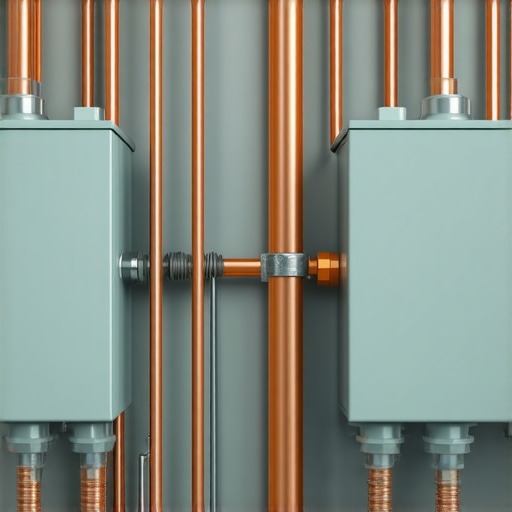
The Tingle of a Ghost: A Forensic Look at Grounding vs. Bonding
I was standing in a crawlspace in a 1940s bungalow near the coast, my knees deep in damp silt and salt air blowing through the vents. My Wiggy (solenoid tester) was vibrating in my hand before I even touched the copper pipe. The homeowner had complained of a ‘static shock’ every time she did the dishes. Most ‘electricians’ would have just swapped the outlet and called it a day. My old journeyman, a man who had more scars from 480v than he had hobbies, used to smack my hand if I reached for a wire before testing for stray voltage. ‘You nick the copper, you create a hot spot,’ he’d scream. He was right, but in this case, the problem wasn’t a nick; it was a total failure to understand the difference between grounding and bonding. Most people use the terms interchangeably. In my 35 years of forensic inspections, that confusion is exactly what causes house fires and electrocutions. Electricity doesn’t want to go to the earth; it wants to go back to its source—the transformer on the pole. If you don’t give it a clear, low-impedance path, it’ll find one through your kitchen faucet or your body.
The Autopsy of a Failure: Why Bonding Saves Lives
Let’s zoom into the physics of a fault. When a hot wire—let’s say a 12-gauge Romex line—comes loose inside a metal junction box because of vibration or a ‘handyman’ who didn’t torque the terminals, that box becomes energized. If that box is Bonded, the current has a low-resistance path back to the panel. This sudden rush of current (the fault) is what trips the breaker. If the box isn’t bonded, it just sits there, waiting for you to touch it while you’re grounded. Bonding is the act of joining all non-current-carrying metal parts together. Grounding is the connection of the whole system to the earth.
“The bonding of all metal piping systems… shall be connected to the service equipment enclosure.” – NEC 250.104
This distinction is why home rewiring services are often a life-or-death necessity in older homes where the ‘ground’ was just a wire tied to a rusty water pipe that has since been replaced with PEX. I’ve seen load center upgrades where the installer forgot the main bonding jumper—that little green screw or strap in the panel. Without it, your ‘grounded’ system is effectively floating, and during a surge or a fault, your electronics aren’t the only things at risk; your entire home’s metal infrastructure becomes a live circuit.
Component Zooming: The Physics of Resistance and Corrosion
In coastal environments, the air is the enemy. Salt ions bridge the gap between phases in your meter can, leading to a slow-motion catastrophe. I’ve opened service enclosures where the grounding electrode conductor (the Home Run to the earth) was so corroded by galvanic reaction that it crumbled like a dry biscuit. This is where power quality analysis becomes critical. When you have high resistance in your grounding path, you get ‘noise’ on your lines, flickering LEDs, and fried motherboard in your smart fridge. We call it Cold Creep in aluminum wiring, but in grounding systems, it’s often simple oxidation. If your service entrance upgrade doesn’t include Monkey Shit (duct seal) to keep that moist salt air out of the conduit, you’re just building a time bomb. We look for the ‘glowing lug’—a result of thermal expansion and contraction over decades that loosens the connection until it arcs. An arcing ground is a silent killer because it often doesn’t pull enough amps to trip a standard breaker, but it generates enough heat to ignite the dust in your walls.
The Load Center: Your Safety Hub
When we perform load center upgrades, we aren’t just swapping a box; we are re-establishing the system’s reference to earth. This is particularly vital for high-draw items like a sauna heater installation or three phase power services in a workshop. A sauna heater is a literal metal box you sit in while soaking wet; if the bonding isn’t perfect, you’re the resistor in a very short circuit. We use Dikes to trim the excess wire clean, ensuring no stray strands can cause a bridge. For modern homes, ethernet wiring services and sensitive electronics require a ‘clean’ ground, which is impossible if your home’s bonding is compromised by storm damage electrical repair that was done as a ‘patch job.’
“Grounding is the intentional connection of a circuit conductor to the earth.” – NFPA 70E
If your grounding rods are driven into dry, sandy soil without a power quality analysis to check soil resistivity, your ground is as useless as a screen door on a submarine. We often find that a ceiling fan installation is the first place people notice a problem—a slight hum or a shock when pulling the chain. That’s the house telling you the bonding path is broken.
Why Priority Service Membership is Your Forensic Shield
I don’t believe in ‘maintenance’ as a sales pitch; I believe in forensics. A priority service membership means a Master Electrician—someone who knows the smell of ozone before a fire starts—is checking your torque settings and your grounding path every year. We use a Tick Tracer to find those buried junction boxes behind the backsplash that flippers love to hide. We ensure your system is bonded to the gas lines, the water lines, and the structural steel. This isn’t just about code; it’s about the laws of thermodynamics. Electricity is lazy; it will always take the path of least resistance. My job is to make sure that path is a copper wire and not your chest cavity. Whether you are adding a ceiling fan installation or need a complete home rewiring service, the physics remains the same. Torque your lugs, bond your metals, and respect the earth. It’s the only way to sleep at night without wondering if that fishy smell in the hallway is an arcing wire or just dinner. Electricity isn’t a hobby; it’s a force of nature that we’ve trapped in your walls. Don’t let it out.