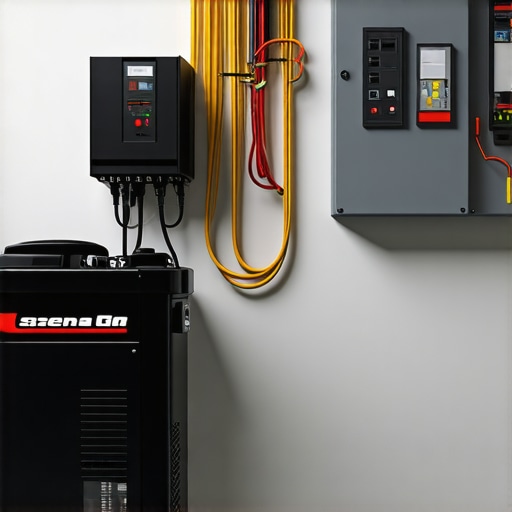
The Sound of a Looming Disaster
You’re in the shop, the table saw is screaming through a piece of kiln-dried white oak, and suddenly the lights dim. You hear it—that distinct, metallic tink of a thermal-magnetic breaker tripping. It’s not just an annoyance; it’s a warning. In my 35 years of chasing electrons, I’ve seen that sound ignored until it turns into the smell of scorched phenolic resin and ozone. Most guys think choosing between a temporary extension and a permanent sub-panel is a matter of budget. It’s not. It’s a matter of physics, and physics doesn’t negotiate.
My old journeyman, a guy who had fewer fingers than he started with but more sense than a code book, used to smack my hand with a pair of dikes if I stripped a wire with a pocket knife. ‘You nick the copper, you create a hot spot,’ he’d scream. ‘That nick is a bottleneck where the electrons get crowded, and when they get crowded, they get hot.’ He was right. Whether you are looking at ADU electrical services or a simple garage wiring project, every connection is a potential point of failure. If you’re building a shop, you’re at a crossroads: do you do it right with a permanent transformer installation, or do you limp along with a camper electrical panel and hope the insulation doesn’t melt?
The Load Calculation: Why Your Math Is Probably Wrong
Before we talk about transformer installation or trenching, we have to talk about electrical load calculations. Most DIYers look at a tool and see ’15 Amps’ and think they’re fine on a 20-amp circuit. They forget about Inrush Current. When a motor starts, it can pull five to six times its rated running amperage for a split second. If you’re running a temporary setup, that surge causes a voltage drop. In the world of the Master Electrician, voltage drop isn’t just a number; it’s heat.
“The service-entrance conductors for a one-family dwelling shall have an ampacity of not less than 100 amperes, 3-wire.” – National Electrical Code (NEC) Section 230.79(C)
If you’re running a shop out of an ADU, a 100-amp service is your bare minimum. If you try to feed that shop via a temporary ‘spider box’ or a temporary feeder, you’re inviting Cold Creep. This is especially true in mid-century homes where cloth insulated wiring replacement hasn’t happened yet. In those old systems, the insulation is so brittle it’ll crumble if you look at it wrong. Adding the high-draw load of a garage wiring project to that ancient infrastructure is like trying to push a fire hose’s worth of water through a cocktail straw. The pressure—in this case, the voltage—has to go somewhere, and it usually ends up as heat inside your walls.
The Physics of Permanent Infrastructure
When we move to a permanent solution, we’re talking about a dedicated home run back to the main service. For a detached shop, this often requires a transformer installation if the distance is over 100 feet. Why? Because resistance is a function of distance. You might start with 240V at the house, but by the time it reaches your shop through a temporary cord, it’s 210V. Your tools run slower, they get hotter, and their lifespans are cut in half. A permanent installation uses larger conductors, often aluminum or copper with specific Circular Mil ratings, to ensure that the voltage stays stable under load.
If you live in a coastal area, the enemy is even more insidious. Salt air isn’t just for the beach; it’s a conductive mist that facilitates Galvanic Reaction. I’ve opened camper electrical panels in Florida that looked like a science experiment—green crust everywhere. This is where you need surge protector installation and stainless steel enclosures. If you don’t use monkey shit (duct seal) to plug the conduits, that salt air will travel right up the pipe and rot your breakers from the inside out. I’ve seen storm damage electrical repair jobs where the entire panel had to be replaced because the owner didn’t seal the service entrance.
The EV Factor: The Shop’s Newest Power Hog
Modern shops aren’t just for woodworking anymore; they’re fueling stations. Adding an EV charger to a shop’s electrical load is a massive shift. A Level 2 charger can pull 48 Amps continuously for hours. This isn’t a ‘duty cycle’ load like a table saw; it’s a ‘continuous load.’ According to the NEC, you have to size the circuit at 125% of the load. That’s 60 Amps just for the car. If you’re trying to do this with temporary garage wiring services, you’re playing with fire—literally. You need a surge protector installation to protect the sensitive electronics in the vehicle, and you absolutely need a load calculation to see if your transformer installation can even handle the extra 11.5kW.
“Aluminum wire connections can overheat and cause a fire without tripping the circuit breaker.” – CPSC Safety Alert 516
The Verdict: Professionalism vs. Purgatory
Temporary power is for job sites that will be gone in a month. Permanent power is for craftsmen. When I do a rough-in, I’m looking for more than just code compliance; I’m looking for ‘the click.’ That’s the sound of a lug being torqued to the specific inch-pounds required by the manufacturer. If you’re just ‘tightening it until it’s snug,’ you’re creating a high-resistance point. Over time, the thermal expansion and contraction (the Cold Creep) will loosen that screw. One day, you’ll be using your tick tracer to find out why the power is out, and you’ll find a melted puddle of plastic where your breaker used to be. Whether it’s network cable installation for your shop’s computer or a heavy-duty ADU electrical service, don’t cut corners. Use the Wiggy, test your grounds, and for the love of all that is holy, torque your lugs. You’ll sleep better knowing your shop isn’t a 2,000-square-foot tinderbox.