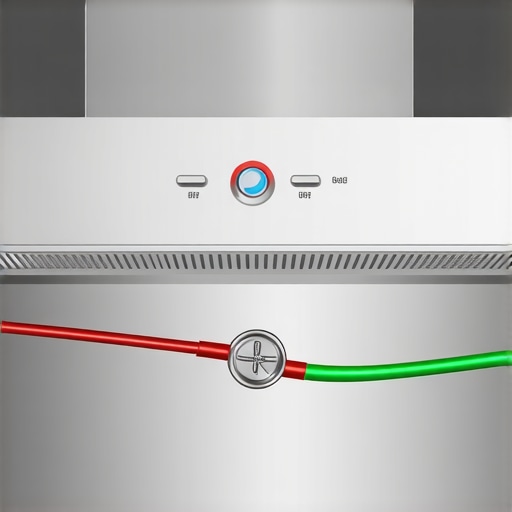
The Tingle You Shouldn’t Feel: A Forensic Autopsy of a Kitchen Disaster
You’re standing in your kitchen, reaching for the handle of that shiny, 900-CFM high-velocity range hood, and you feel it—a sharp, localized ‘bite’ on your fingertips. Most people shrug it off as static electricity from the carpet, but to a forensic electrical inspector, that tingle is the sound of a ticking time bomb. It’s the physical manifestation of stray current looking for a path back to the transformer, and currently, that path is your central nervous system. I’ve spent 35 years tracking down these ‘ghost’ voltages, and let me tell you, when you’re dealing with kitchen range hood wiring, there is no room for the ‘close enough’ mentality of a weekend warrior.
My old journeyman used to smack my hand with a pair of dikes if he saw me stripping a wire with a pocketknife. ‘You nick that copper, you create a hot spot,’ he’d scream. ‘You’re building a heater, not a circuit!’ He was a miserable old goat, but he was right. Every nick, every loose wire nut, and every omitted ground is a point of failure waiting for the right moment of thermal expansion to start a structure fire. In the context of a high-velocity hood, where vibration is a constant factor, these failures are accelerated through a process called mechanical fatigue. If you aren’t torquing your lugs to spec, you’re just providing the fuel.
“The structural metal of an appliance shall be bonded to the equipment grounding conductor to provide a low-impedance path for fault current.” – NEC Article 250.110
The Forensic Breakdown: Why High-Velocity Hoods Fail
When we talk about high-velocity hoods, we aren’t talking about that plastic fan your grandmother had above her stove. We are talking about heavy-duty centrifugal blowers that move massive volumes of air. These units generate significant vibration and can create a static charge through the friction of air moving across the metal ductwork—a phenomenon known as the triboelectric effect. If the unit isn’t properly grounded, that charge builds up on the stainless steel chassis. This is particularly dangerous in homes built between 1900 and 1950, where we often see ungrounded workshop electrical setup logic applied to a modern kitchen. In these older systems, I often find ‘bootleg grounds’—a shortcut where the neutral is jumped to the ground screw. This is a lethal violation. Under a load, or if the neutral breaks upstream, the entire frame of your range hood becomes ‘hot.’
The physics of the failure usually starts at the rough-in. If the installer didn’t use a proper cable connector where the Romex enters the hood’s junction box, the vibration of the motor will eventually cause the sharp metal edge of the knockout to saw through the insulation. I’ve seen it a hundred times. First comes the arcing—the smell of ozone and ‘fishy’ burning plastic. Then comes the carbon tracking. Once a path of carbon is established across the insulation, the electricity doesn’t need the wire anymore. It will jump the gap, heating the metal to thousands of degrees in milliseconds. This is why a 24 hour emergency electrician gets called at 3 AM for ‘smoke in the kitchen’ when the stove isn’t even on.
Component Zooming: The Metallurgy of Grounding
Let’s talk about the grounding screw itself. It’s usually a green, 10-32 machine screw. But in a high-moisture, high-heat kitchen environment, simple contact isn’t enough. You have to account for oxidation layers. When oxygen hits copper, it creates copper oxide, which is an insulator. If your ground connection isn’t tight, or if you’ve used cheap, non-plated steel screws, the resistance at that connection point increases. According to Ohm’s Law (V=IR), as resistance (R) increases at a constant current (I), the voltage drop across that connection increases, which generates heat. Over time, this heat causes ‘Cold Creep’ in the conductors—the metal expands and contracts, further loosening the screw. This is why annual maintenance contracts are vital; an electrician should be checking these torques with a calibrated driver, not just ‘eyeballing’ it.
If you’re dealing with an insurance claim electrical work scenario after a kitchen fire, the first thing the forensic team looks at is the integrity of the equipment grounding conductor (EGC). We look for ‘beading’ on the copper—a sign of arcing. We look for the ‘Widow Maker’—that’s what we call a circuit where the ground has been bypassed. In a high-velocity hood, the grounding wire must be bonded not just to the junction box, but to the actual frame of the blower motor. This ensures that if the motor windings fail and short to the motor case, the breaker trips instantly rather than turning the range hood into a giant electrified heating element.
“Aluminum wire connections can overheat and cause a fire without tripping the circuit breaker.” – CPSC Safety Alert 516
The Fix: A Code-Compliant Grounding Protocol
To properly ground a high-velocity hood, you need to treat it like a home run back to the panel. First, verify your source. Use a Wiggy (a solenoid voltmeter) to test for a true ground, not just a Tick Tracer which can give you a false positive from phantom voltage. If you are in an older home with two-wire ungrounded systems, you cannot simply ‘attach a wire’ to a cold water pipe and call it a day. You need to pull a new 12/2 or 14/2 Romex with a dedicated ground. For those in rural areas or workshop electrical setup environments, ensure your portable generator hookup is properly bonded at the transfer switch, or your hood ground might fail during a power outage.
During the trim-out, make sure you are using Monkey Shit (duct seal) to plug the conduit or cable entry point. Why? Because the temperature differential between the hot stove air and the cool wall cavity creates condensation. This moisture can travel down the cable into the junction box, leading to galvanic corrosion at the grounding point. If you aren’t sure about your existing wiring, a virtual consultation wiring session or remote electrical diagnostics can help identify red flags like old cloth insulation or Zinsco panels before you even buy the hood. If you’re upgrading to a smart meter installation, take that opportunity to have the electrician inspect your main bonding jumper; the entire system’s safety hinges on that one connection.
Conclusion: Sleep Better with a Torqued Connection
Electricity is a lazy, dangerous beast. It’s always looking for the easiest way back to the earth, and it doesn’t care if that way is through your range hood’s chassis or your body. When you’re installing a high-velocity unit, you aren’t just hooking up a fan; you’re managing an inductive load in a high-vibration environment. Don’t rely on the ‘Handyman Special.’ Ensure your GFCI outlet installation nearby isn’t being used as a shortcut for the hood’s ground. Take the time to scrape the paint off the chassis where the ground lug sits to ensure metal-to-metal contact. It’s the difference between a kitchen that functions and a kitchen that ends up in a forensic report. When you’re finished, test it with a load. If the lights don’t flicker and the chassis stays at zero volts, you can finally sleep at night knowing your house isn’t the next 3 AM emergency call.