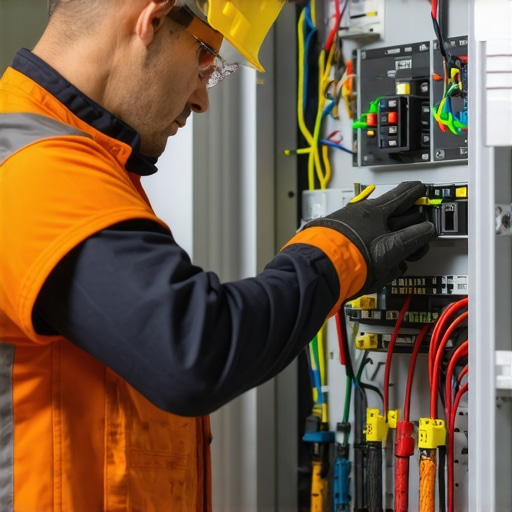
The Ghost in the Copper: Why Your Mid-Century Home is a Waiting Inferno
I walked into a ‘fully renovated’ 1974 ranch last Tuesday where the flipper had buried three live junction boxes behind a custom stone backsplash in the kitchen. I didn’t find them with a stud finder; I found them with my tick tracer because the stone was literally radiating a 60Hz hum. The homeowner wanted a simple surge protector installation, but what they had was a localized tectonic fault line of electricity waiting to liquefy their Romex. This is the reality of residential power: it is a silent, invisible force that is constantly trying to find its way back to the earth, and if your wiring isn’t up to snuff, it’ll use your framing studs as a bridge.
“Aluminum wire connections can overheat and cause a fire without tripping the circuit breaker.” – CPSC Safety Alert 516
The Anatomy of Failure: Aluminum and the Cold Creep
If your home was built between the mid-60s and the late 70s, you aren’t just living in a house; you’re living inside a giant experiment in metallurgy. During that era, copper prices spiked, and the industry pivoted to aluminum. The problem? Physics doesn’t care about your budget. Aluminum has a much higher coefficient of thermal expansion than copper. Every time you turn on a space heater or a vacuum, that wire heats up and expands. When you turn it off, it contracts. This is called ‘Cold Creep.’ Over a decade, that movement backs the wire right out from under the terminal screw on your outlets. Now you have a loose connection. A loose connection creates resistance. Resistance creates heat. Before you know it, the plastic insulation is charred, the outlet smells like rotten fish, and you’re one spark away from a 911 call. This is why AFCI breaker services are non-negotiable for these structures. An Arc-Fault Circuit Interrupter doesn’t just wait for a short circuit; it listens for the specific signature of an arc—that tiny, lightning-bolt jump of electricity across a loose gap—and kills the power before the wood ignites.
The Deadliest Sin: Improper Swimming Pool Bonding
When we talk about swimming pool bonding or spa grounding services, most folks nod along thinking it’s just more ‘code red tape.’ It isn’t. Grounding is about giving electricity a path to the earth so it doesn’t use your body. Bonding is about making sure everything around the water—the ladder, the light niche, the pump, even the rebar in the concrete—is at the same electrical potential. I’ve seen ‘handymen’ install a 50-amp spa pack using a Widow Maker (a non-contact voltage tester that gives false negatives) and forget the equipotential bonding grid. If there’s a voltage gradient between the water and the wet concrete deck, you become the conductor. You don’t even need a direct short; a stray milliamp from a neighbor’s failing transformer can travel through the soil and find your pool. This is why a bonded and insured Master Electrician is the only person who should ever touch a pool deck. We use heavy-gauge solid copper wire and specialized lugs to ensure every metal component is tied together in a continuous loop. We don’t just ‘eye’ it; we verify it with a Low-Resistance Ohmmeter to ensure we have less than the NEC-mandated resistance.
“The equipotential bonding required by this section shall be installed to reduce voltage gradients in the pool area.” – NEC 680.26
The Hidden Danger of Holiday Cheer and Signage
People love their Christmas light services and sign lighting installation, but they rarely think about the load. You start daisy-chaining LED strands or high-output commercial signs on a circuit that was already screaming for mercy because of a refrigerator or an AC unit, and you’re asking for a meltdown. When we do a home backup generator install, we perform a total load calculation. We don’t just look at the labels; we look at the ‘in-rush current’—that massive spike of amperage required to start a motor. If your panel is a Federal Pacific or a Zinsco, those breakers are notorious for ‘jamming.’ The bus bar could be melting into a puddle of slag, and the breaker will stay in the ‘ON’ position like a soldier who’s been dead for three days but is still standing. We call those ‘fire starters’ in the trade. A real pro will pull that panel, check for pitting on the bus, and likely recommend a heavy-up to a 200-amp service with a demand response system to manage your peaks.
Why Bonded and Insured Actually Matters to Your Mortgage
When you hire a ‘trunk slammer’—the guy with a ladder and a bucket of mixed screws—you are the insurer. If he nicks a wire with his dikes while doing a rough-in and that wire eventually arcs and burns the house down six months later, your insurance company is going to look for the permit. No permit? No licensed pro? No check. Being bonded and insured means I have a financial guarantee and a professional liability policy that stands between your life savings and a catastrophic loss. Whether we are doing a complex troubleshooting job on a flickering home run or setting up a priority service membership for a commercial client, we follow the torque specs on every lug. I’ve seen ‘pro’ installers tighten a main lug ‘until it felt right.’ That’s how you strip the threads or leave it just loose enough for vibration to start an oxidation layer. We use calibrated torque wrenches because 120 inch-pounds is a science, not a feeling. We use ‘Monkey Shit’ (duct seal) to prevent moisture from traveling down the service mast into your panel. We do the ‘trim-out’ with surgical precision because a single stray strand of copper outside a terminal is a potential ground fault. When the job is done, you don’t just have lights; you have a system that is engineered to fail safely. That is the only way I sleep at night, and it’s the only way you should too.