
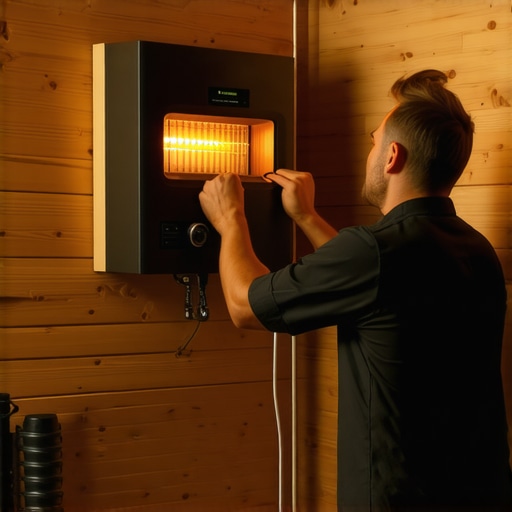
The Scent of a Slow-Motion Disaster
Most folks step into a sauna to relax, but when I walk into one, I’m not smelling cedar; I’m sniffing for the sharp, ozone tang of melting PVC insulation. Over thirty-five years of forensic inspections has taught me that a sauna is essentially a controlled house fire that’s just waiting for a lapse in judgment to lose its ‘controlled’ status. By 2026, as we pack more load into our aging electrical grids, the margin for error is shrinking to zero. You want a spa? Fine. But if you don’t respect the physics of 40-amp continuous loads, you’re just building a pyre.
My old journeyman, a man who had ‘high voltage’ etched into his soul, used to smack my hand with a pair of dikes if he saw me rushing a terminal connection. ‘You nick that copper, kid, and you’ve just built a bottleneck for every electron in that circuit,’ he’d growl. ‘That bottleneck gets hot. Heat causes expansion. Expansion loosens the screw. Now you’ve got an arc, and an arc doesn’t care about your weekend plans.’ He was right. Every fire I’ve investigated in the last decade started because someone thought ‘good enough’ was acceptable for a high-wattage appliance.
Step 1: The Load Calculation and Main Disconnect Audit
Before you even look at a heater catalog, we need to talk about your service. Adding a 6kW or 9kW heater isn’t like plugging in a toaster. You are adding a massive, sustained load that can run for hours. Most mid-century homes are already gasping for air on 100-amp services, especially with the modern rush for EV charger installation. If your panel is a Federal Pacific or a Zinsco, you’re already living in a tinderbox. Those breakers are notorious for ‘jamming’—they won’t trip even when the wire is glowing cherry red.
“The total connected load shall not exceed the rating of the service entrance equipment.” – NFPA 70: National Electrical Code
We start with main disconnect services. You need to ensure your main lugs can handle the draw without ‘cold creep’—that’s when the metal expands and contracts until the connection loses its bite. If your lights flicker when the AC kicks on, you have no business adding a sauna until you’ve performed a heavy-up.
Step 2: The Home Run and Harmonic Mitigation
A sauna requires a dedicated circuit—what we call a ‘home run’—from the panel directly to the heater. No junctions, no ‘tapping’ off the electric gate opener or the shed wiring install. I’ve seen handymen try to save fifty bucks on copper by splicing into an existing circuit. That’s how you burn down a garage. We use 8-gauge or 6-gauge copper, and I don’t care what the DIY forums say: do not use aluminum for sauna heaters. The coefficient of thermal expansion is too high for a wet, high-heat environment.
Furthermore, modern saunas with digital controllers can introduce electrical noise. This is where harmonic filter services come into play. High-frequency harmonics can overheat the neutral wire even if the breaker stays cool. We mitigate this by ensuring the rough-in is clean and the grounding is absolute. I use a Wiggy to test for phantom voltage before I ever let a client flip that switch. If I see a needle jump where it shouldn’t, we don’t move to the trim-out phase.
Step 3: Moisture Management and Smart Integration
Water and electricity are old enemies, and in a sauna, they’re forced to live together. Every smart home wiring project involving a sauna needs to account for 100% humidity. When we do smart thermostat wiring for these units, we aren’t just looking for convenience; we are looking for failsafes. High-limit switches must be hard-wired, not just software-dependent. If your smart app glitches, the physical thermal cut-off must be there to kill the power.
I’ve seen ‘flipper specials’ where they used standard Romex inside the sauna walls. That’s a death sentence. We use THHN wire in liquid-tight flexible conduit for the final connection to the heater. The heat eventually turns standard Romex jackets into brittle crackers that crumble at a touch, exposing live copper to the steam. That’s how you get a ‘widow maker’—a metal heater housing that’s suddenly energized at 240 volts.
Step 4: Airflow and Thermal Dissipation
People focus on the heater but forget the room. A sauna is a pressure cooker. Without proper attic fan installation or a dedicated ceiling fan in the changing area to move moisture away from the electrical panel, you’re begging for corrosion. Salt-air environments make this even worse; the moisture acts as a bridge for electricity to crawl across insulators. This is why I advocate for ‘monkey shit’ (duct seal) in every conduit opening to prevent humid air from migrating into the electrical boxes.
“Aluminum wire connections can overheat and cause a fire without tripping the circuit breaker.” – CPSC Safety Alert 516
If you’re installing a heater, ensure the clearances are followed to the millimeter. I’ve performed autopsies on walls where the studs were slowly carbonized over three years because the heater was two inches too close to the wood. This is called ‘pyrophoric carbonization.’ The wood’s ignition temperature drops until one day, the wall just vanishes in a flash of flame.
Step 5: The Final Torque and Inspection
The last step is the one everyone skips: the torque wrench. You cannot ‘feel’ 35 inch-pounds of torque. You either use the tool, or you guess. And if you guess wrong on a 40-amp circuit, the resistance at the terminal will generate enough heat to melt the breaker’s bus bar. This is non-negotiable. I check every lug with a tick tracer and then a physical torque test. We also offer military discount wiring for veterans because they understand the value of a standard operating procedure.
Electricity isn’t a hobby. It’s a force of nature that we’ve tricked into running our lives. When you build a sauna, you’re inviting that force to sit in a wooden room with you. Treat it with the respect it deserves, or it will remind you why our ancestors were afraid of lightning. Sleep at night knowing your connections are torqued, your load is balanced, and your house isn’t the next entry in my forensic logbook.