
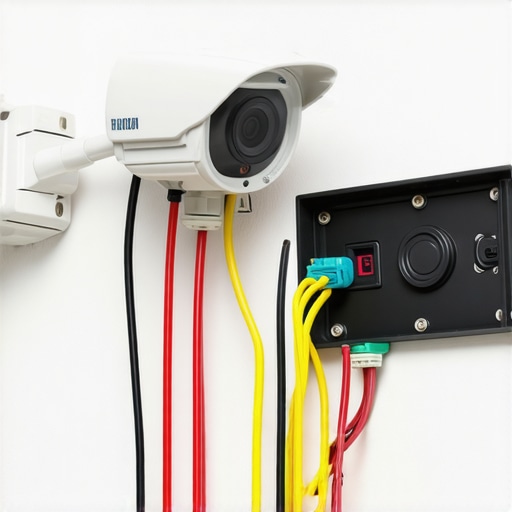
5 Security Camera Wiring Mistakes That Kill Your 2026 Feed
I can still smell the acrid stench of scorched PVC and ozone from a job site back in ’98. My old journeyman, a man who had more scars from ‘widow makers’ than a bait fisherman, grabbed my wrist before I could close a junction box. He didn’t say a word; he just pointed at a single, microscopic nick I’d made in the copper while stripping the jacket with my dikes. ‘You nick the copper, you create a hot spot,’ he finally growled. ‘In five years, that resistance builds. In ten, the house burns. Don’t be the guy who starts a fire because he was too lazy to use the right tool.’ He was right then, and that lesson is even more vital today as we integrate sensitive network cable installation with high-draw systems like a level 2 EV charger.
The Autopsy of a Dead Feed: Why Your High-Res Camera Looks Like 1994
When I walk onto a forensic inspection where a homeowner is complaining that their 4K security feed looks like a grainy VHS tape from a gas station, I don’t look at the software first. I look at the physical layer. Most 2026-era camera failures are rooted in the physical degradation of the conductor. People think digital is ‘on or off,’ but in the world of high-speed data and Power over Ethernet (PoE), physics is a cruel mistress. We are seeing a massive spike in failures due to the ‘Mid-Century Infrastructure Trap.’ In homes built between 1960 and 1980, we’re often retrofitting modern tech into spaces where heat dissipation was never considered. If your camera wiring is running parallel to old three phase power services in a commercial setting, or even just jammed next to a smart thermostat wiring run in a tight stud bay, you are inviting disaster.
“Where the conductor is subject to physical damage, it shall be protected.” – National Electrical Code (NEC) Article 300.4
1. The ‘CCA’ Death Sentence (Copper Clad Aluminum)
This is the most common sin I see. Homeowners buy a 1000-foot spool of ‘Cat6’ online for a price that’s too good to be true. It’s usually Copper Clad Aluminum (CCA). In a forensic breakdown, CCA is a nightmare for PoE. Aluminum has 1.6 times the electrical resistance of copper. When you push power over those tiny 24-gauge strands to a camera 100 feet away, that resistance generates heat. This is the ‘Cold Creep’ phenomenon in action—aluminum expands and contracts at a different rate than the brass or gold-plated contacts in your RJ45 jack. Over time, the connection loosens, oxidation layers form, and your feed starts dropping. By 2026, as cameras demand more wattage for onboard AI processing and infrared arrays, these CCA lines will literally cook themselves inside your walls.
2. Inductive Coupling: The Silent Signal Killer
You cannot treat network cable installation like you’re pulling Romex for a recessed lighting installation. I’ve seen ‘pros’ zip-tie Cat6 directly to the main service lateral. When your level 2 EV charger kicks on to pull 48 amps, it creates a massive electromagnetic field (EMF). Through inductive coupling, that 60Hz hum bleeds directly into your data lines. This isn’t just ‘noise’; it’s a packet-loss factory. It’s the same reason why we use vibration analysis services for industrial motors—harmonics matter. If your data line is screaming because it’s too close to a high-voltage line, the camera’s processor has to work overtime to error-correct, leading to thermal throttling and eventual hardware failure. Always maintain a minimum 12-inch separation from high-voltage lines unless you’re using shielded (STP) cable that is properly drained and grounded.
3. The ‘Drip Loop’ Delusion and Capillary Action
I’ve replaced more outdoor cameras due to ‘wicking’ than actual lightning strikes. When you perform a landscape lighting install or mount a turret camera, you must understand capillary action. If your cable enters the building from above the camera without a drip loop, rain follows the jacket right into the housing. But the forensic reality is worse: if the jacket is nicked anywhere along the run, water can travel inside the cable jacket, using the internal fibers as a wick. I’ve seen NVRs (Network Video Recorders) destroyed because water traveled 50 feet through the inside of a Cat5e jacket and dripped directly onto the motherboard. It’s why I always keep a tub of ‘monkey shit’ (duct seal) in my truck. If you don’t seal the penetration, you’re just building a pipe for water to find your electronics.
4. Bend Radius and the Physics of Attenuation
High-speed data isn’t a liquid; it’s a high-frequency wave. When you kink a data cable or pull it too hard around a sharp corner during the rough-in, you are physically changing the ‘Twist Rate’ of the internal pairs. These twists are precisely engineered to cancel out crosstalk. When you flatten that cable, you create an impedance mismatch. Think of it like a kink in a garden hose, but instead of water stopping, the signal reflects back toward the source. This is where augmented reality troubleshooting comes in handy—I can now use sensors to see exactly where the signal ‘bottleneck’ is occurring. If you wouldn’t bend a copper pipe into a 90-degree angle without a fitting, don’t do it to your data lines.
“Aluminum wire connections can overheat and cause a fire without tripping the circuit breaker.” – CPSC Safety Alert 516
5. Ignoring the NEC Code Updates on PoE Bundling
The 2023 and 2026 NEC code updates have gotten very specific about ‘Current-Carrying Power Over Ethernet.’ When you bundle 24 data cables together in a tight, Velcro-wrapped home run, the cables in the center of that bundle can’t dissipate heat. If those cameras are high-draw units—perhaps they have built-in heaters for snowy climates or powerful emergency exit lighting integration—the internal temperature of the bundle can exceed the insulation rating (usually 60°C or 75°C). We call this ‘Thermal Runaway.’ Once the insulation softens, the conductors can short. Always check your load calculations. If you’re running high-wattage PoE, you need to increase your cable gauge or reduce the bundle size. Don’t let your security system become the ignition source for a structure fire.
At the end of the day, electricity is lazy and it’s looking for any excuse to take a shortcut. Whether you’re doing a simple smart thermostat wiring job or a massive three phase power services upgrade, the rules of physics don’t change. You torque your lugs, you respect your bend radii, and you never, ever trust a cheap conductor. When I finish a trim-out, I want to know that I can sleep at night because every connection is torqued to spec and every run is isolated. Your 2026 security feed depends on the sweat you put into the copper today. Don’t be the reason a forensic inspector like me has to come through your house with a tick tracer and a camera, looking for the remains of a ‘flipper special’ wiring job.