
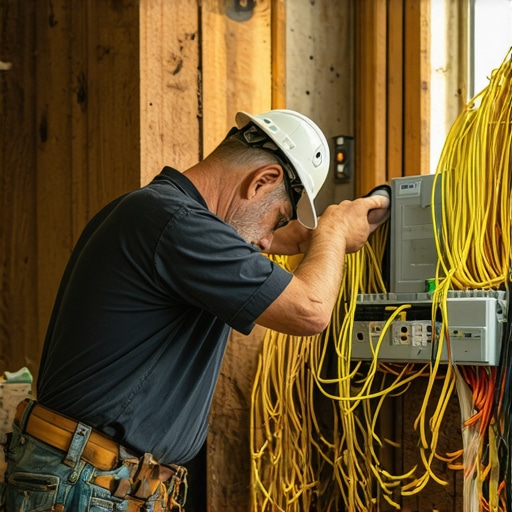
The Invisible Decay: Why 2026 is the Deadline for Your Home’s Cloth Wiring
I’ve spent thirty-five years pulling dead rats out of service lucks and sniffing out shorts that would make a fire marshal sweat, but nothing raises the hair on my neck like the sight of a gray, frayed cloth-covered wire snaking through a joist. If your home was built between the late 1920s and the 1960s, you aren’t living in a ‘charming vintage’ space; you’re living inside a slow-motion fuse. By 2026, the youngest cloth-insulated conductors in existence will be nearly sixty years old. That is double their intended lifespan. We aren’t just talking about old tech anymore; we are talking about the physics of material failure and the inevitable breakdown of organic polymers. My old journeyman used to smack my hand if I stripped a wire with a knife. ‘You nick the copper, you create a hot spot,’ he’d scream. He was right. Every nick, every bend, and every decade of heat cycles is a step closer to a structural fire.
“Aluminum wire connections can overheat and cause a fire without tripping the circuit breaker.” – CPSC Safety Alert 516
Danger 1: Vulcanized Rubber Desiccation and the ‘Snake Skin’ Effect
When we talk about cloth-insulated wiring, we aren’t actually worried about the cloth itself—the cloth was just a mechanical jacket. The real insulation was a layer of vulcanized rubber surrounding the copper. Over fifty years, the sulfur in that rubber undergoes a chemical shift. It becomes brittle, a process called desiccation. In my forensic inspections, I’ve seen wires that look perfectly fine until you touch them. The moment you move that wire to install track lighting services or up lighting services, the rubber cracks and falls off in flakes like snake skin. This leaves the bare copper exposed inside your walls. If that wire is near a grounded pipe or another phase, you get an arc. Not a trip-the-breaker-immediately kind of arc, but a ‘sizzle-and-glow’ arc that generates thousands of degrees of heat. This is why vibration analysis services are becoming a thing even in high-end residential—detecting the subtle hum of loose, vibrating conductors before they ignite the dust in your wall cavities.
Danger 2: The Moisture Trap and Galvanic Corrosion in Modern Environments
Cloth insulation is hygroscopic—it drinks moisture from the air. In a restaurant kitchen electrical environment or even a humid basement, that old cotton braid acts like a wick. It draws moisture toward the copper, leading to oxidation. When you mix this with the lack of an equipment grounding conductor—which most cloth-style systems lack—you have a recipe for disaster. I’ve walked into kitchens where the equipotential grid was nonexistent because the original installers relied on the lead sheath or the building’s structural steel, both of which have since corroded. If you’re planning a 200 amp panel install to handle modern appliances, you cannot simply terminate these old ‘home runs’ into a new bus bar. The surge in potential current will find the weakest link in that moisture-laden braid. I always tell my apprentices: don’t trust a tick tracer on cloth; use a Wiggy. You need to see if that wire can actually hold a load under pressure, not just detect a ghost voltage.
“The grounding electrode conductor shall be copper, aluminum, or copper-clad aluminum.” – NFPA 70, National Electrical Code (NEC)
Danger 3: Thermal Expansion and the ‘High-Draw’ Death Spiral
Modern life is heavy on the grid. We have EV chargers, demand response systems, and high-intensity architectural lighting. Old cloth wiring was designed for a world with three light bulbs and a radio. When you pull 15 amps through a 14-gauge cloth wire for six hours straight, the copper expands. When it cools, it contracts. This ‘cold creep’ eventually loosens the screws at the receptacle. In a modern rough-in, we use Romex and torque-rated lugs, but in 1945, they just looped the wire and hoped for the best. Once that connection is loose, the resistance goes up. As resistance goes up, heat goes up. Eventually, the monkey shit (duct seal) used to plug the conduit melts, and the insulation turns into a carbon path. You won’t even know it’s happening until you see the ‘widow maker’—a glowing orange spot behind your outlet. If you’re upgrading to fiber optic cabling or smart home tech, do yourself a favor and do a full trim-out of the old copper first.
The Forensic Solution: Why a Grounding Electrode Install Isn’t Enough
Most handymen will tell you to just ‘GFI the first outlet’ and call it a day. That’s a band-aid on a gunshot wound. A GFI won’t stop a fire caused by arcing wires inside the wall. The only real solution for 2026 is a complete rewire and a proper grounding electrode install. We need to get rid of the cloth, pull new THHN or Romex, and ensure the 200 amp panel install is balanced. Stop thinking about electricity as a utility and start thinking about it as a controlled fire. If the containment system (the insulation) is sixty years old, it’s not a matter of if it fails, but when. Get your dikes ready, because it’s time to cut out the past before it burns down your future. Sleep at night knowing your lugs are torqued to spec and your insulation isn’t made of combustible rags.