
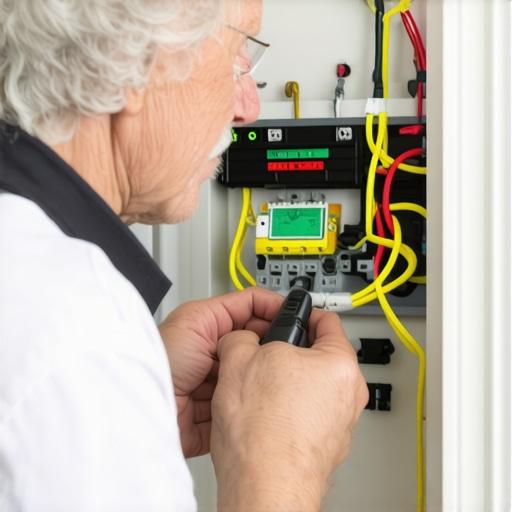
The Hum of a Ticking Clock: Why Your 1970s Panel is a Liability
I’ve spent 35 years in the belly of the beast, crawling through blown-in insulation that sticks to your sweat like fiberglass fur and staring at service panels that look more like a bird’s nest than an electrical distribution system. You don’t do this job for that long without developing a sixth sense for disaster. It’s a specific vibration in the soles of your boots when a main lug is loose, or that sharp, metallic tang of ozone that hits the back of your throat before you even pull the dead front off the panel. For seniors living in homes built during the construction booms of the late 20th century, that hum isn’t just background noise—it’s the sound of a system reaching its thermal expiration date. As we move into 2026, the push for electrification means your old ‘Home Run’ circuits are being pushed harder than they were ever designed for. If you’re still running 1974-era breakers to power a 2026 lifestyle, you’re not just outdated; you’re at risk.
“Aluminum wire connections can overheat and cause a fire without tripping the circuit breaker.” – CPSC Safety Alert 516
My old journeyman used to carry a heavy brass plumb bob in his pocket. One afternoon, back when I was a green apprentice, I was rushing a rough-in on a split-level ranch. I was using my pocket knife to strip the Romex jackets because I’d misplaced my dikes. He didn’t say a word; he just swung that plumb bob and caught me right across the knuckles. ‘You nick the copper, you create a hot spot,’ he growled. ‘That nick reduces the cross-sectional area of the conductor. Resistance goes up, heat goes up, and thirty years from now, that wire snaps inside the wall while some grandmother is sleeping.’ He was a mean old bastard, but he was right. Every single connection in your home is a battle against physics. When we talk about electrical wiring services for seniors, we aren’t just talking about swapping out a beige outlet for a white one. We are talking about forensic mitigation of decades of thermal expansion and contraction.
1. Grounding Electrode Install & Bonding Jumper Services
Most people think the third prong on their plug is just a suggestion. It’s not. It’s your life insurance policy. In older homes, we often find that the grounding electrode install was done to the standards of 1965—usually a single galvanized pipe driven three feet into the dirt. Over time, soil chemistry eats that steel. You’re left with a ‘floating ground,’ which is effectively no ground at all. If a surge hits or a hot wire shorts to a metal appliance frame, the electricity has nowhere to go but through the person touching the toaster. We use a Wiggy (solenoid voltmeter) to test these circuits, and the results in older homes are often terrifying. By 2026, many seniors are opting for a complete grounding overhaul. This involves driving two eight-foot copper-clad steel rods into the earth, spaced at least six feet apart, to ensure a low-impedance path to ground. But the rods are only half the battle. You need bonding jumper services to ensure your water pipes and gas lines are at the same potential as your electrical system. Without a proper bonding jumper, your shower head could literally become energized during a fault. It’s about creating a ‘Short Circuit Current Path’ that forces the breaker to trip instantly, rather than letting the metal pipes in your walls sit there and cook at 120 volts.
2. Attic Fan Installation & Bathroom Exhaust Fan Upgrades
Heat is the silent killer of copper insulation. In the peak of summer, an unventilated attic can reach 150 degrees Fahrenheit. This isn’t just uncomfortable; it’s a chemical disaster for your wiring. The PVC jackets on older Romex cables weren’t designed for sustained volcanic temperatures. They become brittle. You touch a wire to move it, and the insulation flakes off like old scabs, leaving live copper exposed to the wood framing. A professional attic fan installation is a primary safety intervention for seniors. By pulling that stagnant, superheated air out of the structure, you drop the ambient temperature around your branch circuits, significantly extending the life of the wire. Similarly, a high-efficiency bathroom exhaust fan isn’t just about clearing steam after a shower. It’s about moisture mitigation. In older homes, moisture migrates into light fixtures and junction boxes, causing ‘tracking’—a phenomenon where electricity begins to crawl across the surface of a dusty, damp insulator. This leads to carbon tracking, which eventually turns into a full-blown structure fire. We see this constantly in ‘flip’ houses where someone buried a junction box behind a ceiling; the moisture finds it, the arc starts, and by the time you smell the smoke, the framing is already gone.
“All 15-ampere and 20-ampere branch circuits supplying outlets or devices installed in dwelling unit kitchens, family rooms, dining rooms, living rooms, parlors, libraries, dens, bedrooms, sunrooms, recreation rooms, closets, hallways, laundry areas, or similar rooms or areas shall be protected by a listed arc-fault circuit interrupter.” – NEC Section 210.12
3. Spa Grounding Services & Deck Lighting Safety
Many seniors are installing therapeutic hot tubs or upgrading their outdoor living spaces with deck lighting services for better visibility and fall prevention. Here’s the reality: water and electricity don’t just dislike each other; they are a lethal combination. When I perform spa grounding services, I’m looking for more than just a green wire. I’m looking for ‘Equipotential Bonding.’ This involves connecting all metal parts of the spa, the heater shell, and even the reinforcing steel in the concrete pad together. We create a ‘cage’ of safety so that there is no voltage difference between the water and the ground you’re stepping on. If your contractor didn’t use a bonding jumper on the metallic components of your outdoor lighting or spa, they’ve installed a ‘Widow Maker.’ For 2026, we are seeing a massive shift toward low-voltage LED deck lighting, which is inherently safer, but the transformers still require a bonded insured electrical professional to ensure the primary side of the circuit is protected by a GFCI that actually works. Most people don’t realize those test buttons on your outlets should be pressed every month. If it doesn’t ‘click’ and cut power, you’re essentially playing Russian Roulette with your morning coffee.
4. Augmented Reality Troubleshooting & Priority Service Membership
The tech has finally caught up to the trade. In 2026, we don’t just rely on a tick tracer (non-contact voltage detector) and a prayer. Augmented reality troubleshooting allows us to overlay a thermal heat map of your walls directly onto a tablet screen. We can see the ‘hot spots’ where a loose wire nut is arcing behind the drywall without having to punch holes in your plaster. It’s forensic, it’s non-invasive, and for seniors on a fixed budget, it prevents the ‘exploratory surgery’ costs of traditional electrical work. This is why a priority service membership is becoming the standard for proactive home maintenance. These memberships aren’t just a marketing gimmick; they provide for annual infrared scans of your main breaker panel. We look for ‘Cold Creep’—the physical deformation of the wire under the pressure of the lug screw. Over years of heating and cooling, the metal actually moves, creating a loose connection. A loose connection is a high-resistance connection. High resistance equals heat. Heat equals fire. We catch it with the AR goggles, torque it back to the manufacturer’s inch-pound specifications, and you go back to sleep knowing your house isn’t going to try to kill you in the middle of the night. If you’re looking for bonded insured electrical work, don’t settle for a ‘handyman’ with a pair of pliers. Demand the guys who understand the physics of the grounding electrode and the importance of a clean trim-out.