
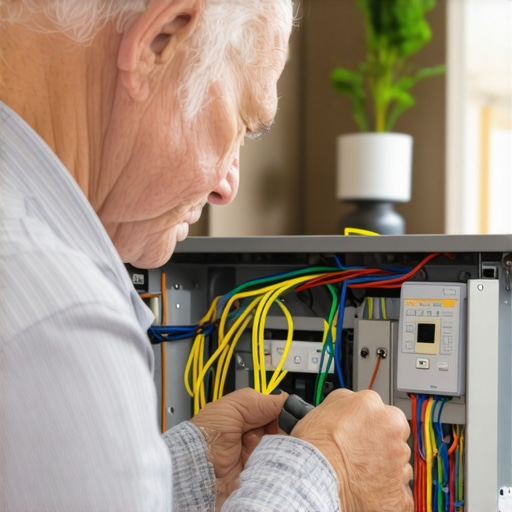
4 Senior Discount Services for Safer Home Wiring in 2026
Most homeowners look at their walls and see paint and pictures; I look at them and see a complex network of copper and aluminum thermal highways that are slowly degrading. If your home was built between 1960 and 1980, you aren’t just living in a mid-century gem; you are living on top of a ticking clock. After 35 years in this trade, I’ve learned that electricity is a lazy, opportunistic force that is constantly looking for a path to the ground, and it doesn’t care if that path is through your copper pipes or your heartbeat. My old journeyman used to smack my hand if I stripped a wire with a knife. ‘You nick the copper, you create a hot spot,’ he’d scream. He was right. That microscopic nick reduces the cross-sectional area of the conductor, increasing resistance at that specific point. Resistance creates heat. Heat creates carbon. Carbon is conductive, and before you know it, you have a sustained arc that can hit 5,000 degrees Fahrenheit without ever drawing enough current to trip a standard breaker. For seniors on a fixed income, keeping up with these invisible threats is a massive burden, which is why specialized discount services for 2026 are focusing on the critical infrastructure that keeps the lights on and the structure standing.
1. Bonding Jumper Services and Military Discount Wiring for Aging Panels
In the trade, we often find what we call a ‘Widow Maker’—a circuit that stays live even when you think it’s dead, or a metal chassis that has become energized because of a lost ground. One of the most vital safety services for 2026 is the inspection and installation of bonding jumper services. In many mid-century homes, the electrical system relies on the metallic water pipe as the primary grounding electrode. However, as soon as a plumber replaces a section of that old copper with PEX or PVC, you’ve broken the path to the earth. Without a proper bonding jumper around the water meter or the new plastic pipe, your entire house loses its safety discharge path. This is especially dangerous in the garage or basement where moisture is present. [IMAGE_PLACEHOLDER] We are seeing a massive push for military discount wiring programs that specifically target veterans living in homes with Federal Pacific or Zinsco panels. These brands are the pariahs of the forensic world. The FPE ‘Stab-Lok’ breakers are notorious for ‘jamming.’ Internally, the lubricant used in the 1970s dries into a glue-like consistency. When a short circuit occurs, the thermal element tries to trip, but the mechanical pivot is seized. The breaker stays closed, the Romex wire in your attic turns into a heating element, and the house burns down with the breaker in the ‘ON’ position.
“Aluminum wire connections can overheat and cause a fire without tripping the circuit breaker.” – CPSC Safety Alert 516
During a rough-in or a panel changeout, we use a Wiggy to test for solenoid-validated voltage, ensuring that every home run back to the panel is properly phased and torqued to the manufacturer’s inch-pound specifications. Hand-tightening with a screwdriver isn’t enough; thermal expansion and contraction, also known as ‘Cold Creep,’ will eventually loosen that connection.
2. Flood Water Electrical Safety and Silt Remediation
For seniors living in coastal or low-lying areas, 2026 has brought new standards for flood water electrical safety. If water has ever touched your outlets, they are compromised. It’s not just the moisture; it’s the silt. When floodwater recedes, it leaves behind a conductive, corrosive film of minerals and waste inside the receptacle. You might think it’s dry and safe to use a year later, but as soon as you plug in a high-draw appliance, that silt acts as a bridge between the hot and neutral terminals. We use ‘Monkey Shit’ (the industry term for duct seal) to block conduits and prevent water migration, but the real fix for seniors is elevating the home run junctions and installing weather-rated GFCI protection at a higher datum line.
“The equipment grounding conductor shall be used to ground the non-current-carrying metal parts of equipment.” – NEC Article 250
This ensures that even if the floor is damp, the path of least resistance is back to the panel, not through your shoes.
3. ADU Electrical Services and Tiny Home Wiring for Multi-Generational Living
We are seeing more seniors move into backyard units or ‘Granny Flats.’ ADU electrical services and tiny home wiring require a sophisticated understanding of load calculations. You can’t just pull a ‘tap’ off the main house and hope for the best. A modern ADU often requires an EV charger for the family car and high-speed fiber optic cabling for medical monitoring systems. When we perform these installs, we often find the main service is undersized. A 100-amp panel from 1972 was never designed to handle the continuous load of an electric vehicle. This is where power factor correction comes into play. By installing capacitor banks near large inductive loads like HVAC compressors, we can improve the efficiency of the electrical system, reducing the ‘apparent power’ draw and helping seniors save on their monthly utility bills while reducing the heat stress on their main bus bars. We use a Tick Tracer to verify that no stray voltage is leaking into the metallic siding of these smaller structures, a common issue when DIYers skip the bonding jumper services.
4. Security Camera Wiring and Fence Line Lighting
Perimeter safety is a top priority for 2026. Security camera wiring has evolved from simple coax to Power over Ethernet (PoE). For seniors, this means we can install high-definition surveillance without needing a separate power outlet at every camera location. However, fence line lighting and exterior security require careful voltage drop calculations. If the wire run is too long and the gauge is too thin, the voltage drops, the amperage spikes to compensate, and the wire insulation begins to bake. Using dikes to clean up old, frayed exterior wiring and replacing it with direct-burial UF cable or conduit-protected THWN-2 ensures that the ‘safe’ light in the backyard doesn’t become a ground fault nightmare. Whether it’s a veteran using a military discount wiring program or a retiree securing their forever home, the goal is the same: torque the lugs, bond the steel, and make sure the smoke detectors only go off when you burn the toast, not because your panel is melting behind the drywall.