
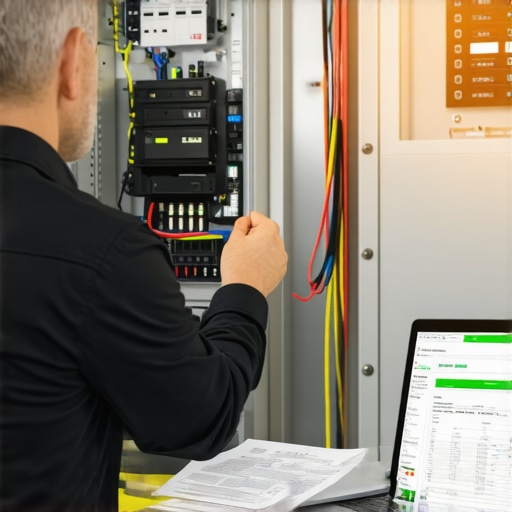
The Scent of a Failing System: Why Your 1970s Panel is a Liability
I walked into a ‘fully renovated’ kitchen last week where the flipper had installed a $5,000 quartz backsplash and high-end pendant light hanging from the ceiling. It looked like a magazine cover. But when I pulled out my circuit tracer, the signal died behind the stone. I spent three hours tracking down a buried junction box—live wires twisted with electrical tape, no wire nuts, just tucked behind the drywall like a dirty secret. That flipper didn’t just break the law; they built a fire trap. That is the reality of many homes built between 1960 and 1980. You think you’re buying a dream, but you’re actually sitting on a 100 amp service upgrade requirement that’s twenty years overdue. When I see an old Federal Pacific Electric (FPE) panel, I don’t see a circuit breaker; I see a fuse that refuses to blow. These panels are notorious for ‘jamming.’ In a standard breaker, a thermal-magnetic trip mechanism responds to heat or a short circuit. In an FPE ‘Stab-Lok’ system, the internal bridge often gets stuck. You could have a dead short in your workshop electrical setup, and that breaker will sit there, stone-cold, while the Romex in your walls turns into a heating element.
“Aluminum wire connections can overheat and cause a fire without tripping the circuit breaker.” — CPSC Safety Alert 516
The Physics of Failure: Cold Creep and Your Service Mast
If your home was built during the mid-century era, you’re likely dealing with aluminum branch circuit wiring. This isn’t just ‘old wire’; it’s a material science nightmare. Aluminum has a much higher coefficient of thermal expansion than copper. Every time you turn on a space heater or a toaster, that wire heats up and expands. Because it’s trapped under a steel screw in a terminal, it has nowhere to go. It deforms. This is called ‘cold creep.’ When the wire cools down, it shrinks, but it doesn’t return to its original shape. Now you have a microscopic gap. That gap creates resistance. Resistance creates more heat. Eventually, you get an oxide layer that acts as an insulator, and that’s when you start smelling the fishy, acrid scent of a melting outlet. Correcting these code violation corrections isn’t just about ‘fixing a plug’; it’s about mechanical integrity. We use AlumiConn connectors or COPALUM crimps to create a gas-tight seal that prevents this cycle. Most homeowners don’t realize that a simple GFCI outlet installation in a 1970s home requires more than just swapping the device; you have to ensure the upstream grounds are actually contiguous, or you’re just providing a false sense of security.
The 2026 Reality: Why You Need a 200 Amp Heavy-Up
Modern life is hungry. In the 1970s, a 100-amp panel was plenty for a fridge, a few lights, and a color TV. Today, we are asking those same bus bars to handle an EV charger, a heat pump, and a high-end workshop electrical setup. Before we even talk about financing, we have to look at the electrical load calculations. If you try to pull 120 amps through a 100-amp main breaker for a sustained period, you’re looking at thermal fatigue. The main lugs will begin to discolor, turning a dull bluish-grey. That’s a sign that the metal has been annealed—it’s lost its spring tension. Once that happens, the connection is compromised. If you’re planning on underground wiring services for a new detached garage or a camper electrical panel, you can’t just ‘tap’ into the existing system. You need a dedicated home run back to the main distribution point. This is where people get sticker shock, but the cost of a fire is significantly higher than the cost of a copper upgrade.
“The National Electrical Code requires that all 125-volt, single-phase, 15- and 20-ampere receptacles installed in crawl spaces and unfinished basements have GFCI protection.” — NEC Section 210.8(A)
How to Fund the Fix: 4 Proven Ways to Get Financing in 2026
1. **FHA Title 1 Property Improvement Loans:** These are the gold standard for structural safety. Unlike a traditional HELOC, you don’t necessarily need a mountain of equity. The government backs these because they want the housing stock to stay standing. If I provide free electrical estimates that clearly state the existing panel is a fire hazard or contains known code violations, it strengthens your case for this type of funding. 2. **Utility-Sponsored On-Bill Financing:** By 2026, many utility companies have realized that old, inefficient panels are a drag on the grid. They offer programs where the cost of a 100 amp service upgrade or the installation of energy-efficient structured wiring panels is added to your monthly bill over five to ten years. It’s low-interest and stays with the property. 3. **The Inflation Reduction Act (IRA) Extended Credits:** While many think these were temporary, the structural incentives for residential electrification have been refined. You can often claw back 30% of the cost of a panel upgrade if it’s required for a heat pump or EVSE installation. This isn’t just a deduction; it’s a direct credit. 4. **Specialized Trade Financing:** Many master electricians now partner with fintech lenders who understand ’emergency’ repairs. If your panel is arcing—what we call a ‘widow maker’—you don’t have time to wait for a bank. These lenders can approve a loan for a complete rewire or underground service replacement in minutes. I’ve seen homeowners use this to move from a dangerous Zinsco panel to a modern, surge-protected 200-amp Square D system before the week is out.
The Inspector’s Checklist: Don’t Get Burned by the ‘Handyman Special’
When you’re looking at financing, don’t just look at the bottom line. Look at the scope of work. Does it include ‘monkey shit’ (duct seal) at the service entrance to keep water out of your panel? Does the quote include a new grounding rod system? If your electrician isn’t pulling out a Wiggy or a high-end multimeter to check the impedance of your ground path, they aren’t doing a forensic job. They’re just doing a ‘trim-out’ and leaving the real problems behind. For those setting up a workshop, insist on structured wiring panels that separate your sensitive electronics from the high-draw motors of your table saws. It prevents data corruption and keeps your ‘tick tracer’ from giving false positives. Remember, electricity doesn’t have a brain; it just wants to find a path to the earth. My job is to make sure that path isn’t through your body or your bedroom wall. Whether it’s a simple pendant light hanging or a full-scale service upgrade, treat the copper with respect, or it will bite you. Once you have the financing in place, get the permit, get the inspection, and sleep soundly knowing your lugs are torqued to spec and your breakers will actually trip when they’re supposed to.