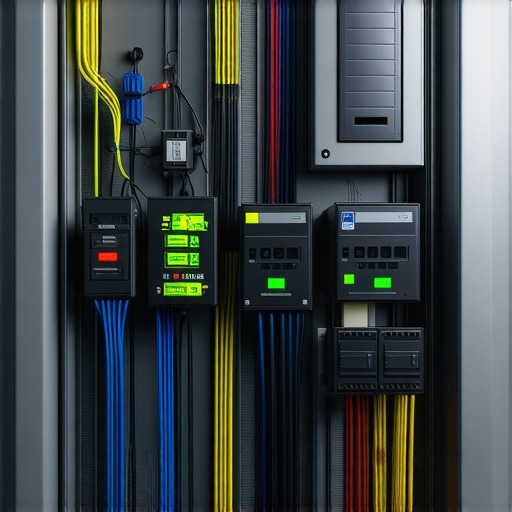
The Autopsy of a Silent Killer: Why Your Walls are Whispering Fire
That faint, sickly sweet scent of ozone? Or maybe that intermittent flicker in the bathroom vanity that you’ve been ignoring for three months? That isn’t a ‘quirk’ of an old house. It is the sound of physics trying to burn your life to the ground. As a master electrician who has spent three decades pulling charred skeletons of Romex out of stud bays, I can tell you that by the time you smell the ‘fishy’ scent of melting PVC insulation, you are already in the endgame. The traditional thermal-magnetic breaker sitting in your panel is a blunt instrument. It’s designed to trip when you plug in too many space heaters, but it’s deaf, dumb, and blind to the micro-arcs that cause over 50,000 home fires a year.
I recently walked into a ‘fully renovated’ kitchen where the flipper had buried live junction boxes behind a beautiful subway tile backsplash. They didn’t even use wire nuts on one of the legs—just twisted the copper and slapped some cheap electrical tape on it. I found them with my tracer because the homeowner complained about a ‘clicking’ sound whenever the dishwasher ran. When I finally smashed through that tile, I found a junction box that looked like a miniature blast furnace. The tape had long since carbonized, and the only thing keeping the house standing was pure luck. This is where the marriage of smart home wiring and AI fault detection changes the game. We are moving away from reactive ‘dumb’ breakers and toward predictive forensic monitoring.
The Physics of the Fail: Arcing, Resistance, and Cold Creep
To understand why AI is necessary, you have to understand Cold Creep and thermal expansion. In mid-century homes built between 1960 and 1980, aluminum wiring was the standard. Aluminum is a temperamental metal; it expands and contracts at a much higher rate than copper when current flows through it. This cyclic loading causes the wire to literally ‘creep’ out from under terminal screws. This creates a high-resistance connection. As resistance increases, heat builds. This heat creates an oxide layer, which is even more resistive. It’s a death spiral. Eventually, the air between the loose wire and the terminal ionizes, and you get an arc.
“Aluminum wire connections can overheat and cause a fire without tripping the circuit breaker.” – CPSC Safety Alert 516
A standard circuit breaker replacement won’t necessarily stop this if you’re replacing like-for-like. A 20-amp breaker will happily let a 5-amp arc jump across a loose neutral all night long because 5 amps isn’t enough to trip the thermal element. This is where AI fault detection, integrated into modern subpanel installation, steps in. These systems don’t just look at the volume of current; they look at the signature of the wave.
How AI Decodes the Electrical Sine Wave
Electricity isn’t just a flat stream of water. It has a signature. A vacuum cleaner has a specific harmonic profile. A LED dimmer has another. An arcing wire has a chaotic, high-frequency ‘noise’ that is distinct from anything else. AI-driven monitors, often installed during a service entrance upgrade, sample the electrical current tens of thousands of times per second. They use machine learning algorithms to distinguish between the ‘good’ arcs—like the brushes in a power drill—and the ‘bad’ arcs occurring inside your walls. When the system detects the signature of carbonizing insulation, it pings your phone or trips the circuit before the temperature reaches the point of auto-ignition.
The Hidden Dangers of Modern Loads: Saunas and Holiday Lights
We are asking more of our 1970s-era electrical systems than ever before. I’ve seen homeowners insist on a sauna heater installation in a basement fed by a rusted-out Zinsco panel. You’re pulling 40 to 60 amps of continuous load through bus bars that are already pitted from decades of moisture. That’s a recipe for a structural fire. The same goes for the ‘Griswold’ effect during the winter. My holiday emergency calls usually involve overloaded outdoor receptacles where the homeowner has daisy-chained sixteen strands of incandescent lights into a single 15-amp circuit. AI monitoring can identify these over-current patterns before you even blow a fuse, identifying ‘hot spots’ in the smart home wiring architecture that a human eye would never catch during a standard rough-in.
Harmonics and the Silent Strain on Your Home
Many homeowners don’t realize that their electronics are ‘dirtying’ the power in their homes. Switching power supplies in computers and TVs create non-linear loads. This leads to harmonic distortion. If you’ve ever noticed your bathroom exhaust fan running hot or making a strange humming noise, you might be dealing with harmonic issues. Professional harmonic filter services can clean this up, but AI detection is the first line of defense in identifying that these distortions are actually shortening the life of your appliances and stressing your neutral wires.
“Arc-fault circuit interrupters (AFCIs) are necessary to provide protection against fire-start hazards that standard overcurrent devices cannot detect.” – NFPA 70, National Electrical Code
Insurance Claims and Forensic Proof
If the worst happens, having a log of your home’s electrical health is invaluable. Insurance claim electrical work is a nightmare of finger-pointing. The adjuster wants to say it was ‘poor maintenance.’ With AI-integrated panels, you have a digital paper trail showing that the system was monitored and that the failure was a sudden component malfunction rather than negligence. When I perform a service entrance upgrade, I tell my clients that they aren’t just paying for a new meter can and a grounding rod; they are paying for a forensic record of their home’s safety.
The Master Electrician’s Verdict
Electricity is a lazy, invisible beast. It is always looking for the shortest path to ground, and it doesn’t care if that path is through your dry-rotted 1940s insulation or your finger. Using a ‘tick tracer’ to see if a wire is live is the bare minimum. Truly protecting a home in the 21st century requires the kind of ‘Component Zooming’ that only AI can provide. Whether you are looking at a subpanel installation for a new workshop or just trying to survive the season with Christmas light services, stop relying on 40-year-old technology to protect your family. Get the AI monitoring, torque your lugs to spec, and for heaven’s sake, stop burying junction boxes behind your drywall. If I have to break out my ‘dikes’ and ‘wiggy’ to find a fire you started with a ‘handyman special,’ it’s already too late.