The Sensory Warning: A House Trying to Shake Its Teeth Loose
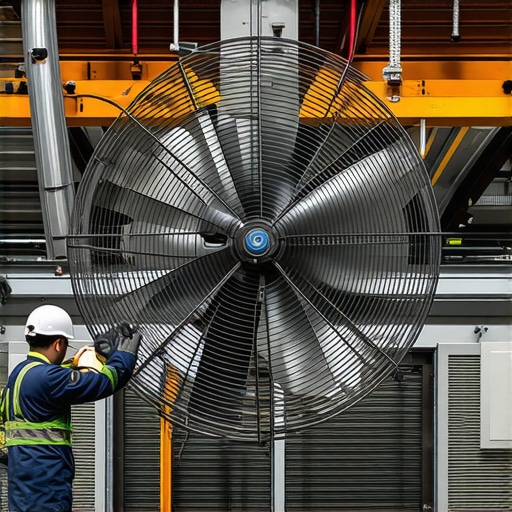
You don’t just hear a massive industrial fan that’s out of balance; you feel it in your marrow. It starts as a low-frequency thrum, a rhythmic thump-thump-thump that bypasses the ears and goes straight to your chest. In this particular case, a client called us out because their workshop’s 84-inch industrial fan was vibrating the ceiling so violently that dust was raining down from the rafters like gray snow. This wasn’t just an annoyance; it was a structural liability and a fire hazard disguised as a mechanical failure.
When an industrial-grade motor starts swinging mass that isn’t centered, it’s no longer a fan. It’s a 15-pound wrecking ball moving in a localized orbit. Most people think they can just ignore it or maybe tighten a screw. They’re wrong. I’ve seen the aftermath where a mounting bracket finally gave up the ghost, and the fan became a horizontal guillotine. If you’re smelling ozone or the distinct, acrid scent of scorched insulation, that vibration has already moved from a mechanical problem to an electrical emergency.
The Old Timer’s Lesson: The Shrapnel in the Drywall
My journeyman back in the late 80s used to have a unique way of teaching us about centrifugal force and rotational mass. He kept a piece of a fan blade, about six inches long, framed in the back of his truck. He’d point to it and tell the story of a warehouse in Chicago where a high-speed fan sheared off its hub. ‘The blade didn’t just fall,’ he’d say, ‘it embedded itself four inches into a structural beam.’ He taught me that if you ever see a fan wobble more than a quarter-inch at the tip, you don’t adjust it—you kill the power immediately. He was right. Every vibration is a microscopic hammer blow to your electrical connections and your building’s skeleton.
The Forensic Breakdown: Why Fans Lose Their Center
When we perform remote electrical diagnostics or on-site inspections, we’re looking for more than just a bent blade. We are looking at the physics of Moment of Inertia and Centrifugal Load. Industrial fans, much like a bathroom exhaust fan or a heavy-duty attic fan installation, rely on precise weight distribution. If one blade accumulates more dust than another, or if the factory balance weights have shifted, the entire system begins to fight itself.
Resistance isn’t just a term for electrical circuits; it’s a mechanical reality. An unbalanced fan creates parasitic drag. This causes the motor to draw more current (amperage) to maintain its RPMs. This extra heat radiates into the motor leads. If you’re running on an older system that hasn’t seen a 100 amp service upgrade or lacks main disconnect services within reach, you’re looking at a localized meltdown. We often find that vibration leads to ‘Cold Creep’—a phenomenon where the thermal expansion and mechanical shaking cause copper or aluminum conductors to literally crawl out of their lugs, increasing resistance and creating a high-heat ‘hot spot.’
“Where vibration is present, conductors shall be protected from physical damage and connections shall be made with pressure-type connectors or other approved means to prevent loosening.” – NFPA 70: National Electrical Code (NEC) Article 430.245
Component Zooming: The Physics of Thermal Expansion and Mechanical Fatigue
Let’s talk about the mounting hardware. When we’re pendant light hanging or mounting heavy fans, the integrity of the junction box is paramount. In this industrial case, the vibration was so severe that it was actually elongating the holes in the steel mounting plate. This is Cyclic Loading. Every rotation (let’s say 200 RPM) is a stress cycle. Over 24 hours, that’s 288,000 stress cycles. In a week, you’ve exceeded the fatigue limit of cheap Grade 2 bolts.
From an electrical standpoint, this vibration is a nightmare for your home run. The constant shaking transfers back through the Romex or conduit. If the installer didn’t use a proper strain relief or ‘Monkey Shit’ (duct seal) to dampen the entry point, the wire insulation will eventually chafe against the metal edges. Once that insulation is breached, you have a dead short. We used a Tick Tracer to find a secondary fault where the vibration had actually backed out a wire nut three rooms away. It’s a chain reaction of failure.
The Fix: More Than Just a Balancing Kit
Our process for stabilizing this monster involved more than just sticking lead weights on a blade. We started by isolating the main disconnect services to ensure the site was dead. You don’t work on a rotating mass without a physical lockout/tagout. We then used a laser tachometer to find the exact blade that was lagging in its arc.
1. **Structural Reinforcement:** We replaced the standard mounting with a vibration-dampening gasket system. This prevents the harmonic resonance from traveling into the joists.
2. **Electrical Hardening:** We pulled the old, frayed leads and replaced them with high-flex stranded wire. Solid core wire has no place in a high-vibration environment; it’s too brittle. We also applied dielectric grease to the terminals to prevent oxidation.
3. **Precision Balancing:** Using a weight-offset method, we brought the blade variance down to within 0.2 grams. This is the same level of precision you’d want for a portable generator hookup or a turbine—anywhere where rotation equals reliability.
“Aluminum wire connections can overheat and cause a fire without tripping the circuit breaker, especially under mechanical stress.” – CPSC Safety Alert 516
Beyond the Fan: Integrating Safety Systems
While we were up in the lifts, we performed a full site survey. If your building is old enough to have vibrating fans, it’s old enough to have hidden infrastructure issues. We checked the pathway lighting install for ground faults and evaluated the Christmas light services panel to ensure the client wasn’t overloading the same phase as the industrial motor. Balancing the electrical load is just as important as balancing the fan blades. If you have all your heavy induction motors on Phase A and nothing on Phase B, you’re creating a neutral imbalance that can burn out your electronics.
We even provided free electrical estimates for a full 100 amp service upgrade, as the current panel was a 1970s relic with signs of bus bar pitting. You don’t want to run modern industrial equipment on a panel that was designed before the microwave oven was a household staple.
Conclusion: Sleep at Night Knowing It’s Torqued
Electricity isn’t a hobby, and industrial mechanical systems aren’t toys. When we finished, the fan was so silent you could hear the air moving—not the building groaning. We checked every connection with a Wiggy to ensure voltage drop was negligible and that every lug was torqued to the specific inch-pounds required by the manufacturer. If your fan is shaking, don’t wait for the ‘shrapnel in the wall’ moment. Get a professional who knows the difference between a loose screw and a structural time bomb. It’s the difference between a cool breeze and a catastrophic fire.