The Invisible Decay: Why Your 1970s Electrical System is a Ticking Clock
I remember my first week as an apprentice, standing in a basement that smelled like scorched dust and old laundry. My journeyman, a man who had more scars than a lumberjack and a permanent scowl, handed me his Wiggy. ‘Don’t trust those digital toys,’ he grunted, pointing his dikes at a Federal Pacific panel. ‘A digital meter will show you ghost voltage from a phantom circuit, but a Wiggy—that solenoid tester tells you if the circuit has the actual muscle to kill you.’ He made me strip back a piece of Romex from a 1970s home run that looked perfectly fine. As I peeled the jacket, a fine white powder drifted out. ‘That’s oxidation, kid. That wire is dying from the inside out because nobody bothered to check the terminations for twenty years.’ He was right then, and thirty-five years later, the physics haven’t changed. Electricity is a lazy, violent force that is constantly trying to return to the earth, and the only thing stopping it from burning your house down is a system of copper, aluminum, and plastic that is likely vibrating itself to death right now.
When we talk about the hidden costs of ignoring your annual electrical maintenance, we aren’t talking about a few dollars on a utility bill. We are talking about the thermal runaway occurring in your walls. In mid-century homes, specifically those built between 1960 and 1980, we deal with the legacy of aluminum wiring and the infamous ‘Stab-Lok’ breakers. Most homeowners see a breaker as a safety device; I see an unmaintained 40-year-old breaker as a jammed door. If a fault occurs—perhaps during a lighting installation services project or while you’re powering up a massive home theater wiring setup—that breaker needs to trip in milliseconds. But inside those old FPE or Zinsco panels, the lubricants have dried into a sticky resin, and the bus bars are often pitted with galvanic corrosion. When the surge hits, the breaker jams. The wire becomes a heating element. This is why infrared thermography scans are no longer optional for serious homeowners; they are the only way to see the heat signatures of a failing connection before the plastic reaches its flashpoint.
“Aluminum wire connections can overheat and cause a fire without tripping the circuit breaker.” — CPSC Safety Alert 516
The Physics of ‘Cold Creep’ and Why Your Outlets are Humming
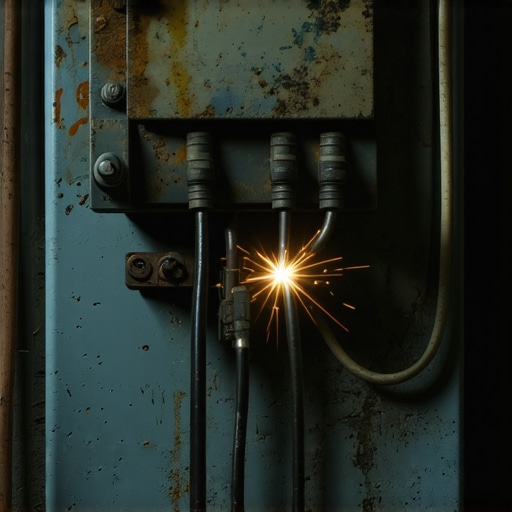
Let’s talk about Cold Creep. This is a term we use in forensic inspections to describe the mechanical failure of aluminum conductors. Aluminum has a much higher coefficient of thermal expansion than the steel or brass screws found in your typical 1970s-era outlet. Every time you turn on your kitchen range hood wiring or a heavy appliance, the wire heats up and expands. Because the screw won’t move, the aluminum is compressed—it literally ‘creeps’ out of the terminal. When you turn the appliance off, the wire cools and contracts. Over thousands of cycles, a microscopic gap forms. That gap is a playground for arcing. Arcing isn’t just a spark; it’s a plasma event that reaches temperatures hotter than the surface of the sun. It carbonizes the surrounding insulation, turning it into a conductor. By the time you notice a ‘fishy’ smell or flickering lights during holiday light installation, the fire has already started its rough-in phase inside your junction boxes.
In a restaurant kitchen electrical environment, this process is accelerated by a factor of ten. You have high-amperage equipment, steam, and grease-laden air that acts as a surfactant, pulling contaminants into the service entrance upgrade components. I’ve performed forensic ‘autopsies’ on commercial panels where the main lug was so badly oxidized that the voltage drop was causing the motors in the walk-in freezers to burn out prematurely. The owner thought he had a ‘refrigeration problem.’ He actually had a maintenance problem. If he’d had a weekend electrician services check-up, a simple torque-check and a dab of Monkey Shit (duct seal) or antioxidant paste would have saved him $15,000 in equipment replacement.
The Modern Load Crisis: Microgrids and High-Definition Demands
We are currently living in an era where we are asking 50-year-old infrastructure to handle 21st-century loads. When you start talking about microgrid integration or installing high-speed EV chargers, you are pushing your service entrance upgrade to its absolute physical limit. Most old homes have 100-amp services. A modern lifestyle, complete with a home theater wiring suite and smart appliances, can easily peak at 80 or 90 amps. This leaves zero headroom. When the system is at 90% capacity, the heat generation in the panel is exponential, not linear. This is where infrared thermography scans become your best friend. We can see a ‘hot’ breaker from across the room before it ever reaches the point of no return. Ignoring this leads to the ‘Widow Maker’—a term we use for those live, ungrounded faults that sit waiting for someone to touch a metal faceplate.
“All mechanical connections shall be tightened to the specified torque values… Failure to maintain proper torque results in increased resistance and catastrophic thermal failure.” — NEC 110.14(D)
The cost of a lifetime workmanship guarantee is far lower than the cost of a forensic fire investigation. During a trim-out, I often find bootleg grounds—where a lazy ‘handyman’ connected the neutral to the ground screw because the old house didn’t have a ground wire. It makes a cheap tick tracer light up green, but it’s a death trap. It puts current on the non-current-carrying metal parts of your appliances. During an annual inspection, we catch these ‘flipper specials’ before they can do harm. We check the rough-in integrity, ensure your lighting installation services aren’t overloading a shared neutral, and verify that your grounding electrode system hasn’t rotted away in the soil. Don’t wait for the smell of ozone to call for weekend electrician services. Electricity doesn’t give warnings; it gives consequences. Ensure your home is torqued, balanced, and scanned. It’s the difference between a quiet night and a 3:00 AM visit from the fire department.