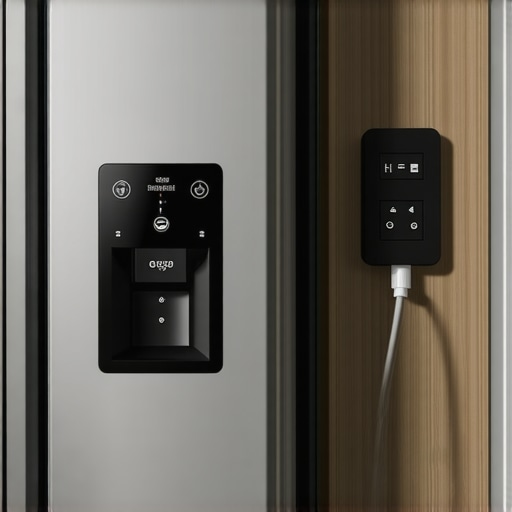
The Acrid Scent of a Four-Thousand-Dollar Error
You smell it before you see it. That sharp, metallic tang of ozone and vaporized silicon that signals the death of a modern appliance. I have spent 35 years in this trade, and nothing irritates me more than seeing a homeowner invest five grand into a refrigerator that has more computing power than the Apollo 11 lunar module, only to plug it into a 20-year-old outlet with zero protection. You wouldn’t run your laptop through a rusted extension cord during a lightning storm, yet people do the equivalent with their smart fridges every single day. My journeyman used to smack my hand if I stripped a wire with a knife. ‘You nick the copper, you create a hot spot,’ he’d scream. He was right. He taught me that electricity isn’t just about making things turn on; it’s about managing heat and resistance at a microscopic level. Today, those ‘hot spots’ are happening inside the micro-gates of your fridge’s control board, and the culprit is often the very power grid you trust to keep your milk cold.
The Forensic Breakdown: Why Your Smart Fridge is a Target
A smart fridge is not just a compressor and a lightbulb anymore. It is a complex ecosystem of low voltage lighting, smart thermostat wiring, and integrated circuit boards that control everything from ice thickness to your grocery list. These components operate on low-voltage DC power, which is incredibly sensitive to fluctuations in the AC line. When we talk about surges, most people think of a lightning strike hitting a transformer. While that happens, the more insidious threat is the ‘internal surge.’ Every time your fridge’s heavy-duty compressor kicks on, or your HVAC system starts up, it creates a transient voltage spike. These spikes are like tiny hammers hitting a glass pane. Eventually, the glass—your fridge’s semiconductor layer—shatters.
“Aluminum wire connections can overheat and cause a fire without tripping the circuit breaker.” – CPSC Safety Alert 516
While that quote focuses on aluminum, the principle of connection integrity applies to every 200 amp panel install I perform. If the path to ground isn’t perfect, that surge has nowhere to go but into your appliances. In a smart fridge, the Metal Oxide Varistor (MOV) is the first line of defense, but these components are sacrificial. They can only take so many hits before they degrade and fail, often in a state of thermal runaway that can scorch the housing of the control module.
The Physics of the Transient: Component Zooming
To understand why you need a dedicated surge protector, we have to look at the physics of a nanosecond transient. In a standard 120V 60Hz cycle, the voltage peaks at about 170V. A surge can jump to 600V or 1000V in less than a microsecond. This causes Dielectric Breakdown. Inside the chips of your smart fridge, the insulation layers are measured in micrometers. A high-voltage spike creates an arc—essentially a miniature bolt of lightning—that jumps across these layers, welding them together. This is why your screen might stay on, but the fridge stops cooling, or the ice maker starts acting possessed. It’s not a software bug; it’s physical damage to the silicon.
When I’m doing insurance claim electrical work, I often have to tell families that their ‘appliance failure’ was actually a preventable electrical event. Insurance companies are getting tighter with their payouts, often demanding proof of bonded insured electrical work and proper protection before they cut a check for a totaled kitchen. This is why I always recommend a two-tiered approach: a whole-house surge protector at the panel and a dedicated, high-clamping-force protector at the fridge itself.
The Backup Power Paradox
Many homeowners think they are safe because they have a home backup generator install. However, generators can be ‘dirty’ power sources. When a generator takes over the load during a power outage, the initial frequency and voltage can swing wildly before stabilizing. Without a dedicated surge protector, your smart fridge is the first thing to feel that turbulence. The same applies to an RV hookup installation; shore power is notoriously unstable. If you are feeding a high-end appliance from anything other than a clean, utility-grade source, you are playing Russian roulette with your circuit boards.
Installation and the Trade Reality
When I go in for a rough-in or a trim-out, I’m looking for more than just tight screws. I’m looking at the data closet organization and how it interacts with the main power. Noise on the line from a poorly shielded data cable can actually interfere with smart appliance sensors. I use my Wiggy to check for phantom voltage and my Tick Tracer to ensure I’m not about to get a 120V surprise from a ‘neutral’ that’s actually carrying a load. If I find a ‘Widow Maker’—a hot wire that’s been mislabeled—I know the rest of the house is likely a mess. [IMAGE_PLACEHOLDER]
For a smart fridge, you want a surge protector with a low ‘Clamping Voltage’ (the voltage at which it starts diverting the surge to ground) and a high Joule rating. Don’t buy the $10 strip from the grocery store. You need a device specifically rated for high-draw appliances that can handle the arc flash studies equivalent of a kitchen environment. If you see me using Monkey Shit (duct seal) around the exterior penetrations of your pathway lighting install, it’s because I’m obsessed with keeping moisture out of the system. Moisture leads to corrosion, corrosion leads to resistance, and resistance leads to voltage drops that fry smart boards.
Final Verdict: Don’t Be the Forensic Subject
At the end of the day, electricity is a lazy beast; it will always take the path of least resistance. If you don’t provide a safe path to ground via a dedicated surge protector, your smart fridge’s motherboard becomes the path. I’ve pulled enough dikes out of my tool belt to cut away charred Romex to know that prevention is a hell of a lot cheaper than a forensic inspection after a fire. Get your 200 amp panel install checked, ensure your grounding rods are actually in the dirt and not just snapped off six inches down, and for the love of your wallet, put a protector on that fridge.