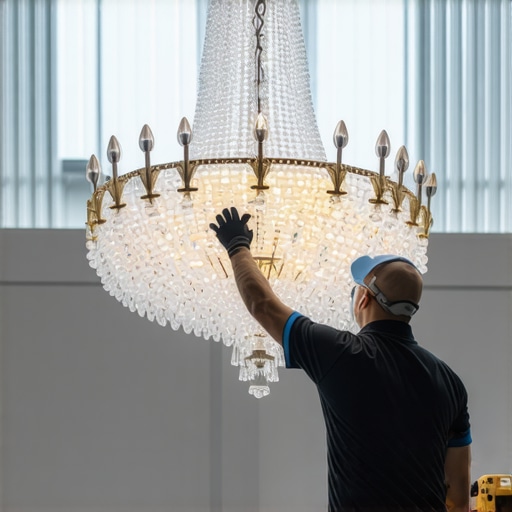
The Sound of Impending Disaster
The first thing you notice in a foyer with a poorly hung fixture isn’t the sparkle of the crystal; it’s the slight, rhythmic vibration of the ceiling drywall when the HVAC kicks on. That’s the sound of a hundred-pound chandelier held up by nothing but hope and two #8-32 screws. I’ve spent 35 years in the trade, and I’ve seen foyer ceilings that look like they’ve been through a war zone because a DIYer thought a standard plastic round box could defy gravity. When you’re dealing with a fixture that weighs as much as a medium-sized dog, you aren’t just doing electrical work; you’re performing structural engineering. If you get it wrong, you aren’t just looking at a broken light; you’re looking at a lethal projectile.
The Old Timer’s Lesson: The Nick That Kills
My journeyman used to smack my hand if I stripped a wire with a knife or even if I was too aggressive with my dikes. ‘You nick that copper, you create a hot spot,’ he’d scream. He was right. In these old 1920s foyers with high ceilings, the heat rises and pools at the peak. If you’ve got a nicked conductor buried in a crowded box, that heat can’t dissipate. Over time, the copper crystallizes and becomes brittle. One day, you go to change a bulb, you wiggle the fixture, and the wire snaps like a dry twig, arcing across the canopy. I’ve seen it happen. That’s why every rough-in needs to be pristine. You don’t just ‘stuff’ wires into a box; you dress them with respect.
“Boxes used at ceiling outlets that are used for the support of a luminaire shall be listed for the purpose and shall be required to support a luminaire weighing a minimum of 23 kg (50 lb).” – National Electrical Code (NEC) 314.27(C)
The Forensic Breakdown: The Mechanics of Failure
When a hundred-pound chandelier fails, it’s usually at the mounting point. Most standard residential boxes are rated for 50 pounds. When you double that load, you enter the zone of mechanical creep. The threads in the zinc-plated crossbar begin to deform. This is where Component Zooming becomes critical. Think about the physics: a hundred pounds of static weight is one thing, but if that foyer has a draft, the fixture can oscillate. This creates dynamic loading. The shear stress on the mounting screws increases exponentially. Eventually, the metal reaches its yield point. If you used a Tick Tracer and found power but the light is out, I’d bet my pension that the heat from a loose neutral has already melted the wire nuts inside that overstressed box.
The Infrastructure Context: The Old Home Trap
In homes built between 1900 and 1950, you aren’t just fighting gravity; you’re fighting the decay of the insulation itself. The old rubber-and-cloth insulation on the wires becomes so brittle that if you breathe on it wrong, it flakes off, leaving bare copper exposed. This is why a home automation setup in an old foyer is a nightmare if you don’t do a full office lighting upgrade style assessment first. You can’t just slap a smart dimmer on a circuit where the Romex is disintegrating. You need a dedicated home run back to the panel to ensure that your surge protector installation actually has a path to ground that isn’t just a bootleg ground connected to a water pipe. When we do a three phase power service check on a commercial-to-residential conversion, the first thing I look for is the integrity of the foyer ceiling structure. Often, I find ‘monkey shit’ (duct seal) used to hide gaps where a handyman couldn’t get the box flush.
The Structural Fix: Beyond the Plastic Box
To safely hang a hundred pounds, you need to bypass the box for support. This means installing a heavy-duty fan brace or, better yet, structural blocking made of 2×6 lumber lag-bolted between the joists. I use a 3/8-inch threaded rod (the hickey) that threads directly into the structural wood. This transfers the weight of the chandelier to the frame of the house, not the electrical box. During the trim-out, I verify every connection with a Wiggy to ensure I have a solid voltage reading under load. If the voltage drops when the lights come on, you’ve got high resistance somewhere—likely a loose screw on a device or a poorly crimped lug. This is why priority service membership is vital for homeowners with these massive fixtures; regular thermal imaging can catch a hot connection before it turns into a foyer fire.
“All electrical equipment shall be installed and used in accordance with the manufacturer’s instructions and the safety requirements of NFPA 70.” – NFPA 70 Standard for Electrical Safety
Integrating Modern Systems
While I’m up there on the scaffolding, I usually find the homeowner wants security camera wiring or network cable installation run to the high corners of the foyer. It makes sense. You’ve already got the access. But you have to keep your low-voltage lines at least six inches away from your power lines to prevent EMI (electromagnetic interference). If you zip-tie your Cat6 to the Romex, your 10-gigabit network will perform like dial-up. I also recommend a home backup generator install for these high-end homes because a massive chandelier with LED drivers can be sensitive to the power surges that occur when the grid flickers back to life. A surge protector installation at the main panel is the only way to protect the thousands of dollars you spent on that foyer centerpiece.
The Final Torque: Sleep at Night
Electricity is lazy; it’s always looking for the easiest path to ground, and it’ll go through you or your house’s framing to get there. When we do an outlet switch repair or fence line lighting job, we apply the same forensic rigor. Every screw is torqued to the manufacturer’s spec. For a hundred-pound chandelier, if you aren’t using a torque screwdriver on those terminal blocks, you’re just guessing. And in this trade, a guess is a gamble with someone’s life. When the job is done, I want to know that I could hang from that fixture myself without it budging. That’s the difference between a ‘renovation specialist’ and a Master Electrician. We don’t just make it look good; we make it survive.