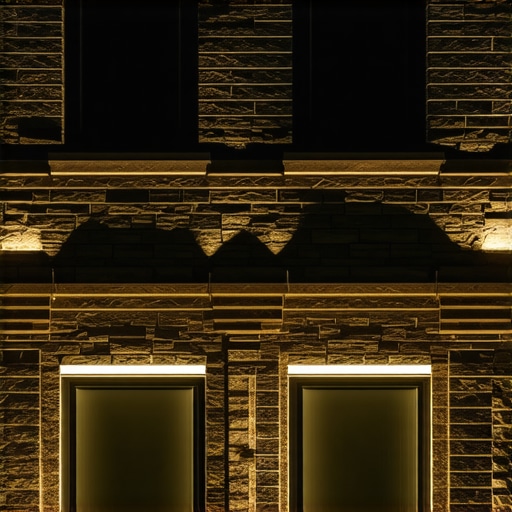
The Autopsy of a Failed Facade: Why Your Outdoor Lighting is Shoring Out
I was called out to a multi-million dollar estate last Tuesday because the stone facade lighting—a beautiful array of high-end LED uplights—had turned into an expensive, flickering mess. The homeowner complained of a ‘strange buzzing’ coming from the stone pillars. I pulled out my Wiggy and found a 40-volt leakage between the stone and the ground. The culprit? A ‘handyman’ had run standard outdoor-rated cable directly through the mortar joints. Over three years, the alkalinity of the wet mortar had literally eaten through the insulation, creating a high-resistance short that was turning the stone wall into a giant heating element. This is why I treat every exterior job like a forensic investigation. My journeyman used to smack my hand if I stripped a wire with a knife. ‘You nick the copper, you create a hot spot,’ he’d scream. He was right. In a masonry environment, that hot spot isn’t just a nuisance; it’s the start of a structure fire you can’t see until it’s too late.
“Aluminum wire connections can overheat and cause a fire without tripping the circuit breaker.” – CPSC Safety Alert 516
When you are dealing with architectural stone, you aren’t just ‘installing lights.’ You are managing a hostile environment. Stone is porous. It breathes, it traps moisture, and in coastal areas, it holds salt like a sponge. If you’re near the water, that salt air bridges the gap between phases in your fixtures, leading to catastrophic failure. Before we even talk about the rough-in, we have to talk about electrical load calculations. Most homeowners think they can just keep adding patio cover outlets and stone-mounted sconces to an existing circuit. They forget that continuous outdoor loads are calculated at 125% of the actual wattage. If your overhead service drop is already straining under the weight of a 20-year-old HVAC unit, adding a massive landscape lighting package without a subpanel installation is a recipe for a Widow Maker scenario where a loose neutral fries every sensitive electronic device in your house.
The Physics of Salt-Air Corrosion and Galvanic Reaction
In coastal zones, the enemy is invisible. Salt air doesn’t just rust the outside of a fixture; it travels up the conduit through a process called capillary action. If you don’t use Monkey Shit (duct seal) at the entry points of your exterior boxes, that humid, salt-heavy air will rot your meter can from the inside out. I’ve seen dock electrical services where the copper looked like green powder because someone forgot the dielectric grease. When wiring for stone, we use heavy-wall PVC or stainless steel. Anything else is just a temporary solution. We also have to consider swimming pool bonding if that stone facade is anywhere near the water feature. If your stone mason didn’t bond the rebar or the wire mesh in that stone wall to the pool’s bonding grid, you’re creating a potential difference that can literally kill someone in the water. This isn’t a hobby; it’s physics. You need bonded insured electrical work because if the grounding isn’t perfect, the stone becomes a conductor.
The Forensic Breakdown: Why Conduit Matters More Than the Light
Let’s talk about the Home Run. Every major architectural feature should have its own dedicated run back to the panel. I don’t care if the LED driver says it only pulls 10 watts. Voltage drop is the silent killer of outdoor systems. If you run 100 feet of thin-gauge wire through a stone wall, the resistance increases, the heat rises, and the driver burns out. Then you’re stuck trying to chisel out a $500 light fixture from a $50,000 stone wall. We use power quality analysis to ensure the line is clean before we ever do the trim-out. If the house has ‘dirty power’—spikes and sags from a nearby industrial park or poor grid maintenance—those expensive LEDs will strobe like a cheap disco. This is why whole house surge protection is mandatory, not an upsell. A single lightning strike or a transformer pop down the street will cook the internal circuitry of every facade light if you don’t have a Type 1 surge device at the main panel.
“All 15- and 20-ampere, 125-volt receptacles located within 6.0 m (20 ft) of the inside walls of a pool shall be protected by a ground-fault circuit interrupter.” – NEC 680.22(A)(4)
The Solution: Proper Rough-In for Stone and Masonry
The best way to wire a stone facade is to treat it like a parking lot lighting project: heavy-duty infrastructure buried deep. We use Schedule 80 PVC, never Schedule 40, because masonry settles and can crush thinner pipes. We use dikes to cleanly cut the leads, ensuring zero copper nicks. We never, ever use Romex outside. Even if it’s in conduit, condensation will build up inside the pipe and the paper filler in the Romex will act like a wick, pulling water into your panel. We use THWN-2 wire with a nylon jacket that can handle being submerged in the inevitable ‘sweat’ that occurs inside conduit. When I see a tick tracer light up on a stone wall where no lights are even installed, I know the installer used the wrong wire and the insulation has failed. Don’t be the guy who has to explain to a client why their $200,000 renovation is literally glowing in the dark because of a $5 roll of the wrong tape.
The Final Torque: Safety and Longevity
At the end of the day, my job is to make sure you sleep through the night without the smell of ozone waking you up. Whether we are talking about dock electrical services or architectural accents, the rules of electricity don’t change for aesthetics. You calculate the load, you protect the wire from the environment, and you ground the living daylights out of everything. When we finish a stone facade project, every screw is torqued to spec, every box is sealed with Monkey Shit, and the power quality analysis shows a clean wave. Electricity is a lazy beast; it’s always looking for the easiest path to ground. If you don’t give it a safe path through a properly bonded system, it will find its own way through you or your house. Do it right, use a pro, and keep your Wiggy in your bag because the system just works.