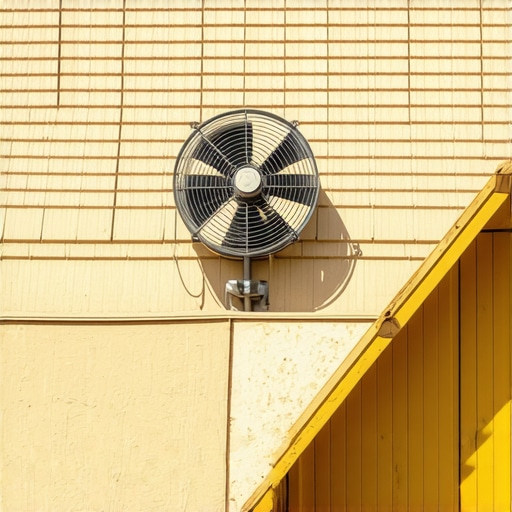
The Pressure Cooker Overhead: A Forensic Look at Your Attic
Walk into a 140-degree attic in July, and you aren’t just looking at a storage space; you’re looking at a thermal battery that is actively trying to destroy your home’s structural skeleton. As a licensed master electrician with nearly four decades of crawling through blown-in cellulose and tracing circuits, I’ve seen what happens when heat and moisture are allowed to stagnate. Most homeowners think an attic fan is just about lowering the AC bill. They’re wrong. It’s about preventing a slow-motion architectural suicide. When you don’t have proper air exchange, your shingles bake from both sides, your plywood decks delaminate, and your electrical insulation begins a process called thermal aging that turns flexible Romex into brittle, fire-prone glass.
My journeyman used to smack my hand with a pair of dikes if he saw me stripping a wire with a pocketknife. ‘You nick that copper, you create a microscopic hot spot, and in an attic that’s already a furnace, that’s where the fire starts,’ he’d scream. He was a cranky old bastard, but he was right. In an unventilated attic, the ambient temperature can easily exceed the rating of your wiring’s insulation. If your house was wired in the 70s or 80s, you’re likely dealing with older NM cable that wasn’t designed for the 90-degree Celsius thresholds we see today. Adding a powered attic ventilator isn’t a luxury; it’s a cooling system for your home’s nervous system.
“Aluminum wire connections can overheat and cause a fire without tripping the circuit breaker, especially when subjected to the extreme thermal cycling found in unventilated attic spaces.” – CPSC Safety Alert 516
The Physics of Shingle Decay and The Forensic Autopsy
Let’s talk about the ‘Forensic Breakdown’ of a failing roof. Most people see a curling shingle and blame the weather. I see a lack of convection. Heat radiates through the roof deck, but without a path for that energy to escape, the underside of the shingle reaches temperatures that literally boil the volatile oils out of the asphalt. This is where the ‘Component Zooming’ matters. At a molecular level, the bitumen becomes brittle. Once the oils are gone, the granules lose their grip and wash away in the next rain. You’ve just turned a 30-year roof into a 12-year liability because you didn’t want to run a dedicated home run for a fan motor.
Then there’s the moisture. In the winter, warm air from your kitchen range hood wiring or bathroom fans leaks into the attic. If that moisture hits a cold roof deck, it condenses. I’ve been in attics where the rafters were literally ‘sweating’ enough to trip a GFCI. This moisture leads to fungal rot in the wood and corrosion on your electrical junctions. I’ve opened J-boxes in poorly ventilated attics where the wire nuts were filled with a green, fuzzy oxidation that looked like a science project. That’s high-resistance waiting to happen. High resistance equals heat; heat equals a call to the fire department.
The Electrical Infrastructure: More Than a Simple Plug-and-Play
Installing a fan isn’t just about slapping a motor in a hole. A professional, bonded insured electrical contractor knows that a motor in a high-heat environment requires specific considerations. You need to account for the ‘locked rotor amperage.’ If those bearings seize because of the grit and heat, that motor is going to pull massive current before the thermal overload kicks in. I’ve seen ‘weekend electrician services’ tap into a bedroom lighting circuit for an attic fan. Suddenly, you’ve got a 5-amp motor starting up on a circuit already burdened by a vacuum cleaner and a TV. The voltage drop causes the motor to run hotter, shortening its life and potentially melting the wire insulation at the weakest point—usually a loose connection in a daisy-chained outlet.
“To prevent electrical fires, all fixed appliances must be grounded in accordance with NEC Article 250, and branch circuits must be sized to handle 125% of the continuous load of the motor.” – NFPA 70: National Electrical Code
When we do a rough-in for an attic system, we look at the whole picture. Is the main disconnect service capable of the extra load? Does the homeowner need a ceiling fan in the master bedroom to offset the AC load further? We use a ‘Tick Tracer’ and a ‘Wiggy’ to ensure that we aren’t tapping into a multi-wire branch circuit that could lead to a shared neutral disaster. In the world of restaurant kitchen electrical or high-demand home rewiring services, we treat every motor as a potential failure point. Your attic fan is no different. It needs a clear path to the panel—a home run—to ensure it doesn’t interfere with your fiber optic cabling or sensitive electronics elsewhere in the house.
OSHA Compliance and the Reality of Attic Work
This isn’t a DIY job for a Saturday afternoon. OSHA compliance wiring isn’t just for the job site; it’s a set of principles that keeps workers alive. Crawling through an attic requires knowledge of structural integrity and heat stress management. I’ve seen guys pass out from heat exhaustion because they didn’t realize the attic was 50 degrees hotter than the living room. Beyond the human cost, there’s the ‘Handyman Special’ risk. I once performed an autopsy on a system where a flipper used ‘Monkey Shit’ (duct seal) to hide the fact that they hadn’t used proper connectors on a junction box. The wires were arcing inside the seal, slowly carbonizing the wood rafter. A licensed master electrician would have used a proper Romex connector and a metal box to contain any potential arc. That’s the difference between a house that stays standing and one that’s a pile of ash.
If your lights flicker when the wind blows or you smell something fishy (the scent of burning Bakelite), you’re already in the ‘Time Bomb’ phase. Upgrading your ventilation and ensuring your wiring is up to code isn’t about resale value—though insurance companies are increasingly dropping coverage for homes with ancient panels or unmitigated heat risks. It’s about the physics of safety. You want to sleep at night knowing that every terminal is torqued to spec and that your roof isn’t a ticking thermal bomb. Don’t wait until the shingles are brittle and the wires are toasted. Get a professional to evaluate your airflow and your infrastructure. It’s cheaper than a new roof, and significantly cheaper than a fire restoration.