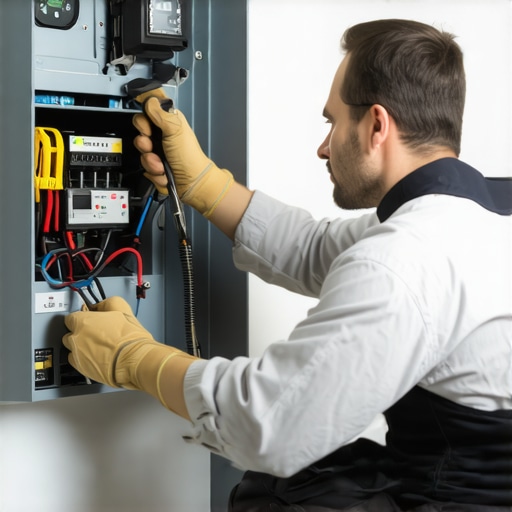
The Sensory Warning: Detecting the Invisible Killer
You don’t always see an electrical failure coming, but you can usually smell it. It starts as a faint, cloyingly sweet scent of burning fish or roasting plastic. That is the smell of phenolic resin in your breaker or the PVC jacket of your Romex cabling carbonizing at 400 degrees Fahrenheit. When you smell that, the clock isn’t just ticking; it’s screaming. As a forensic inspector who has spent three decades looking at the charred remains of ‘renovated’ properties, I can tell you that the difference between a minor service call and a total structure loss is usually about forty-five minutes and a bit of common sense. If your lights are flickering in a rhythmic cadence, or if you hear a ‘sizzling’ sound behind the drywall, you aren’t looking at a minor nuisance. You are witnessing the breakdown of dielectric strength in your insulation.
“Aluminum wire connections can overheat and cause a fire without tripping the circuit breaker.” – CPSC Safety Alert 516
The Forensic Narrative: The Flipper’s Hidden Hazard
I recently walked into a high-end commercial property that had just undergone a massive ‘industrial’ aesthetic renovation. The client complained that the industrial motor controls for their HVAC system were tripping intermittently. I pulled out my Tick Tracer and started sweeping the walls. I found a massive hot spot behind a decorative steel panel. The flipper had used indoor-rated 14/2 Romex to feed a transformer installation, then buried three junction boxes behind the metal siding without any accessibility. One of those boxes was arcing so violently that the steel panel was warm to the touch. They called for a virtual consultation wiring review, but I was there within the hour because I knew exactly what that heat signature meant. We had to perform a full rough-in audit just to find the other ‘surprises’ left behind. This is why warranty backed repairs are the only thing that should matter to a homeowner—if the guy who fixed it won’t stand behind it for ten years, he didn’t fix it; he just hid the problem.
The Anatomy of Failure: Why Your 60 Amp Panel is a Time Bomb
Many mid-century homes are still limping along on a 60 amp panel upgrade that happened back when the only heavy load in the house was a toaster and a black-and-white TV. Today, you’re trying to run a heat pump, a Tesla charger, and a double oven on that same bus bar. The physics simply don’t work. When you pull 80 amps through a 60 amp main lug, you trigger a phenomenon called Cold Creep. This is especially prevalent in aluminum-wired homes from the 1970s. Aluminum has a much higher coefficient of thermal expansion than copper. Every time you turn on your dryer, the wire expands; when you turn it off, it contracts. Over thousands of cycles, the wire literally ‘creeps’ out from under the terminal screw. This creates a high-resistance connection, which creates heat, which creates an arc. This is where preventative electrical maintenance saves lives. Upgrading to a 200 amp panel install isn’t about luxury; it’s about providing enough physical surface area on your bus bars to handle modern current density without melting the Monkey Shit duct seal in your service mast.
The Grounding Crisis: More Than Just a Copper Rod
I’ve seen ‘electricians’ pound a single five-foot rod into the dirt and call it a day. That is a Widow Maker mistake. A proper grounding electrode install requires understanding soil resistivity. If you live in a coastal area, salt air corrosion will rot your grounding bridge in less than five years. If you’re inland with high clay content, the ground might as well be rubber. Without a low-resistance path to earth, a surge—whether from lightning or a utility transformer failure—will find the path of least resistance through your 60-inch OLED TV or, worse, through you. This is why GFCI outlet installation is mandated in every wet location. A GFCI doesn’t look for a short to ground; it monitors the balance of current between the hot and neutral. If even five milliamps go missing—likely through your arm while you’re standing on a damp garage floor—the internal solenoid trips the circuit in less than 1/40th of a second.
“GFCI protection shall be provided for all 125-volt, 15- and 20-ampere receptacles installed in the locations specified in 210.8(A)(1) through (11).” – NEC 210.8
Same-Day Logistics: Getting a Pro on the Scene
If you have an emergency, do not call a general handyman. They’ll show up with a pair of dikes and a roll of electrical tape and try to ‘patch’ a structural failure. To get same-day service, you need to provide the dispatcher with a forensic profile. Use your phone for a virtual consultation wiring check; send photos of the panel interior, the brand name of the breakers (if it says Federal Pacific or Zinsco, tell them immediately), and any visible charring. This allows the master electrician to prep a home run kit before they even leave the shop. If you’ve experienced flood water electrical safety issues, do not touch the main breaker. Water bridges the gap between the phases, and the moment you touch that handle, you could become the grounding electrode. Professionals use a Wiggy (solenoid voltmeter) to check for stray voltage before they even step into a flooded basement. Real service is about speed, but it’s mostly about the torque wrench and the thermal camera. Anything less is just gambling with your family’s safety.