The Old Timer’s Lesson: Why a Nicked Wire is a Death Sentence
My journeyman used to smack my hand if I stripped a wire with a knife. ‘You nick the copper, you create a hot spot,’ he’d scream. He was right. Most people see a tiny score mark on a strand of Romex and think it is just a cosmetic flaw. In reality, you have just engineered a point of high resistance. When you engage in holiday light installation, you are often pushing your home’s exterior circuits to their absolute thermal limit for six to eight hours a night. Under that continuous load, that tiny nick experiences localized heating. The metal expands and contracts, a process that eventually fatigues the conductor until it arcs. If you are lucky, it just kills the circuit. If you are not, it ignites the dry leaves in your gutters. This is why professional timing matters; we need the daylight and the dry weather of early autumn to inspect these points of failure before the snow hides the sins of the previous year.
The Mid-Century Time Bomb: Aluminum Wiring and Seasonal Stress
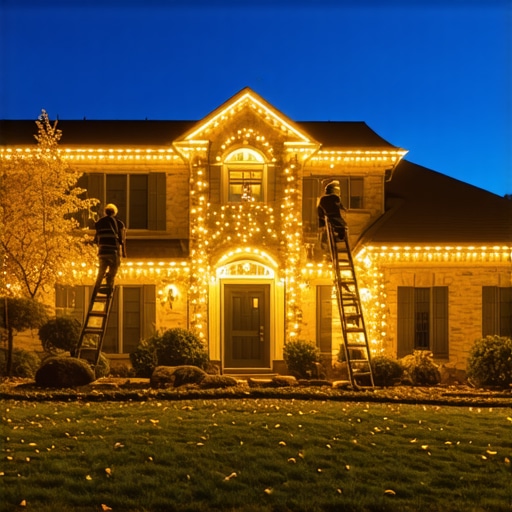
If your home was built between 1965 and 1978, you are likely sitting on a powder keg of aluminum wiring. Aluminum is a different beast than copper. It suffers from a phenomenon called Cold Creep. When the wire heats up under the load of a lighting installation services project, it expands significantly more than the steel or brass screws on your outlets. This pressure eventually squeezes the wire out from under the terminal. When the lights go off and the wire cools, it contracts, leaving a microscopic gap. This gap is an invitation for oxidation. Aluminum oxide is an insulator, not a conductor. Now the current has to fight through that layer of junk, generating even more heat. [image_placeholder_1] It is a feedback loop that ends in a charred junction box. Booking your service in late summer or early fall allows a Master Electrician to use a Tick Tracer and a Wiggy to verify the integrity of your outdoor receptacles before the moisture of winter sets in.
“Aluminum wire connections can overheat and cause a fire without tripping the circuit breaker.” – CPSC Safety Alert 516
The Anatomy of an Overload: Why October is the Cutoff
Most homeowners treat their outdoor outlets like a magic bucket that never overflows. But every holiday light installation is a math problem involving Ohm’s Law. If you have a 15-amp circuit—common in older homes—you only have 1,440 watts of usable continuous power (80% of the breaker’s rating per NEC). If you are already running a doorbell camera install on that same transformer or have other parasitic loads, you are redlining the system. We see it every year: someone plugs in ten strands of old-school C9 incandescent bulbs and then wonders why their electric gate opener stopped working or why the breaker won’t reset. By booking your service early, we can perform a proper load calculation. Sometimes that means a home backup generator install or a portable generator hookup is needed to handle the winter surge, or perhaps a dedicated home run back to the panel to ensure the lights don’t dim every time the fridge kicks on.
Forensic Failure: The Physics of Salt and Moisture
In mid-century panels like Federal Pacific or Zinsco, the bus bars are often the first to go. These ‘widow makers’ are notorious for not tripping even when a direct short occurs. During a warehouse lighting retrofit or a restaurant kitchen electrical audit, I’ve seen breakers that have literally welded themselves to the bus bar. When you add the moisture of a late November rain to a seasonal lighting setup, you create ‘tracking.’ Moisture finds a path through the dust and carbon on your outdoor sockets, creating a high-voltage bridge to ground. If your lighting installation services aren’t using Monkey Shit (duct seal) to plug the penetrations where the wire enters the house, you’re just funneling water into your walls. This is why we insist on early OSHA compliance wiring checks for commercial clients; we need to ensure every GFCI is tripping at exactly 5 milliamps before the ground freezes.
“Temporary electrical power and lighting installations shall be permitted for a period not to exceed 90 days for holiday decorative lighting and similar purposes.” – NEC 590.3(B)
Beyond the Bulbs: Integrated Infrastructure
The best time to book isn’t just about the lights; it’s about the total health of your electrical system. While we are up there on the ladders, we are looking at your service mast and your weather head. Is the triplex frayed? Is the drip loop correct? If you are planning on hot tub wiring services for the winter, it makes sense to coordinate that with your seasonal lighting. A Master Electrician isn’t there to just hang pretty colors; we are there to ensure the rough-in for your winter projects doesn’t compromise your main service. We use Dikes to clean up the rats’ nest of old wires and ensure that every trim-out is torqued to spec. Don’t wait until the first frost when every ‘handyman’ with a ladder is busy. Book the pro who knows the difference between a neutral and a ground, and who treats your home like the high-voltage machine it actually is.