The Scent of a Smoldering Backyard Nightmare
You smell it before you see it. That pungent, acrid stench of ionizing PVC insulation—it’s the perfume of a house fire in the making. I’ve seen homeowners try to run a table saw, a miter saw, and a compressor off a single 14-gauge orange extension cord snaked 150 feet from the kitchen outlet to the back 40 where they’re attempting a shed wiring install. By the time they hit the trigger on that saw, the voltage drop is so severe the motor is groaning in agony, drawing double the amperage to compensate for the lack of pressure. That cord isn’t just a conductor anymore; it’s a heating element. This is why we talk about temporary power poles, or T-poles, not as an ‘extra’ cost, but as a life-insurance policy for your property.
My old journeyman, a man who had more scars from ‘widow makers’ than I have tools in my bag, used to smack my hand if I even thought about stripping a wire with a standard utility knife. ‘You nick that copper, you create a microscopic hot spot,’ he’d scream over the roar of the job site. ‘The electrons don’t just flow through the middle, they crowd the surface. You give them a bottleneck, and they’ll turn that wire into a torch.’ He was right. That same logic applies to your home’s infrastructure. When you’re tackling a backyard project, you are putting a ‘Home Run’ load on a system that was likely designed for a 1970s toaster, not a modern construction site. If you aren’t considering a service entrance upgrade or at least a temporary service, you’re playing Russian roulette with your bus bars.
“Temporary wiring shall be removed immediately upon completion of construction or purpose for which the wiring was installed.” – NEC Section 590.3(D)
The Forensic Breakdown: Why Your Panel Can’t Handle the Heat
Let’s look at the physics of why your current setup is probably a time bomb. Most homes built between 1960 and 1980 were outfitted with 100-amp or 125-amp services. At the time, lighting installation services meant a few 60-watt bulbs. Today, you have a smart thermostat wiring system, three TVs, a computer lab in the spare bedroom, and an HVAC that pulls a massive inrush current every time the compressor kicks. Now, you want to add a 15-amp circular saw 100 feet away? You’re pushing the limits of Ohm’s Law. As resistance increases over distance, voltage drops. To maintain power (Wattage), the current (Amperage) must increase. Increased amperage equals heat. Heat leads to the ‘Cold Creep’ in older aluminum-fed panels where the lugs loosen as they expand and contract, eventually arcing and melting your main breaker.
When I do a forensic inspection after a ‘small’ electrical fire, I often find a meter base replacement was desperately needed years ago. The lugs inside the meter can have become pitted and oxidized. In some cases, I’ve found ‘Monkey Shit’ (that’s duct seal for the uninitiated) used to plug holes but failing to stop moisture from migrating down the service mast. That moisture creates a high-resistance bridge between the phases. A temporary power pole bypasses this entire aging infrastructure, providing a clean, dedicated 50 or 100-amp service directly from the utility transformer to your project site. It ensures your shed wiring install starts with a solid foundation, rather than parasitic leaching from your bathroom circuit.
Component Zooming: The Anatomy of a T-Pole
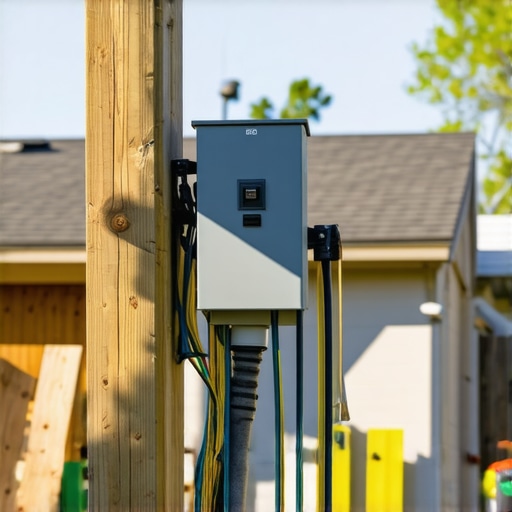
A proper temporary power pole isn’t just a 4×4 stuck in the dirt. It’s a specialized assembly consisting of a weather-head, a service mast, a meter socket, and a small distribution panel with GFCI-protected outlets. We use ‘dikes’ to trim the conductors precisely, ensuring no excess copper is exposed. We pack the service head with ‘Monkey Shit’ to keep out the rain. Every connection is torqued to specific inch-pounds because a loose connection is an arcing connection. I use my ‘Wiggy’—a solenoid tester—to verify the voltage under load. If that needle bounces, I know we have a neutral issue. You won’t find that with a cheap digital multimeter that reads ‘phantom voltage’ through induction.
“Aluminum wire connections can overheat and cause a fire without tripping the circuit breaker.” – CPSC Safety Alert 516
Whether you’re doing a retail store wiring job or a warehouse lighting retrofit, the principles of temporary power remain the same: isolation and protection. For a backyard project, the T-pole acts as a firewall. If you short out a tool in the mud, the GFCI on the pole trips, not the breaker in your hallway. This is especially critical if your home still has an old Federal Pacific or Zinsco panel—brands I call ‘The No-Trip Specials.’ Those breakers have a nasty habit of jamming their internal pivots, turning a simple short circuit into a full-blown structure fire. I’ve seen bus bars melted into puddles of slag because a breaker refused to trip during a bathroom exhaust fan swap gone wrong.
The Reality of Weekend Electrician Services
I get it. You want to save a few bucks. You think weekend electrician services are just for people who can’t use a screwdriver. But electricity isn’t a hobby. It’s a force of nature that wants to find the shortest path to the ground, and it doesn’t care if that path is through your copper pipes or your chest cavity. When you’re planning office lighting upgrades or a simple shed build, the temporary pole is your first line of defense. It allows for a clean rough-in and trim-out without tripping the house lights every time you fire up a compressor. It also gives you the opportunity to assess if you need a full service entrance upgrade before you add more permanent load to the house. If your meter base looks like it was salvaged from a shipwreck, a meter base replacement isn’t just a suggestion; it’s a requirement for passing inspection.