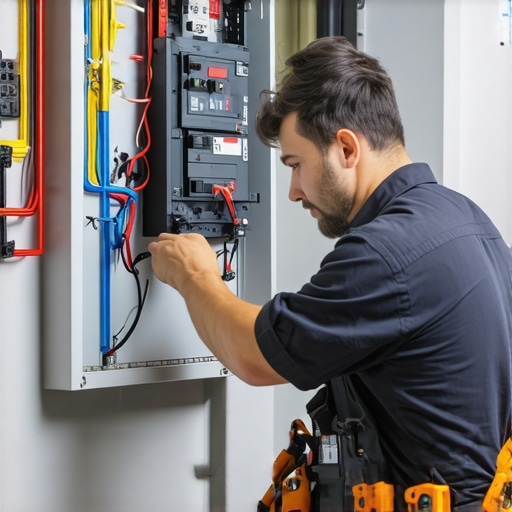
The Hidden Decay Behind Your Drywall
I’ve spent thirty-five years pulling dead rats out of service gear and smelling the distinctive, sickly-sweet aroma of melting PVC insulation. Most homeowners treat their electrical system like a toaster—if it works, it’s fine. But electricity isn’t a static utility; it’s a constant, violent flow of electrons that generates heat, vibration, and mechanical stress. When you live in a home built between 1960 and 1980, you aren’t just living in a house; you’re living inside a slow-motion chemistry experiment. My old journeyman used to smack my hand with a pair of dikes if I ever tried to strip a wire with a pocket knife. ‘You nick the copper, you create a hot spot,’ he’d bark. He wasn’t being mean; he was teaching me the physics of failure. A single nick reduces the cross-sectional area of the conductor, increasing resistance at that exact point. Resistance creates heat. Heat causes the metal to expand, which eventually loosens the terminal, creating an arc. By the time you smell the ozone, the home run back to the panel is already charred. This is why preventative electrical maintenance isn’t a luxury; it’s the only thing keeping your family from a midnight visit from the fire department.
“Aluminum wire connections can overheat and cause a fire without tripping the circuit breaker.” – CPSC Safety Alert 516
The Physics of Failure: Cold Creep and Aluminum Wiring
If your home was built during the mid-century peak, you likely have aluminum branch circuit wiring. The industry thought they’d found a cheaper alternative to copper, but they ignored the mechanical properties of the metal. Aluminum suffers from something we call ‘Cold Creep.’ When current flows through a wire to power your workshop electrical setup or a heavy appliance, the wire heats up and expands. When the load drops, it cools and contracts. Aluminum expands at a much higher rate than the steel or brass screws in your outlets. Over years of these thermal cycles, the wire literally ‘creeps’ out from under the screw. This leaves a microscopic gap where an arc can jump. That arc is 3,000 degrees Fahrenheit. It doesn’t trip a standard breaker because the amperage hasn’t exceeded the limit; it’s just a ‘leaking’ current that burns through wood studs like a plasma cutter. This is exactly why we insist on outlet switch repair that involves proper AlumiConn connectors or a total copper rewire. Using financing to handle these costs upfront means you aren’t gambling with your life every time you plug in a heater.
Why Your Old Panel Is a Loaded Gun
If I walk into a garage and see a Federal Pacific Electric (FPE) or Zinsco panel, I don’t even need my Wiggy to know there’s trouble. These panels are the ‘Widow Makers’ of the industry. The design of the bus bars in these mid-century units was fundamentally flawed. Over time, the tension clips that hold the breakers to the bus bar lose their spring. This creates a high-resistance connection that welds the breaker to the bar. I’ve seen smart meter installation jobs where we had to pull the entire meter can because the heat from a jammed FPE breaker had migrated back through the service entrance cables, melting the Monkey Shit duct seal and fusing the wires into a solid mass of charred plastic. Upgrading to a modern 200-amp service with grounding electrode install ensures that your system has a clear path to earth for surges, rather than letting that energy dissipate through your flat-screen TV.
“The grounding electrode conductor shall be installed in one continuous length without splice or joint.” – National Electrical Code (NEC) 250.64(C)
Modern Demands on Ancient Infrastructure
We are asking 50-year-old wires to do things they were never designed for. In 1972, the biggest load in a house was a refrigerator and a few lightbulbs. Now, you’re asking that same Romex to handle fiber optic cabling hubs, ethernet wiring services, doorbell camera install projects, and high-draw outdoor patio cover outlets. When we perform a rough-in for a modern renovation, we aren’t just adding wires; we are calculating the total connected load. If you add a workshop in the garage without a ‘heavy-up’ service upgrade, you are pushing your transformer to the limit. Financing these upgrades allows you to install a priority service membership plan, ensuring that an inspector like me checks your torques and temperatures every year before a loose neutral ruins your day. We look at the smart meter installation as a diagnostic tool, not just a billing device. It can alert you to fluctuating voltages that indicate a failing utility connection before your appliances start smoking.
The Solution: Zero Upfront Cost Upgrades
I get it. A full panel swap, grounding electrode install, and a complete trim-out of modern devices can cost as much as a used car. But when you use financing to spread that cost over years, you are essentially paying for insurance. The ‘upfront cost’ of a house fire is significantly higher. Whether it’s running ethernet wiring services to clear up your Wi-Fi congestion or installing patio cover outlets so you aren’t daisy-chaining extension cords (which are the #1 cause of residential fires), doing it right the first time is the only way an electrician can sleep at night. Don’t let a ‘handyman’ with a roll of electrical tape and a lack of respect for Ohm’s Law touch your home. Get a Master Electrician, get it financed, and get it safe.”