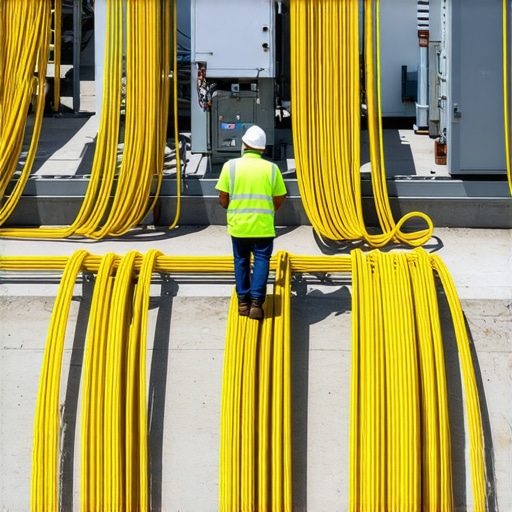
The Sensory Warning of a Failing Site
Walk onto any high-stakes commercial construction site and you will hear it before you see it. It is not the sound of the hammer drills or the heavy machinery, but a low-frequency, persistent 60Hz hum that signals a temporary power system is being pushed to its thermal limits. As a forensic inspector with 35 years in the dirt, I have learned to trust my nose more than my Wiggy. The smell of burnt Bakelite and the sharp, metallic tang of ozone are the precursors to a catastrophic failure. Temporary power is often treated as a secondary thought, a ‘rough-in’ convenience, but in reality, it is a high-risk electrical environment where the physics of resistance and heat never take a day off. Whether we are talking about a massive warehouse lighting retrofit or a quick storm damage electrical repair, the rules of the National Electrical Code are written in the ashes of sites that ignored the basics.
“Temporary wiring shall be removed immediately upon completion of construction or purpose for which the wiring was installed.” – NEC 590.3(D)
The Anatomy of a Failure: A Forensic Breakdown
My old journeyman, a man we called ‘Iron-Mike,’ once watched me prep a home run for a temporary sub-panel. I used a utility knife to strip the jacket off a 4/0 SOOW cable, and the blade whispered against the copper. Mike grabbed my wrist so hard it bruised. ‘You nick that copper, you create a stress riser,’ he growled. ‘In a building that vibrates from jackhammers, that wire will snap or arc. You don’t just build it; you build it to survive the vibration.’ He was right. When you nick a conductor, you are essentially creating a bottleneck for electrons. This leads to a phenomenon known as localized resistance heating. On a commercial site, where a temporary panel might be feeding everything from a restaurant kitchen electrical setup to a data closet organization crew’s chargers, that heat builds until the insulation reaches its glass transition temperature and fails.
The Physics of ‘Cold Creep’ and Thermal Cycling
One of the most frequent causes of site fires I investigate during fire damage wiring restoration is the failure of large-gauge terminations. Temporary power systems frequently use aluminum feeders because they are cheaper for short-term use. However, aluminum has a high coefficient of thermal expansion. When the site’s heavy loads kick on—say, during a holiday emergency call where heaters are maxed out—the aluminum wire expands. Because the steel lug in the breaker doesn’t expand at the same rate, the wire is physically compressed. When the load drops and the wire cools, it shrinks, but it doesn’t return to its original shape. This is ‘Cold Creep.’ Over weeks of use, the connection becomes loose. A loose connection is a high-resistance connection. High resistance equals heat. Heat equals fire. This is why code violation corrections often focus on the simple act of re-torquing lugs to the manufacturer’s inch-pound specifications.
“The employer shall use either ground-fault circuit interrupters… or an assured equipment grounding conductor program.” – OSHA 1926.404(b)(1)
The ‘Widow Maker’ and Other Site Hazards
In the field, we see ‘widow makers’—homemade double-male extension cords used to back-feed circuits—more often than I’d like to admit. These are death sentences in a yellow jacket. Even in smaller projects like an ADU electrical services build-out or a landscape lighting install, the temptation to ‘just make it work’ leads to ungrounded systems and bootleg neutrals. When I pull out my tick tracer and it screams at a metal enclosure that should be grounded, I know I’m looking at a disaster in progress. We often find that someone has used monkey shit (duct seal) to hide a poorly fitted conduit entry, thinking it will keep the moisture out. But moisture is persistent. In temporary setups, water ingress creates a ‘salt bridge’ across phases, leading to a phase-to-phase arc that can vaporize a 200-amp bus bar in milliseconds.
The Solution: Professional Integrity Over Convenience
True safety on a commercial site requires more than just plugging in a spider box. It requires a rigorous inspection of every cord, every GFCI, and every termination. Using dikes to cleanly trim zip ties is about more than aesthetics; it’s about preventing accidental snags that pull on strain reliefs. Whether it’s a simple doorbell camera install for site security or a complex restoration, the principles of Ohm’s Law remain the same. Do not let your temporary power be the reason your permanent project never finishes. Sleep at night knowing every lug is torqued, every ground is bonded, and no conductors are nicked. Electricity isn’t a hobby; it is a force of nature that we merely lease for the duration of the job.