The Scent of a Short: Why Your Holiday Glow Might Be a Fire Hazard
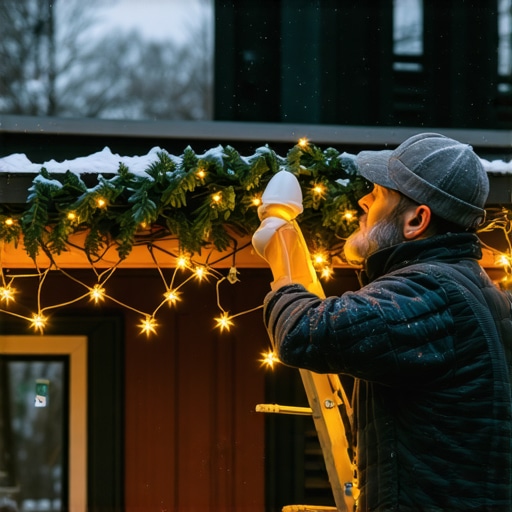
I remember walking into a split-level in the suburbs three days before Christmas. The air was crisp, but inside the entryway, there was that unmistakable, sickening scent of ozone and burning fish. The homeowner was proud of his ‘Clark Griswold’ display—thousands of twinkling lights draped over every square inch of the fascia. But as I pulled the cover off his 1974 Federal Pacific panel, I saw it: the main lug was discolored, a bruised purple-black from extreme heat. He’d hired a ‘guy with a ladder’ to staple lights directly into the trim. That guy had used a T50 stapler and driven a steel staple right through the cloth insulated wiring that fed the porch light, effectively turning the entire gutter system into a live conductor. This is the reality of DIY holiday lighting in mid-century homes; it’s not just about aesthetics, it’s about forensic electrical safety.
The Physics of the ‘Hot Gutter’ and Dielectric Breakdown
When you hang lights, you aren’t just decorating; you are interacting with your home’s grounding system. Most gutters are aluminum—a fantastic conductor. If your home still has cloth insulated wiring replacement on the ‘to-do’ list, you’re playing a dangerous game. Over decades, that cloth becomes brittle, a phenomenon known as desiccation. When a ‘pro’ handyman clips a light string to a gutter, they often nick this fragile insulation. Suddenly, 120 volts are looking for a path to ground, and your gutter, dripping with melted snow, is the perfect highway. This creates a ‘Widow Maker’ scenario where touching the downspout can result in a lethal discharge. Professionals avoid this by using non-conductive polycarbonate clips that provide a physical air gap, preventing dielectric breakdown between the wire and the metal.
“Aluminum wire connections can overheat and cause a fire without tripping the circuit breaker.” – CPSC Safety Alert 516
Cold Creep and the Myth of the ‘Simple’ Extension Cord
Let’s talk about the 1960s-1980s infrastructure. Many of these homes utilize aluminum branch circuit wiring. Aluminum has a much higher coefficient of thermal expansion than copper. We call it ‘Cold Creep.’ When you plug a massive holiday load into an outdoor outlet, the wire heats up and expands, pushing against the screw terminal. When the lights turn off, it contracts. Over a 30-day holiday season, those wires can loosen enough to create an arc-fault. If you haven’t invested in a surge protector installation for your whole house, that arcing can send high-frequency transients back through your system, frying your expensive 4K TV or your fridge’s control board. A professional installer doesn’t just plug things in; they perform a load calculation to ensure your 15-amp circuit isn’t screaming at 18 amps.
The Hidden Danger of the ‘Handyman’ Splice
I’ve seen it a thousand times: someone needs ‘just five more feet’ of reach, so they chop an extension cord and wire-nut it together, wrapping it in electrical tape. In the trade, we call that a ‘Handyman Special,’ and it’s a death sentence for your gutters and your peace of mind. Moisture wicks into those tape joints. If you’re lucky, it just trips a GFCI. If you’re unlucky—perhaps you’re in an older home where the outdoor outlets aren’t even grounded—it stays live. We provide after hours electrical repair for exactly these disasters. A true professional uses temporary power services or installs dedicated weather-rated enclosures. They know that underground wiring services are the only way to safely move power from the house to those lawn reindeer without creating a trip hazard or a fire-starter.
“All 15- and 20-ampere, 125-volt receptacles located outdoors shall have ground-fault circuit-interrupter protection.” – NFPA 70: National Electrical Code (NEC) 210.8
Modern Solutions: Automation and Demand Management
If you’re serious about safety, you don’t use a mechanical timer from a big-box store that’s going to melt under a 10-amp load. You look into a home automation setup. Smart controllers allow for soft-starts and can be integrated into demand response systems to ensure you aren’t pulling peak power when the rest of your house is running the dryer and the oven. For those with serious displays—the kind that require an RV hookup installation just to power the animatronics—we often perform a ‘heavy-up’ on the service. This isn’t an upsell; it’s physics. You cannot pull 200 amps through a 100-amp bus bar without something giving way. Professional sign lighting installation techniques apply here: we use ‘Monkey Shit’ (duct seal) to plug every conduit entry point, ensuring no moisture migrates into your panel during a winter thaw.
Why Warranty Backed Repairs Matter
When a master electrician handles your exterior power needs, you get warranty backed repairs. If a breaker trips, we don’t just flip it back; we use a Wiggy or a Tick Tracer to find the leakage current. We look for ‘Hot Spots’ with thermal imaging. We ensure the rough-in was done to code and the trim-out is watertight. You wouldn’t trust a plumber to fix your computer; don’t trust a landscaper to manage your home’s electrical load. Whether it’s replacing that ancient panel or ensuring your sign lighting installation is up to par, the goal is to make sure the only thing glowing on your property is the lights, not the wiring. Sleep at night knowing your lugs are torqued and your gutters are grounded. Electricity isn’t a hobby—it’s a force of nature that’s always looking for a way out. My job is to keep it in the wire.