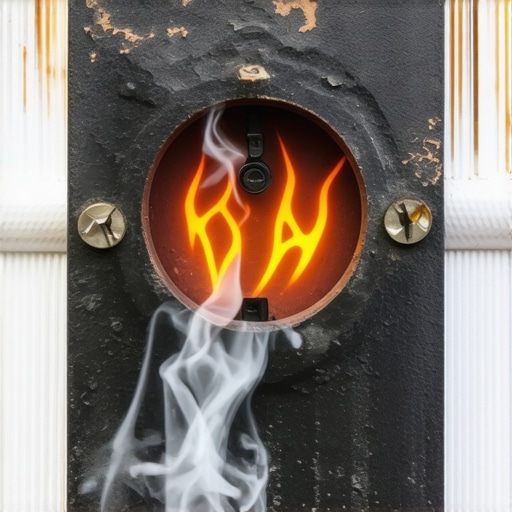
You smell it before you see it. That sharp, metallic tang of ozone hanging in the damp morning air, right near your service entrance. Most homeowners walk past that gray box on the side of their house every day without a second thought. They see a bit of orange flaking around the edges, maybe a streak of rust running down the siding, and they think it is just ‘cosmetic.’ As a forensic inspector who has spent three decades poking through the charred remains of what used to be living rooms, I can tell you that rust in a meter socket is a ticking fuse. It is not a matter of if it will fail, but how much of your property it takes with it when it does.
The Old Timer’s Lesson: The ‘Bleeding’ Can
My first journeyman, a grizzly guy named Miller who could bend conduit with his bare hands, used to drag me to the side of every house during a rough-in. He once pointed to a meter enclosure that was weeping a dark, rust-colored sludge from the bottom knockouts. ‘Kid,’ he said, ‘that is not just iron oxide. That is the house crying because its heart is rotting.’ He took his Wiggy—an old-school solenoid tester—and showed me how the voltage was fluctuating wildly because the neutral was hanging on by a literal thread of corroded copper. If that neutral had snapped, the voltage would have swung like a pendulum, frying every appliance in the house instantly. He taught me that once moisture enters the enclosure, the chemistry of catastrophe begins.
The Forensic Breakdown: Why Oxidation is an Assassin
To understand why a rusty meter socket is a death sentence for your electrical system, you have to look at the physics of contact resistance. Inside that box, the utility meter is held in place by heavy-duty spring-loaded jaws. These jaws must maintain a massive amount of clamping pressure on the meter stabs to ensure a low-resistance connection. When the steel enclosure rusts, it creates a micro-environment of high humidity and electrolyte-rich air. This triggers Galvanic Reaction between the steel, the aluminum or copper lugs, and the meter’s stabs. Resistance is the enemy. According to Ohm’s Law, as resistance increases due to the buildup of non-conductive rust and oxidation layers, the heat generated (I squared R) increases exponentially. This is not the heat of a toaster; this is heat that reaches thousands of degrees in a localized spot.
“Corrosion in electrical connections increases resistance, which leads to overheating and potential fire hazards, often without drawing enough current to trip a circuit breaker.” – CPSC Safety Alert 516
In coastal areas, this process is accelerated by salt air, which acts as a bridge for electricity. I have performed infrared thermography scans on meter sockets that looked fine to the naked eye, only to find the internal bus bars glowing at 450 degrees Fahrenheit. That heat transfers back through the service entrance conductors, melting the insulation off your home run wires and potentially igniting the wooden framing of your home. By the time you see the lights flicker, the copper has likely already begun ‘cold creeping’—expanding and contracting until the mechanical lugs lose their grip entirely.
The Coastal Context: Salt, Moisture, and Arcing
If you live near the water, your meter socket is under constant biological and chemical attack. Salt is hygroscopic; it pulls moisture out of the air and holds it against the metal. This creates a ‘salt bridge’ that can allow current to track across the insulating blocks inside the socket. Once a path is established, you get carbon tracking. The electricity literally burns a path through the dust and salt, leading to a phase-to-ground or phase-to-phase arc-flash. This is why we recommend annual maintenance contracts for coastal properties. A quick visual is not enough; you need an inspector to pull the meter (with utility permission) and check the torque on those lugs.
The Infrastructure Trap: From 60 Amp Relics to Modern Loads
Many homes with rusty meter cans are still running on ancient infrastructure. I still see the occasional 60 amp panel upgrade request where the homeowner is trying to save a buck, but their service entrance looks like it was salvaged from a shipwreck. You cannot run a modern home—with its EV chargers, hot tubs, and permanent holiday lighting—through a corroded 60-amp or 100-amp service. The increased load forces more current through those high-resistance, rusty connections. It is like trying to force a fire hose of water through a straw filled with sand; something is going to burst. If you are adding a subpanel installation or chandelier installation, your first step should be ensuring the ‘source’ of your power is structurally sound. A bonding jumper services check is also vital here, as rust often destroys the electrical continuity required for your grounding system to function during a fault.
Identifying the Warning Signs
How do you know if you are in danger? Look for these specific red flags: 1. Rust Streaks: If you see orange stains coming from the meter hub (where the pipe enters the box) or the bottom knockouts. 2. Acoustic Buzzing: A healthy meter is silent. If it buzzes like a beehive, that is the sound of micro-arcing. 3. Discolored Siding: If the vinyl or wood around the meter looks scorched or warped. 4. Flickering Under Load: If your lights dim when the AC kicks on, it might not be the breaker; it could be the meter jaws losing their temper due to heat. We often provide same day service appointments for these symptoms because they are considered ‘critical life-safety’ issues.
“All electrical equipment shall be installed and maintained in a neat and workmanlike manner, free from significant corrosion that may affect its safe operation.” – National Electrical Code (NEC) Section 110.12
The Solution: Don’t Patch a Time Bomb
I have seen guys try to wire-brush a rusty lug or spray it with ‘monkey shit’ (duct seal) to hide the damage. That is a coward’s fix. If the structural integrity of the enclosure is compromised, the only code-compliant and safe solution is a full replacement. This often involves a ‘heavy-up’ to 200 amps, ensuring your home can handle modern demands, including battery backup wiring and spa grounding services. When we perform a replacement, we use dikes to clean up the old wiring and ensure every new connection is torqued to the specific inch-pounds required by the manufacturer. We use dielectric grease to prevent future oxidation and ensure the weather-head is properly sealed so moisture never reaches the ‘heart’ again. Electricity is the most dangerous guest in your home; don’t let it live in a rusted cage.