The 2 AM Buzz: A Forensic Look at Why Your Walls Are Vibrating
You’re lying in bed, and you hear it—a faint, rhythmic hum that sounds like a hornet’s nest trapped inside the drywall. Most people roll over and ignore it. I don’t. I’ve spent 35 years tracking that sound to its source, and it usually ends at a charred bus bar or a breaker that’s surrendered to the heat. When your electrical panel starts talking to you, it’s not a conversation; it’s a final warning. Waiting for a ‘convenient time’ to replace a failing service entrance is like waiting for a heart attack to decide on a diet. This is why same day service appointments aren’t just a luxury; they are a triage necessity for a home on the brink of an arc-flash event.
The Old Timer’s Lesson: Why the Nick Matters
My first journeyman, a grizzled guy named Artie who smelled like stale coffee and solder, used to keep a pair of 9-inch dikes in his back pocket specifically to slap my knuckles. I remember one rainy Tuesday in a 1940s crawlspace when I was rushing a rough-in. I used a utility knife to strip a piece of 12/2 Romex. Artie stopped me, grabbed my hand, and pointed to a tiny, microscopic score mark I’d left on the copper. ‘You nick the copper, you create a hot spot,’ he growled. ‘Resistance creates heat. Heat creates fire. You want to be the reason a kid doesn’t wake up?’ He was right. That tiny nick reduces the cross-sectional area of the conductor, forcing the current through a smaller ‘pipe.’ In a mid-century home, these sins of the past are compounded by decades of vibration and thermal cycling. This is the forensic reality of residential electricity: it is a slow-motion car crash until it’s a sudden catastrophe.
The Mid-Century Time Bomb: Aluminum Wiring and Cold Creep
If your home was built between 1965 and 1978, you’re likely sitting on a specific kind of infrastructure risk: aluminum branch circuit wiring. The physics here are brutal. Aluminum has a different coefficient of expansion than the brass or copper terminals on your outlets and breakers. We call it ‘Cold Creep.’ Every time you turn on a space heater or a sauna heater installation, the wire heats up and expands. When you turn it off, it contracts. Over time, this movement backing out the screw terminal. Now you have a loose connection. A loose connection is an air gap, and electricity loves to jump gaps. That’s an arc. It burns at thousands of degrees, turning the wire insulation into a liquid and eventually a fuel.
“Aluminum wire connections can overheat and cause a fire without tripping the circuit breaker.” – CPSC Safety Alert 516
This is why many insurance companies will flat-out cancel your policy if they find a Federal Pacific or Zinsco panel in the basement. They know the statistics. These panels are famous for ‘jamming.’ The breaker looks like it’s on, the handle moves, but the internal pivot is seized. It won’t trip even if the wire is glowing cherry red. Replacing these isn’t an ‘upgrade’ like a kitchen backsplash; it’s a life-safety mandate.
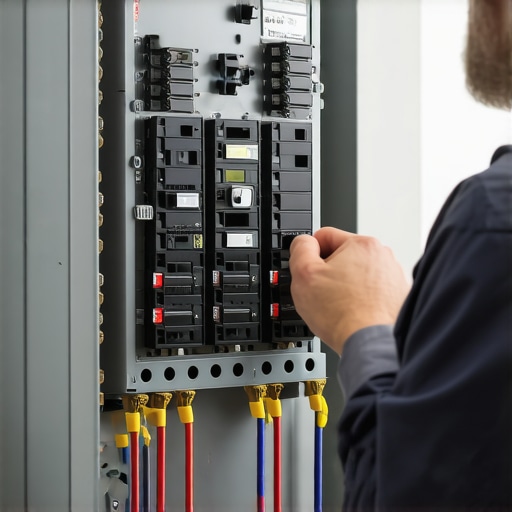
[image_placeholder_1]
The Modern Load Crisis: Why 100 Amps Isn’t Enough
Your grandfather’s house ran on a 60-amp or 100-amp service. He had a fridge, a few incandescent bulbs, and maybe a radio. Today, you’re asking that same aged copper to handle a sauna heater installation, high-speed EV chargers, and sophisticated HVAC systems. We are seeing a massive uptick in holiday emergency calls because people plug in thousands of LED lights and inflatable lawn ornaments, pushing an already stressed 40-year-old breaker to its breaking point. When you add high-draw appliances, you don’t just need a bigger box; you need a total system audit. You need to look at the underground wiring services to ensure the utility feed hasn’t been compromised by shifting soil or root intrusion. Most homeowners don’t realize that their main service mast might be pulling away from the house, creating a gap where water enters the panel—literally ‘monkey shit’ (duct seal) can only do so much to stop the inevitable corrosion once the water starts its slow drip down the service cable.
The Forensic Breakdown: Pitting, Carbon Tracking, and Ozone
When I open a panel for an inspection, I’m looking for the ‘Forensic Fingerprint’ of failure. I look for ‘pitting’ on the bus bars—tiny craters where electricity has been jumping from the breaker to the rail. I look for ‘carbon tracking,’ which is a conductive path of burnt material that allows electricity to leak where it shouldn’t. And I use my nose. If I smell ozone—that sharp, metallic, electric scent—I know I’m looking at an active arc. If I smell ‘fishy’ odors, that’s the plastic of the breaker housing off-gassing as it melts. At this stage, you don’t have weeks to save up for a repair. You need same day service appointments with a bonded insured electrical contractor. This is where financing becomes a critical tool. Financing allows you to execute an emergency replacement without draining your emergency savings or putting it on a high-interest credit card that wasn’t designed for home infrastructure.
Why Financing is the Professional Choice
I’ve seen people hesitate on a panel replacement because of the price tag, only to call me back three days later after a small fire has caused $50,000 in smoke damage. Using financing for an emergency panel replacement is about risk management. It allows you to install a modern, safe system—complete with harmonic filter services to protect your sensitive electronics and a generator transfer switch for future resiliency—immediately. Modern panels now require AFCI (Arc-Fault Circuit Interrupter) breakers by code. These are computers in themselves; they ‘listen’ to the wave pattern of the electricity and trip the moment they detect the signature of an arc. They are expensive, but they are the only thing that stops the ‘Cold Creep’ fires I mentioned earlier. Financing covers these code-required safety features that a ‘handyman’ would likely skip to save a buck.
“The NEC requires AFCI protection in all 15A and 20A branch circuits providing power to outlets in residential family rooms, dining rooms, living rooms, and bedrooms.” – NEC Section 210.12
Infrastructure Context: The Modern Home’s Needs
If you’re considering a ceiling fan installation or adding new lighting, you’re adding to the total load. If your panel is already 25 years old, you’re at the end of the component’s reliable life cycle. We also have to talk about harmonic filter services. Modern LED bulbs, computer power supplies, and variable-speed motors ‘pollute’ your electrical system with high-frequency noise. In old panels, this noise can cause vibration in the breakers, leading to premature wear and nuisance tripping. A full panel replacement allows us to clean up the ‘Home Run’ wires, ensure the grounding rods are actually reaching the water table, and provide a priority service membership so you’re never at the bottom of the list when the grid goes haywire. If your power is out, we can even provide temporary power services to keep your fridge running while the heavy lifting is done. Don’t treat your electrical system like a hobby. It’s a pressurized system of pure energy held back by thin layers of plastic and luck. When the luck runs out, make sure your contractor is bonded insured electrical and that you’ve used the right financing tools to get the job done to code, not to a budget.