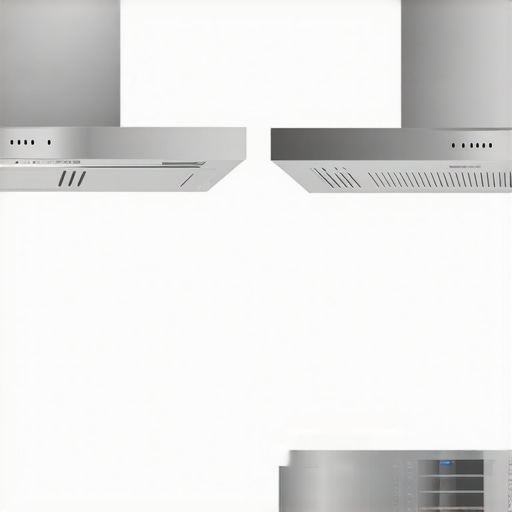
The Pungent Odor of a Failing Circuit
The first sign isn’t usually a trip of the breaker. It’s that subtle, sickly-sweet scent of melting PVC insulation—what we in the trade call the ‘death rattle’ of a circuit. If you’ve just swapped your yellowing 1982 Nutone for a 1200 CFM pro-style beast and you’re smelling ozone, your kitchen is trying to tell you that the laws of physics aren’t suggestions. In thirty-five years of residential forensics, I’ve seen more charred range hood junction boxes than I care to count, and 90% of them happened because the homeowner assumed a fan is just a fan.
My first journeyman, a man who had lost the tip of his ring finger to a 480-volt bus bar in the late seventies, used to pull me aside during a rough-in and point at the wire nuts. ‘Kid,’ he’d growl, ‘if you don’t twist these until the wire itself begins to corkscrew, you’re building a heater, not a connection. Resistance is a fire looking for a place to start.’ He was right. That lesson is more relevant today than ever, especially when people try to hang a high-performance range hood on a circuit that was originally designed to power a 40-watt bulb and a weak propeller fan.
“Individual branch circuits shall supply only the load for which they are rated.” – NEC Article 210.23
The CFM-Amperage Correlation: Why the Physics Changed
Your old range hood likely moved about 100 to 200 Cubic Feet per Minute (CFM) of air. It used a simple shaded-pole motor that pulled maybe 1 or 2 amps at most. You could practically run it on a couple of flashlight batteries. Today’s high-end hoods, designed for those massive gas ranges that put out enough BTUs to heat a small village, are moving 600, 900, or even 1500 CFM. To push that much air against the static pressure of your ductwork, the motors have grown exponentially. We aren’t just talking about a larger fan; we are talking about dual blowers and high-torque induction motors.
When you kick a modern hood onto ‘Boost’ mode, the in-rush current—the ‘startup spike’—can be significant. If that hood is shared with your recessed lighting installation or, God forbid, the refrigerator, you are asking for a brownout or a localized overheat. I have used my Wiggy to test lines where the voltage dropped 10% the second the fan engaged. That kind of voltage drop causes the motor to run hotter, which increases resistance, which creates more heat—a classic thermal runaway. This is why a dedicated 20-amp home run back to the panel is no longer a luxury; it’s a forensic necessity.
Component Zoom: The Physics of Cold Creep and Heat
In mid-century homes, we often deal with 14-gauge Romex. The problem is that many of these older installations have suffered from ‘Cold Creep’ or thermal cycling. Every time you turn on a heavy load, the copper expands. When it turns off, it contracts. Over forty years, those wires can actually wiggle themselves loose from under a screw terminal. When you add a high-amperage modern range hood to this aged infrastructure, you’re pushing that ‘Cold Creep’ to its breaking point. A loose connection creates a high-resistance point where electricity arcs across microscopic gaps. This arcing can reach temperatures exceeding 2,000 degrees Fahrenheit without ever drawing enough current to trip a standard thermal breaker.
“Aluminum wire connections can overheat and cause a fire without tripping the circuit breaker.” – CPSC Safety Alert 516
If your home has aluminum wiring from the late 60s, you are in even more trouble. The oxidation layer that forms on aluminum acts as an insulator, and as you try to pull more amperage for that new kitchen upgrade, that insulator generates heat like a toaster element. I’ve performed 24 hour emergency electrician calls where the drywall behind the hood was actually smoking because of a bad aluminum-to-copper transition. This is why we insist on proper grounding electrode install procedures and total circuit isolation during a kitchen remodel.
The Integrated Smart Kitchen: Beyond the Fan
Modern hoods aren’t just fans; they are complex electronic hubs. Many now feature LED arrays that require specialized drivers, touch-capacitive screens, and even Wi-Fi connectivity for smart meter installation integration. Some even have integrated CAT6 cabling services or ethernet wiring services for home automation. These electronics are incredibly sensitive to ‘dirty power.’ If your hood is on a circuit with a noisy motor or a cheap dimmer, the harmonic distortion can fry the control board in months. Replacing a proprietary PCB in a high-end Italian hood can cost more than the original installation.
Furthermore, if you are investing in a home backup generator install, you need to ensure your range hood’s amperage is accounted for in the load shed calculations. I’ve seen generators stall out because a homeowner turned on the stove, the oven, and the ‘professional’ range hood at the same time during a power outage. It’s all about the math—Ohm’s Law doesn’t care about your kitchen’s aesthetics.
The Forensic Inspection: Signs of Overload
How do you know if your current wiring is insufficient? Look for the ‘ghost in the machine.’ If your kitchen lights flicker when you jump the fan to high, you have a voltage drop issue. If the recessed lighting installation nearby hums or buzzes, you’re looking at harmonic interference. If you touch the wall near the switch and it feels warm, stop. Shut off the breaker and call a pro. This isn’t like home theater wiring where a mistake just means a fuzzy picture; a mistake here is a structural fire hazard.
During a rough-in, I always check the underground wiring services if the kitchen is part of an addition. Moisture intrusion in a lateral line can increase the impedance of the circuit, making it even harder for that new range hood motor to get the clean ‘juice’ it needs. I’ve used my tick tracer to find buried junction boxes that were literally boiling because of the load. Don’t be the person who makes holiday emergency calls because their gravy-making session turned into a three-alarm fire.
The Final Torque: Safety is Non-Negotiable
Electricity is a lazy, dangerous beast that always looks for the shortest path to ground. If your grounding electrode install isn’t up to current code, and your high-amp hood develops a ground fault, the chassis of that stainless steel hood could become live. Imagine touching the hood while your other hand is on a wet faucet. That’s a widow maker scenario. Professional installation means more than just mounting a bracket; it means calculating the load, checking the wire gauge, and ensuring the home run is secured with the right staples and torqued to the inch-pound specs on the breaker. Your kitchen is the heart of your home; don’t let a cheap fan installation stop it.