
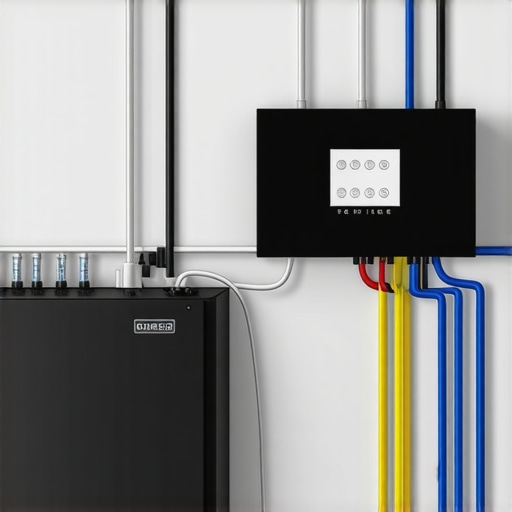
The Invisible Nibble: Why Your Home Is Under Constant Attack
My journeyman used to smack my hand if I stripped a wire with a knife. ‘You nick the copper, you create a hot spot,’ he’d scream. He was right. That tiny nick, invisible to the naked eye, creates resistance. Resistance creates heat. Heat creates a house fire. In 2026, we aren’t just dealing with nicks in a Romex jacket; we are dealing with microscopic silicon pathways inside your $5,000 smart fridge and your home automation setup that are being slowly cooked by voltage transients. If you think a $20 power strip from a big-box store is protecting your EV charger or your data center power setup, you’re not just wrong—you’re dangerously optimistic.
The Anatomy of a Surge: It is Not Just Lightning
Most homeowners think a surge is a bolt of Zeus’s lightning hitting a transformer. Sure, that happens, and it’ll weld your main breakers shut. But the real enemy is the ‘internal surge.’ Every time your whole house fan wiring kicks over, or your sauna heater installation draws its initial load, a spike of energy ripples through your home’s electrical arteries. We call these transients. They are like tiny hammers hitting a glass vase. The vase doesn’t break the first time, or the tenth, but on the hundredth hit, it shatters. This is why your smart switches start flickering and your ceiling fan installation suddenly loses its variable speed control.
“A surge protective device (SPD) shall be an integral part of the equipment or shall be located immediately adjacent thereto to protect sensitive electronic loads.” – NEC 2023 Article 242
The 60-Amp Death Trap
I still walk into homes today where someone is trying to run a modern lifestyle on a 60 amp panel upgrade waiting to happen. You cannot cram an EV charger, a hot tub wiring services project, and a data center power setup into a panel from the Eisenhower administration. When that 60-amp main is pushed to its limit, the heat causes the bus bars to expand and contract—a process called thermal cycling. This loosens the mechanical lugs. A loose lug is a high-resistance connection. When your RV hookup installation draws current through a loose lug, it creates an arc. Your tick tracer might say the line is live, but your Wiggy will show the voltage dropping under load. That voltage drop is the sound of your electronics dying.
Component Zooming: The Metal Oxide Varistor (MOV)
Let’s talk physics. A Whole House Surge Protective Device (SPD) relies on components called Metal Oxide Varistors. Think of an MOV as a pressure relief valve for electricity. When the voltage is normal, the MOV is a high-resistance gatekeeper. It stays shut. But the millisecond that voltage spikes—whether from the grid or your own deck lighting services—the MOV’s resistance drops to near zero. It shunts that excess energy safely to the ground before it can reach your motherboard. However, MOVs are sacrificial. They degrade every time they take a hit. By 2026, with the sheer volume of home automation setup tech in the average house, a standard SPD is working overtime. If you haven’t checked your indicator lights lately, you’re likely flying blind.
“Voltage surges are a leading cause of failure in sensitive electronic equipment, often resulting in cumulative damage rather than immediate failure.” – IEEE Standard 1100
The Forensic Reality of the ‘Handyman Special’
I’ve performed countless forensic inspections after ‘minor’ electrical fires. I’ve seen ceiling fan installation jobs where the ‘pro’ didn’t use a fan-rated box, and the constant vibration eventually chafed the insulation until it arced against the bracket. But the worst are the hot tub wiring services where they skipped the GFCI or didn’t properly bond the water. In the world of high-voltage transients, a poor ground isn’t just a code violation; it’s a bypass for your surge protection. If your ground rod is corroded or your home run isn’t properly torqued, that surge has nowhere to go but through your TV.
Why 2026 Requires a Tiered Defense
You need a Type 1 SPD at the meter can to catch the big hits from the utility, and a Type 2 at the branch panel to catch the internal spikes from your whole house fan wiring. Don’t forget the ‘Monkey Shit’ (duct seal) at the service entrance to keep moisture out of the lugs. If you’re investing in an RV hookup installation or a sauna heater installation, the cost of a high-quality SPD is pennies compared to the silicon it protects. When I do a rough-in, I’m looking at the torque specs on every single breaker. When I do a trim-out, I’m testing every outlet for a solid ground. Because I’ve smelled the ozone of a fried $10,000 smart home system, and I can tell you, it smells like regret and wasted money. Use your dikes to cut out the old, unreliable junk and get a professional to install a whole-house system before your next EV charger cycle toasts your entire life.