
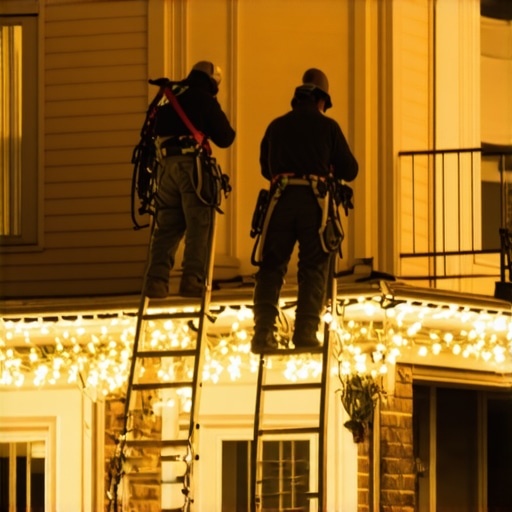
The Ghost of Christmas Future: Why Your 2026 Display Starts at the Service Panel
I’ve spent thirty-five years pulling melted Romex out of charred wall cavities, and if there is one thing I’ve learned, it’s that electricity has no mercy for nostalgia. People see a festive holiday display; I see a thermal imaging nightmare waiting to happen. Before you even think about dragging those boxes out of the crawlspace for your 2026 display, you need to understand the physics of the disaster you might be building. Most homeowners treat their electrical system like a bottomless well, but it is actually a finely balanced ecosystem of resistance, heat, and mechanical tension. When you start plugging in thousands of additional lumens, you aren’t just adding light; you are testing the structural integrity of your home’s molecular bond. If you are living in a mid-century home built between 1960 and 1980, you are likely sitting on a powder keg of aluminum wiring. In those decades, copper prices spiked, and builders swapped it for aluminum. The problem? Aluminum has a much higher coefficient of thermal expansion than copper. This leads to a phenomenon we call Cold Creep. Every time you turn those holiday lights on, the wire heats up and expands. When you turn them off, it contracts. Over time, the wire literally crawls out from under the terminal screws on your outlets. This creates a loose connection, which increases resistance, which creates more heat, eventually leading to a localized sun in your wall. My old journeyman used to smack my hand if I stripped a wire with a knife. ‘You nick the copper, you create a hot spot,’ he’d scream. He was right. With aluminum wiring repair, you aren’t just twisting wires; you are managing metallurgical failure.
Tactic 1: The Forensic Load Calculation (Avoiding the ‘Snap’)
Before you even touch a ladder, you need to pull the dead front off your panel and look at what you’re actually working with. Most people assume a 15-amp breaker can handle a holiday light extravaganza because ‘LEDs use no power.’ That is a dangerous half-truth. While the individual draw is lower, the cumulative inrush current and the stress on aging bus bars are very real. If your house is rocking a Federal Pacific or Zinsco panel, you aren’t just at risk; you’re inviting a ‘no-trip’ scenario where the breaker jams while the wire reaches its melting point. Just like in industrial motor controls, where we worry about phase imbalance and heat dissipation, your home’s lighting needs a dedicated ‘home run.’ If you are planning a massive 2026 display, you shouldn’t be sharing a circuit with your EV charger or your bathroom exhaust fan. I’ve seen cases where a high-draw fan in the master bath combined with a holiday light string on the same circuit caused a neutral to overheat and fail back at the panel. You need a dedicated 20-amp circuit, wired with 12-gauge copper, specifically for your exterior outlets. Don’t rely on the ‘handyman special’ of daisy-chaining five power strips together.
“Aluminum wire connections can overheat and cause a fire without tripping the circuit breaker.” – CPSC Safety Alert 516
Tactic 2: The AlumiConn Solution for Mid-Century Homes
If your forensic inspection reveals that silvery-white conductor in your outlets, do not—I repeat, do not—just plug in your holiday lights and hope for the best. The increased load of a holiday display will accelerate the oxidation of aluminum wiring. When aluminum oxidizes, it creates a layer of aluminum oxide, which is an insulator. Now you have electricity trying to push through an insulator, creating immense heat. The pro tactic for a safer 2026 is a full aluminum wiring repair using AlumiConn connectors or COPALUM crimps. These are the only methods recognized by the CPSC to create a permanent, gas-tight seal. I’ve gone into homes where the ‘pro’ holiday installer used standard purple wire nuts to pigtail copper to aluminum. Those purple nuts are a band-aid on a gunshot wound; they fail under heavy seasonal loads. If I see those, I break out the dikes and start cutting. You want to sleep at night? You torque those AlumiConn lugs to the manufacturer’s specs with a calibrated driver. No guessing.
Tactic 3: GFCI Protection Beyond the Minimum Code
We all know the NEC requires GFCI protection for outdoor receptacles, but for a 2026 display, you need to go further. I recommend a GFCI outlet installation that utilizes a ‘Blank Face’ GFCI located inside the garage or house, protecting the downstream exterior outlets. Why? Because outdoor GFCIs are subject to environmental degradation. Salt air, moisture, and temperature swings cause the internal circuitry to fail, often in the ‘closed’ position where they still provide power but no protection. I’ve used my Wiggy to test outlets that looked fine but wouldn’t trip at 6 milliamps if their life depended on it. In a restaurant kitchen electrical environment, we replace GFCIs every few years because of the steam and grease; your outdoor holiday outlets are facing even harsher conditions. If your holiday lights are flickering, it’s not ‘festive’—it’s a ground fault or a neutral-to-ground bond that shouldn’t be there.
Tactic 4: Weatherproofing the ‘Drip Loop’ and Enclosures
When I’m doing parking lot lighting or deck lighting services, I see the same mistake every time: people think ‘weather-resistant’ means ‘waterproof.’ It doesn’t. For your 2026 display, every connection point needs to be housed in a NEMA 3R enclosure. When you run your lines, you must create a ‘drip loop’—a low point in the wire before it enters any junction box or outlet. This ensures that gravity pulls the water away from the electrical connection. I’ve opened ‘weatherproof’ boxes that were half-full of water because the installer didn’t use monkey shit (duct seal) to plug the conduit entry. That water creates a path for electricity to track across the surface of the outlet, leading to a carbon arc. Once that carbon track is established, it will eventually find its way to ground, often through the wood siding of your house.
Tactic 5: Smart Controls and the Perils of Phantom Loads
Modern holiday displays often involve smart thermostat wiring logic applied to lighting, using apps and hubs to timing. This is great for convenience but adds another layer of complexity. These smart plugs often have lower ampacity ratings than the circuits they are plugged into. If you are using a 15-amp smart plug on a 20-amp circuit, you have created a bottleneck. I’ve seen these devices melt into a puddle of plastic because the homeowner didn’t check the wattage rating against the total number of light strings. For 2026, treat your holiday timer like a piece of industrial motor control equipment. It needs to be rated for the inductive load of the transformers you are plugging into it. If it feels warm to the touch after two hours of operation, it’s a fire hazard. Period.
“All outdoor 15- and 20-ampere, 125-volt receptacles shall be listed weather-resistant type.” – NEC 406.9(A)
Tactic 6: The Insurance Policy – Documenting Your Upgrades
Here is a cold truth most people don’t consider until it’s too late: if your holiday lights burn your house down and the fire investigator finds non-code-compliant wiring, your insurance company might fight the claim. When I perform insurance claim electrical work, the first thing I look for is ‘owner-installed’ modifications. If you’ve modified your panel or run new lines without a permit or a master electrician’s sign-off, you are on thin ice. For your 2026 display, keep receipts for your GFCI outlet installation and any panel upgrades. If you’ve had a ‘heavy-up’ to accommodate an EV charger, that’s a positive in the eyes of an inspector—it shows the system has been modernized to handle current demands.
Tactic 7: The Infrared Sweep (The Forensic Finisher)
Once your display is up and running in 2026, don’t just walk away. Give it a ‘burn-in’ period. Turn everything on and let it run for four hours. Then, take a thermal imaging camera (or a tick tracer if you’re in a pinch to find hot spots) and scan every connection point, from the outdoor outlet back to the main breaker. You are looking for ‘hot spots’—areas where the temperature is significantly higher than the surrounding wire. A hot breaker is a sign of a loose bus bar connection or an internal failure. A hot outlet is a sign of Cold Creep or a poor termination. In my 35 years, I’ve caught more potential fires with a thermal scan than any other method. Electricity is invisible, but heat doesn’t lie. If you find a hot spot, you don’t ‘wait and see.’ You kill the power, break out the tools, and fix it. Because at the end of the day, a holiday display is supposed to be about joy, not watching a fire truck in your driveway.
Reading through this comprehensive guide really highlights how critical it is to consider electrical safety well before the holiday season. I’ve personally had a few close calls over the years, especially with older homes that still have aluminum wiring. The emphasis on implementing AlumiConn connectors truly resonates with me—I’ve found that no quick fix beats a professional upgrade, especially when managing significant loads. I also agree that thermal imaging is an invaluable tool; I once spotted a hotspot in my main panel after a burn-in period, which prevented a potential fire. One thing I wonder about, though: when using smart controls, how often should homeowners conduct these thermal checks, especially during peak usage times? Staying vigilant seems vital, and I’d love to hear how others are maintaining safety with their modern setups as well.