
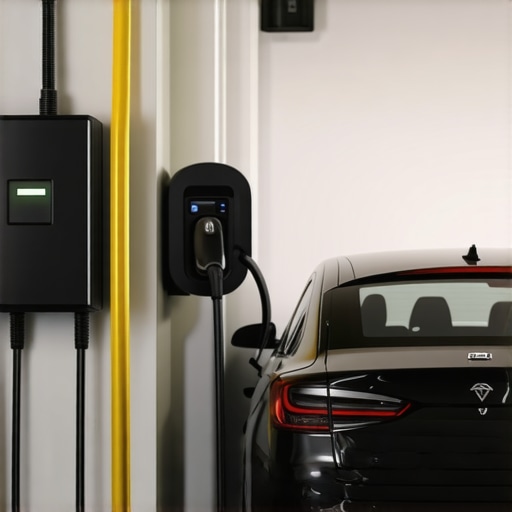
The Silent Heat: Why Your Garage Is a Ticking Time Bomb
I remember a cold Tuesday in February back in ’89. My journeyman, a guy who had more scars from arc flashes than I had birthdays, watched me stripping a piece of #10 THHN with my pocket knife because I’d left my dikes in the truck. He didn’t just yell; he slapped the back of my head so hard my hardhat spun. ‘You nick that copper, kid, and you’ve just built a heater,’ he growled. He was right. That microscopic notch creates a bottleneck, a point of high resistance where the physics of electricity turns into the physics of fire. Fast forward to 2026, and homeowners are trying to shove 48 amps of continuous current through circuits that were originally designed for a single lightbulb and a dusty Sears drill. Most people see a Level 2 charger as a convenience; I see it as a massive thermal load that most mid-century homes are fundamentally unprepared to handle. When we talk about garage wiring services, we aren’t just talking about pulling wire; we are talking about preventing your house from becoming a statistic.
Mistake 1: Ignoring the Brutal Reality of Load Calculations
The most common sin I see is the ‘plug and pray’ method. Homeowners buy a shiny new EV and assume because they have an empty slot in their panel, they have room for a 50-amp breaker. They don’t. Your electrical system is an ecosystem, governed by Ohm’s Law and the National Electrical Code. If you have a 100-amp service—common in homes built between 1960 and 1980—adding a 48-amp continuous load for an EV is like trying to run a fire hose through a soda straw. You might have the physical space for the breaker, but you don’t have the capacity in the bus bars. We call this ‘over-subscription.’ When you’re charging the car, running the AC, and the water heater kicks in, that main breaker isn’t just under stress; it’s vibrating. I’ve pulled my tick tracer out on panels that were so overloaded the plastic casing of the breakers was starting to deform from the heat. This is why a professional data center power setup logic needs to be applied to your home; you need a real load calculation before you even think about the overhead service drop. If your service mast is looking ragged, 2026 is the year to fix it before the utility side fails and takes your charger with it.
“The total connected load shall not exceed the rated capacity of the service or feeder.” – NEC Article 220.10
Mistake 2: The ‘Handyman’ Receptacle Meltdown
In the trade, we have a term for the cheap $15 NEMA 14-50 outlets you find at big-box stores: ‘The Widow Maker.’ Those outlets are rated for intermittent use—like a range that cycles on and off. An EV charger is a continuous load, meaning it pulls full power for hours on end. This creates a phenomenon called ‘thermal cycling.’ The copper wire and the brass terminals in a cheap outlet expand and contract at different rates. Over time, the connection loosens. A loose connection creates resistance, resistance creates heat, and heat creates fire. I’ve seen landscape lighting install jobs done better than some EV ‘pro’ installs. By 2026, the industry is moving toward hardwiring chargers for a reason. Eliminating the plug-and-socket connection removes the weakest link in the chain. If you are doing a rough-in for a new charger, skip the outlet. Hardwire it directly into a high-quality disconnect. This isn’t just about code; it’s about the fact that I’ve seen ‘melted’ outlets that didn’t trip the breaker because the heat was localized right at the contact point. If you’re also looking at permanent holiday lighting or a doorbell camera install, remember that every device you add to your home’s exterior envelope requires a stable, heat-managed source of power.
Mistake 3: Neglecting the Physics of ‘Cold Creep’ in Older Panels
If your home was built in the mid-century era, you likely have some aluminum wiring or an older Federal Pacific or Zinsco panel. These are the ‘Time Bombs’ of the electrical world. Aluminum has a high coefficient of thermal expansion. It moves. We call it ‘Cold Creep.’ As the wire heats up under the massive load of an EV charger, it expands and pushes against the screw in the breaker. When it cools, it doesn’t quite return to its original shape. Eventually, the connection becomes loose. I’ve walked into garages where the smell of ozone was thick enough to taste. You check the panel with a thermal camera, and the breaker for the EV charger is glowing like a cigar tip. This is why spa grounding services are so critical—they understand the relationship between high current and moisture/corrosion. In a garage, humidity can accelerate this oxidation. If you have an older panel, you aren’t just installing a charger; you are likely looking at a panel change-out. Don’t let a ‘trim-out’ artist convince you that a few turns of a screwdriver will fix a bus bar that’s already been pitted by arcing. If you’re doing a fire alarm system install, make sure your electrician is also looking at the integrity of your grounding electrode system.
“Aluminum wire connections can overheat and cause a fire without tripping the circuit breaker.” – CPSC Safety Alert 516
Mistake 4: The Tree-Mount and Outdoor Exposure Failure
People want their chargers in the most convenient spot, which often means mounting them on the exterior or near landscaping. I’ve seen people try to run Romex through a piece of garden hose or strap conduits to trees. Let’s talk about tree mounted lights for a second. Trees grow. They move. They hold moisture. If you treat your high-voltage EV circuit like a 12V landscape lighting install, you are begging for a ground fault. By 2026, the standards for outdoor EVSE (Electric Vehicle Supply Equipment) will be even more stringent. You need liquid-tight flexible conduit or rigid metal conduit, and you need to use ‘Monkey Shit’ (duct seal) to keep moisture from migrating through the pipe into your panel. I’ve seen moisture travel 50 feet through a conduit and rot out a main lug because someone forgot a 50-cent seal. If you’re already running lines for a phone line installation or low-voltage tech, keep them separated. High-voltage induction can wreak havoc on data lines. Every home run back to the panel needs to be clean, torqued to spec with a calibrated wrench (not just ‘hand tight’), and protected from the elements. This is 2026—your car is a computer on wheels; don’t feed it dirty, dangerous power from a compromised circuit.
Final Inspection: Sleep Better Knowing It’s Torqued
At the end of the day, electricity doesn’t care about your budget or your timeline. It follows the path of least resistance, and if that path is through a loose wire in your garage wall, it will take it. When you’re looking at your home’s infrastructure—whether it’s the overhead service drop or the data center power setup in your home office—don’t cut corners. Use a Wiggy to test your voltages, ensure your grounds are solid, and for the love of all that’s holy, stop using ‘handyman’ solutions for master electrician problems. Your 2026 EV deserves a circuit that won’t melt while you sleep.