
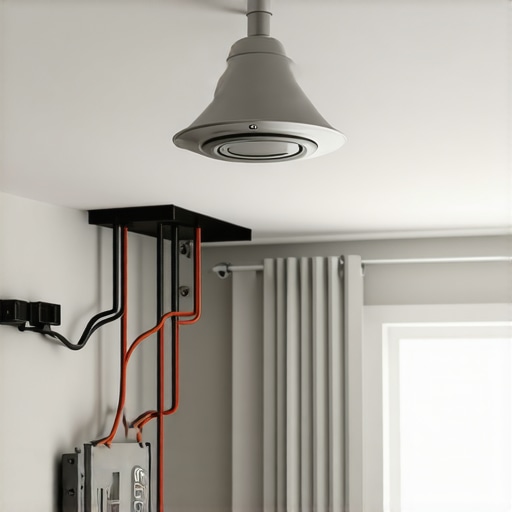
The Forensic Breakdown: Why Your Bathroom is a Petrie Dish
Walk into a bathroom that smells like a wet dog and damp basement, and I’ll show you a homeowner who thinks their exhaust fan is working just because it’s making noise. As a forensic inspector, I’ve seen the aftermath of ‘quiet’ fans that aren’t actually moving a cubic foot of air. By 2026, the cumulative moisture damage in homes built during the recent construction boom will reach a breaking point. Mold doesn’t just happen; it’s engineered by poor electrical choices and worse mechanical venting. When a fan fails to pull moisture, the physics are brutal: warm, humid air hits a cold gypsum ceiling, reaches its dew point, and liquid water saturates the paper backing of your drywall. That is the dinner bell for Stachybotrys chartarum.
I remember my old mentor, a guy who smelled like stale coffee and electrical tape, used to bark at me if I didn’t use a plastic bushing on every Romex entry point in a metal box. ‘The house breathes, kid,’ he’d say. ‘The house vibrates. That fan hums 24/7. You don’t protect that wire, the vibration will saw through the insulation like a dull knife through cheese.’ He was right. Most of the ‘dead’ fans I pull out today aren’t burnt motors; they’re arced-out wires hidden behind the housing, starving the motor of the current it needs to fight back-pressure. If your fan isn’t spinning at its rated RPM, you aren’t venting; you’re just heating up a copper coil in a damp ceiling joist.
“GFCI protection is required for all 125-volt, single-phase, 15- and 20-ampere receptacles installed in bathrooms.” – National Electrical Code (NEC) Section 210.8(A)(1)
Fix 1: Rectifying High-Resistance Neutrals and ‘Tick Tracer’ Mirages
The first thing I do when I walk into a mold-prone bathroom is pull out my Wiggy—a solenoid voltmeter—because a non-contact ‘Tick Tracer’ will lie to you. It might show voltage, but it won’t show you the load-bearing capacity of that circuit. Often, the issue is a loose neutral in the home run back to the panel. In coastal environments, salt air ingress causes a microscopic layer of oxidation on copper terminals. This creates resistance. According to Ohm’s Law, as resistance increases, the voltage available to the motor drops. A motor designed for 120V that only receives 105V will run hot and slow. This ‘brownout’ condition prevents the fan from overcoming the static pressure of the ductwork, leaving the steam to settle in your wall cavities. If you’re seeing flickering while the fan is on, you likely need an electrical panel upgrade to handle the modern load of a high-CFM fan and other bathroom luxuries.
Fix 2: The Dedicated Circuit and Subpanel Logic
Many older homes have the bathroom fan tapped off the same circuit as the lights and—heaven forbid—the garage. If you’re running garage wiring services or a camper electrical panel off the same leg as your master bath, you’re asking for voltage sags. For 2026-ready mold prevention, we’re moving toward dedicated circuits for high-output ventilation. If your main panel is crowded, a subpanel installation is the only code-compliant way to ensure your ventilation system has the dedicated amperage it needs. This is especially true if you are also considering a sauna heater installation, which draws significant current and shares the same moisture-heavy environment requirements. Without dedicated power, the fan motor’s thermal protection will trip, shutting the unit down just when the humidity is at its peak.
“Exhaust fans are a common source of residential fires when motors seize or wiring degrades due to moisture and lack of thermal protection.” – CPSC Safety Bulletin
Fix 3: Battling Salt Air Corrosion with ‘Monkey Shit’ and Stainless Terminals
In coastal zones, the enemy is galvanic reaction. I’ve seen fan housings where the aluminum motor frame and the copper wire have basically welded themselves into a lump of green corrosion. To stop this, we use dielectric grease—or what we call ‘monkey shit’—to seal connections. During the rough-in phase, every connection must be torqued to spec. A loose screw is a hot spot. When the fan vibrates, a loose wire creates a micro-arc. This carbonizes the surrounding dust (of which there is plenty in a fan) and eventually leads to a fire. If you are doing a ceiling fan installation or a chandelier installation elsewhere in the house, you can get away with standard wire nuts, but in a steaming bathroom, you want heat-shrink butt connectors or stainless steel pressure plates.
Fix 4: Integrating Smart Timers and OSHA Compliance Wiring Standards
Mold grows because people turn the fan off as soon as they leave the room. The moisture is still there. The fix is a smart timer or a humidity-sensing switch. From an OSHA compliance wiring standpoint, especially in commercial or multi-family settings, these switches ensure air exchange rates are met without manual intervention. We often look for rebate assistance programs that subsidize these upgrades because they significantly reduce long-term property damage. While you’re upgrading the switches, inspect the fence line lighting or garage wiring for similar moisture-rated flaws. A fan that runs for 20 minutes post-shower is the only way to drop the relative humidity below the 60% threshold where mold thrives. If your fan sounds like a jet engine but isn’t moving a tissue held up to the grille, your wiring is likely fine, but your motor is stalling due to internal resistance—replace the unit and torque those leads.
Conclusion: Sleep Better When It’s Torqued
Electricity isn’t a hobby, and moisture isn’t a joke. By 2026, the homes that survived without mold will be those where the electrician cared about the physics of the ‘trim-out.’ Whether you’re dealing with a simple fan or a complex sauna heater installation, the rules are the same: clean paths, tight connections, and dedicated power. Don’t let a $50 fan ruin a $50,000 bathroom renovation. Check your lugs, use your dikes to strip cleanly without nicking the copper, and ensure your ground is solid. If you’re unsure, pull the breaker and call someone who knows the difference between a neutral and a ground. Your lungs will thank you in three years.